


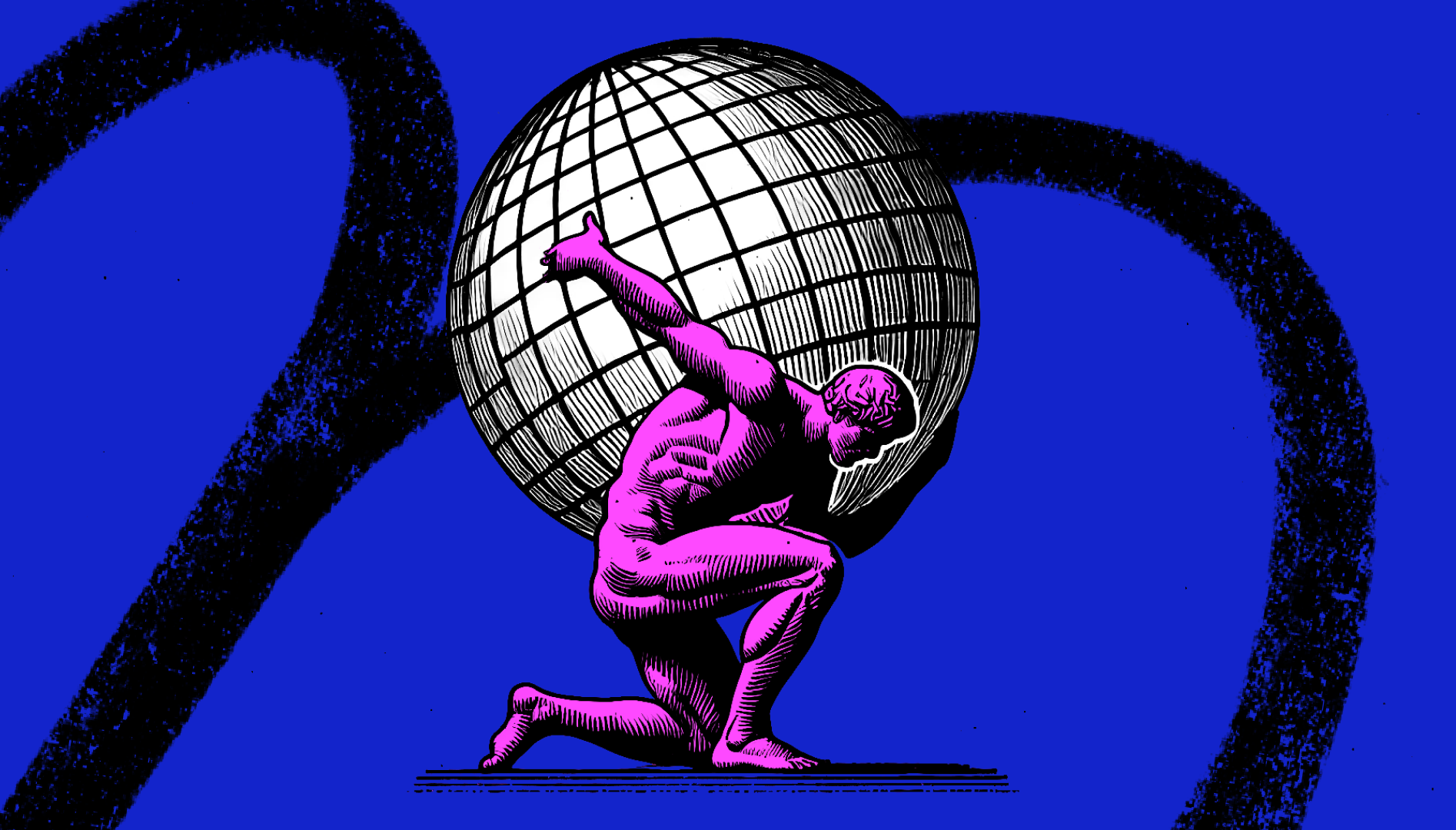


How hard should I push myself?
It’s a question I ask myself a lot, and I bet you do too. On the one hand I really want to push myself. I’m ambitious, I want to leave it all out on the field—some of my peak work moments have come from times when I’ve pushed myself to a place where I didn’t think I could go. We all have more ability to adapt to stress and pressure than we think we do.
On the other hand, I want to be kind to myself. I wonder how much the drive to push myself is really just a drive to make up for something that I feel is missing or inadequate—and whether pushing myself will actually fill the hole. I also sometimes wonder whether letting myself off the hook is just laziness masquerading as self-care. It’s hard to tell.
But importantly, I wonder whether pushing myself might, in fact, kill me. Constant pressure creates chronic stress, and there’s all sorts of scientific studies that show that chronic stress is really bad for you. It makes you more susceptible to heart disease, it makes it harder to recover from illnesses, it can affect your sleep, and it can even affect your working memory.
There’s also all sorts of literature (and conversations on Twitter) that says that stress is actually good for you.
What gives? How much stress is good, and how much is bad?
I think that in order to understand the question we posed at the top—how much we should be pushing ourselves—we have to better understand stress. We need to understand what the stress of pushing ourselves does to our bodies, how much we can take of it, and how we can, hopefully, learn to cope with it better.
That’s what Why Zebra's Don't Get Ulcers by Robert M. Sapolsky is about. Robert's a stress researcher, and as far as I can tell he's one of the good ones. He's the kind of intellectual who's smart, but also smart enough to know what he doesn't know. He's written a book, but he doesn't come across as trying to sell it to you—he's kind of like your zany self-aware smart-as-hell uncle who happens to study the stress responses of baboons for a living.
In the book Dr. Sapolsky harnesses his own research, as well as a wide array of animal and human studies to figure out the answer to a fairly simple question: how does stress work, and why do humans get stress-related diseases?
It’s an interesting question—you can understand why a human body might react poorly to not being fed enough. But why would psychological stress have dangerous consequences? The basic gist is this:
The stress response is built to get us out of danger. If you're an animal in the Serengeti and you're being chased by a lion you really, really want to have a stress response. Being stressed means you’re preparing your muscles to move—a lot. Your heart rate rises and pushes blood to your extremities. Glucose is released into your bloodstream to help run your muscles as fast as possible.
The stress response pushes certain parts of your body into high gear—but it also turns certain parts of your body off. For example, when you’re stressed digestion is inhibited. What’s the point of wasting energy on digesting food for later when you might not even survive for 10 more minutes? Reproduction is also inhibited. Same reason.
This is all well and good in the wild—you don't need to reproduce if a lion is eating your face off. But humans, and some more intelligent animals, have evolved the stress response from an unqualified Good Thing into...well, something that might kill you.
What’s different about our stress response? Well, we have the ability to anticipatedanger. Other animals have this ability too: it’s a good thing to get stressed seeing the lion all the way across the savannah, instead of only when it mauls your intestines out. But humans have evolved this anticipation ability to extend far beyond other animals. We anticipate bad things months, years, or even decades out. And when we do this, the very same stress response gets turned on—even though there is no immediate danger, and there is no immediate way to avoid it.
Suddenly, you aren’t just activating the stress response for a few minutes when you’re running for your life. Instead, it’s activated all the time—chronically. And this is where the problems start.
 Create a free account to continue reading
The Only Subscription
You Need to
Stay at the
Edge of AI
The essential toolkit for those shaping the future

"This might be the best value you
can get from an AI subscription."
- Jay S.
 Every Content
 AI&I Podcast
 Monologue
 Cora
Cora
 Sparkle
 Spiral
Join 100,000+ leaders, builders, and innovators

Email address

Already have an account? Sign in
What is included in a subscription?
Daily insights from AI pioneers + early access to powerful AI tools


 Front-row access to the future of AI
 In-depth reviews of new models on release day
Playbooks and guides for putting AI to work
Prompts and use cases for builders
In-depth reviews of new models on release day
Playbooks and guides for putting AI to work
Prompts and use cases for builders
In-depth reviews of new models on release day
Playbooks and guides for putting AI to work
Prompts and use cases for builders
In-depth reviews of new models on release day
Playbooks and guides for putting AI to work
Prompts and use cases for builders
 Bundle of AI software




 Scott Nover


 Evan Armstrong
 Dan Shipper
 Reviews of new AI models on release day
Comments
Don't have an account? Sign up!
great
A great read. I struggle with the balance, but becoming more mature.
I would have liked a bolded statement that answers the question in the title. Probably the first sentence under "What do we do about it".
It isn't stress, it's how YOU experience it. Some people enjoy jumping off bridges. Some people enjoy doing their hobby for a living 24/7/365.
So basically push yourself as you can handle? Learn to increase what you can handle?