





The transcript of AI & I with Josh Miller and Hursh Agrawal from The Browser Company is below. Watch on X or YouTube, or listen on Spotify or Apple Podcasts.
Timestamps
- Introduction: 00:01:13
- The story of how Dan might’ve been the CEO of The Browser Company: 00:02:47
- The moment Josh and Hursh knew they had to walk away from Arc: 00:09:42
- How to handle the weight of the unknown in a pivot: 00:17:08
- The prototype-driven culture that kept The Browser Company alive: 00:23:31
- Why having a product loved by millions of users isn’t enough :00:25:42
- The architectural decisions underlying how Dia was built: 00:33:29
- How Dia almost shipped without its best feature: 00:47:12
- The best ways people are using Dia in the wild: 00:51:18
- How Josh and Hursh think about competing with incumbents: 01:07:55
- How romanticism informs the product decisions behind Dia: 01:17:04
Transcript
(00:00:00)
Dan Shipper
Josh. Hursh. Welcome to the show.
Hursh Agrawal
It’s good to be here.
Josh Miller
Thanks for having us.
Dan Shipper
Yeah, of course. So good to have you. So for people who don't know you are the co-founders of The Browser Company, the makers of Arc and now Dia. And I'm psyched to talk to you about Dia, and about the journey to get there. As you can see if you're watching the show, me and Hursh are together. We’re in upstate New York in a little cabin. So we've been friends for a long time and I think one thing that people should know coming into this is, we have been sort of on parallel journeys together. As you started The Browser Company, I started Every around the same time as you guys started, and we've been close for a long time. So it's been really fun to get to watch the journey from afar and I'm just really excited to get to talk to you about it, so thanks for coming.
Josh Miller
Well, I'm just going to say for the record, I'm not here—because I didn't get the invite. So we're not that close, Dan. I'll say I'm kidding. No, it's awesome to be here.
Hursh Agrawal
Honored to be here. We’ve listened to so many of the podcasts, and obviously we have so much history.
Dan Shipper
Yeah. So a couple other disclaimers. I'm a small investor in The Browser Company, so people should know that. I also spoke at your wedding so we'll put up a little picture of me speaking there. And another really interesting little bit of history that is fun for me to remember now is there was a point at which you guys were considering me to be the CEO of The Browser Company, which is crazy to think about now because you had come up with the idea to incubate at the time. It was Superhuman for browsers, as I remember. And I was working on Superorganizers, which is a little newsletter which would become Every.
Josh Miller
Oh, did that turn into Every. I didn't even realize that. Wow.
Dan Shipper
Yeah. And so there was a moment in time where we were discussing working together on this. So it's really fun to come full circle five and a half years later and be like, wow. We're all so much older. We have so many more wrinkles. I have a big beard. I think I was pretty clean shaven when we were doing that, so yeah, that was a crazy moment.
Josh Miller
Wow. Super Organizers are your Arc. Well, I hope your Dia goes as well as Every. Fingers crossed. I’m into it.
Dan Shipper
Thank you. I think we all have a lot to learn from each other. So I think the first thing I want to talk about is I watched this pivot from Arc to Dia. I think we were in Thailand together years ago when you were first starting to get really psyched about AI. And I just watched Hursh's eyes—he had this spark. It was a sparkle. It was, oh my god, this is crazy. And I was, yes. I was a little on his shoulder being like, guys, you get it?
Josh Miller
Oh, it's your fault, Dan. I always wondered where that came from.
Dan Shipper
And what's been really interesting to me to see is I've obviously been watching this journey from Arc to Dia and watched the decision happen to be like, we're not going to do Arc anymore. And then watched the public reaction, which was so negative. I think people just loved Arc so much and then watched you guys have to bear that while you were building Dia. And I just want to know what that was like?
Hursh Agrawal
Honestly it was a little unexpected. I don't think we had predicted the reaction that we got when we announced that, especially because we had been in this head space for quite a while. We've been trying to, all throughout 2023 or so, trying to figure out how we get from early adopters to the mass market with Arc. And Arc had this problem, which we call the novelty tax, where there's so much new stuff in it, which really attracted early adopters, but made a lot of the mass market sort of more hesitant to try Arc because it just took a lot to get to learn and use. And so, I mean, Josh can probably say more, we tried so many things to figure out, okay, how do we make Arc sort of approachable to the mass market and then simultaneously AI had been taking off and I think Josh had this video last year of act two. We had this realization that browsers are actually going to change pretty dramatically. And how we use computers is going to change pretty dramatically from a user computer interface point of view, where we're going to talk to our computers, they're going to do stuff because this new Play-Doh allows you to speak in English and they can use tools and suddenly computers are something completely different. And so we went through our own evolution over many months to be like, how do we nudge Arc in that direction? And for a while we called it Arc 2.0 and we were, okay, how do we evolve it? And we just ran into a lot of problems internally too, where we loved Arc so much that we were hesitant to change it. The internal discussions about what we do with the sidebar was, at the wrong level when we have this new Play-Doh, we really had to start from scratch. And so maybe I'm curious for your take Josh actually on, how do you feel about the external messaging? Because for us it was over such a long period of time and so obvious that we had to, okay, we have to start from scratch if we're going to build this thing from the ground up to use AI and to be accessible to the mass market. But I think it was probably a shock to the external folks that, oh my god, we're building a whole new browser.
Josh Miller
Yeah, I mean, the thing I would say is you're catching us two weeks after we really released Dia to this private beta, and I'd say in terms of Hursh and my hopes and expectations, I don't think the first two weeks could have gone better. We feel so proud and so I think I felt an adrenaline release and I think it's safe to say last year sucked. It really did. And I think it's one of those things, many things that I think are most fulfilling and rewarding in life, that if you knew what you knew now, would you have done it? And yet at the same time, in retrospect, it's so obviously the right call. But I think a thing for especially listeners to know, and you alluded to this, Hursh, I've never made software really without Hursh. I met Hursh when I was 20 years old. We both left university barely knowing each other to start a company together. I think flash forward over a decade now, if I'm being really honest, I think it felt so obvious to me and Hursh intellectually, emotionally, the thing I think we both underappreciated was not just me and him anymore. And I mean, I mean, we knew that, but at every moment that Hursh and I looked across a proverbial table and said, hey, should we do this? Should we make this thing? It was me and him. And we share value. we, it's just a different relationship. We were running a company with 70 people and millions of people using the product every month. And we definitely underappreciated the public reaction. I mean, when we started this company, Dan, I when we, when we were trying to recruit you to be the CEO, one of the questions like, how do you get anyone to care about their desktop web browser? In fact, I've never even thought about my desktop web browser before, let alone have an opinion on what we saw the most. So I think we were very surprised by the reaction for sure, and would've done some things differently. But then maybe more importantly, definitely more importantly is our team showing up to a company where at that point in the company's evolution, people came because they loved Arc themselves. They joined Arc more than The Browser Company. Hey, that thing we poured our hearts into for years, I. Now we're starting over. Oh, cool. What are we doing? We don't really know, but it'll be great. We're just going to go that way. Sounds like a great plan. It was a winding journey, but very proud at this point.
(00:10:00)
Dan Shipper
There's a lot here I really want to go into. Tell me about the initial moment where you guys were coming to the decision of like wow, there's something totally new here. And not only is Arc maybe not working in the way that we want it to, but like there's something new that we need to go play with that we can't even really describe what it is. What was that like? How did that whole thing come together?
Josh Miller
One of the things I think I want to be more forthright about here, I don't think we've really said publicly before, is I almost think blaming Arc is a scapegoat. If really Hursh originally and then myself didn't get so inspired by this new material that are LLMs, we would not have pivoted Arc to something else. It's easy in retrospect being it's growing literally the novelty tax. And I 100 percent agree with Hursh that is true. But our first instinct was actually just to make Arc better. So I really think that the origin story here was like, you can't stop thinking about it. You're staying up until 3:00 a.m. Every bone in your body is just, this is why we got into software. But I really gotta credit Hursh. I think I have this part of me that is very anti-Silicon Valley hype, which honestly for people that follow me on Twitter or something, they're probably like, I think of you as like a hype-y dude. And yeah, let's have a therapy session later about that. But for me, the crypto wave was the one that came before And just for me, it felt icky to me, even though I agreed with idealism. So here comes around AI and my knee jerk reaction is, this is a bunch of hot air. But really when I think about it, not thinking about this interview before we came in. When you just said that with the origin story, I think of a conversation I had with Hursh in San Francisco that to me was like we've got to do this thing. So I mean, Hursh, when you really were first to see this world that was coming and feel it in your bones. Do you even remember where it came from and when?
Hursh Agrawal
He's giving me a lot of credit. I came at it from my own perspective. I think realizing part of it was excitement about the Play-Doh, but part of it also was the realization that like, if we don't go this route, I think we're going to get obviated. All software needs to be rewritten for this new world because again, the primary interfaces we have with computers are going to change. But I think a lot of it also came from your experimentation with Arc search. And actually playing with LLMs and realizing we can build something cool here. This is Play-Doh.
Josh Miller
Arc was extremely popular amongst the kind of limited corner of the world that knew about it. And the number one request for Arc was, I need a mobile app. But the browser is very different on mobile than it is on desktop. So we said, okay, let's just build a companion app. You can have your spaces and your tabs on your phone, and I'll in the backdrop of launching this kind of Arc mobile app is when all these kinds of AI tools started popping up and there as much as we wanted. Or I wanted to resist the hype. I'm an intellectually curious guy that loves new technology, and so there was some part of me, especially driven by Hursh that was. But if you really just tried to make the best kind of AI browser experience you could, what would it look like? But it would've been a huge distraction for the team to do that on desktop. So we actually hired a contractor externally. I was living in Paris at the time and kind of hired him for the Skunkworks project. Hey, just for funsies, it's not going to be a big deal. What if we build a mobile browser that only does one thing? Again, we had a little bit of the PTSD from Arc already, which only does one thing really well, and it has something to do with AI at its core, just to prototype and learn. And so the idea was, what if in this mobile browser, instead of pulling backlinks, we made you the perfect webpage. So instead of typing in a query and trying to find the right link from the worldwide web, that is the closest approximation to what you're asking for, but not exactly what you're asking for. Let's understand the intent of your query and just make a webpage on the fly for that thing. Just a very simple idea and it was so not a big deal or meant to be a big deal. I tweeted it on a Sunday before boarding a flight, which for our company is not how you launch new products. And it just exploded more than anything we've made so far. And so we had a number of takeaways from that, but one of them that really influenced Dia was what Hursh is referencing as the novelty budget. Keep it extremely simple, extremely focused. Change one thing and have that one thing be the thing you talk about, which I realize in retrospect is doubt. Welcome to making consumer products for real human beings, but is the antithesis of Arc as in terms of the product philosophy.
Hursh Agrawal
I think Arc search also gave us sort of a strategic realization, which is, if you think about what a browser is, it has sort of a desktop browser especially, it has two components. One is it's sort of a funnel for intent. The omnibox is where you type in all your search queries, and if you have a certain intent it goes to search and then you can go find that thing. And secondly, it's an application platform. And so you run all your web apps in it, sort of the web 1.0 and 2.0 sort of portions of whatever browser does. And both, I think Arc search made us realize that the intent portion is going to be drastically changed by AI because a lot of our intent is going to go to these models that get a bunch of data and then spit out the actual answer. And because AI can use tools and the browser has access to all your apps, it can also really support the application component. And so I think Arc search was our first foray into realizing browsers are going to change. And so we need to rethink what our strategy is because the entire ecosystem has changed. And the browser's place in that ecosystem is going to change drastically. And so that was sort of our first moment of like we've got to rethink what this product is.
Josh Miller
And I think the bit about search is really key here. That came to influence Dia. Keep in mind our kind of approach to building Arc was really as much about urban planning and interior design as software. And that our recognition was you spend hours a day in this rectangle in space and people don't have any feelings about it. Could we change that? And so the sort of conversations we had is, okay, can we enumerate where those minutes and hours are spent? And arguably the core action in a browser is, and was, search. But up until Arc search we sort of said, you can't touch that. We’re not Google. We are there, even though search opens a new chat, I mean the command-T text box is the most popular text box on your desktop computer according to Apple. And I'm sure Microsoft as well. But we kind of said, no, we are, we're not a search company. We couldn't possibly do anything with that. That's Google's domain. Look, even Microsoft through tens of billions over many years and Bing sucks. So what are we going to do? So I think it also opened Pandora's box of saying, oh wait, as Hursh said this is, this is the choke point for the internet. This little box routes you to places and does that mean we can now route you to new places and new things? So that was also a big eye-opening moment from Arc search, which was not the intention at all at the time we started the project.
Dan Shipper
So take me from that moment, from, okay, you've made some realizations from around Arc search to probably, okay, we're going to do Arc 2.0, but actually maybe this is a totally new product. What happened in between there?
Josh Miller
I've never said this before. I think indecision and a lack of excellent leadership on, at least I'll say my part in that. I think Hursh and I knew deep down in that moment what we had to do, whether it was from the Arc perspective or like, Arc search feels so simple and clean and resonant with people. I mean, that was the first time we had people telling us that, hey, I really don't like Arc on desktop. But I love Arc search. So I think the combination of Hursh and then my kind of increasing conviction that this was going to change all of software, as bombastic as that sounded combined with the bottoms up resonance and simplicity and focus of our search. Hursh and I think in our heart of hearts, knew what we had to do, but what happened next was. That was probably in February of last year, and it was in June at a company-wide offsite that we said, we're going to build something new. But then even then it was, it's going to be Arc 2.0, we don't even know, TBD. So I think it probably wasn't until September-ish of last year that we made the call to say it is a completely new product called something completely different with no connectivity to Arc. And I'm so proud of actually a lot of what Hursh and I have done over the past year or two as leaders, especially in this moment. But I'd say that period is the one that I regret the most in terms of just not calling a spade a spade and just ripping the cord.
(00:20:00)
Hursh Agrawal
And to our point earlier, especially with a team that large and the team that joined post product-market fit like getting the team's buy-in and getting aligned with everybody and figuring out what we are doing? And it took a little while.
Josh Miller
Dan, one thing I'll add too is I love Every, one of my favorite publications, not an investor, which is I wish I was an investor, but it's fantastic. And one of the things that is remarkable actually even reading your coverage is keep in mind where AI was 14 months ago. ChatGPT was long in the market and I think for most people paying attention, you could kind of pull the curve forward, but there was also a lot of technology. Macro-risk at the time as well, which is, are the scaling laws really going to continue? Are we going to figure out hallucinations? Even this concept of memory, which is core to what we're doing. I mean, I can't remember the timestamps, but I don't think it was part of the conversation and now is part, arguably the most central idea behind the idea. And so, yeah, it's easy in retrospect to be a little self-deprecating. And it was not obvious to everybody or anyone. And I do remember we put out a video that was, we think AI browsers are the future. And everyone's like, what are you talking about? you're being a hype boy, what are you talking about? And literally today, M. G. Siegler last night wrote this whole article tha AI browsers are definitely going to be a thing and everyone is definitely going to build them. Apple's going to make one, OpenAI's going to make one. And so I don't say that's gloat, it's actually a competition that we have to wrestle with. But at the moment I'm indecisive. There were so many reasons why you would not do what we did, so it was not that clear.
Dan Shipper
I totally remember all of those things, how if you're really using those tools every day, you were like, wow, there's something here. But if you weren't, you were like, this stuff is not good. No serious person could ever use this for their work. And that has completely shifted, at least for a lot of people over the last like 18 months.
Josh Miller
I would even say six months, Dan, one of the things that I remember in the moment was, again, it sounds like a love story or a relationship like me and Hursh in quiet moments together and the conversations we would have about this handle it. looking at each other's eyes glistening about our future intelligence or whatever. But keep in mind, Hursh and I are both people who really care about the people in our lives outside of work and put a lot of effort into those relationships. I'm really close with my family and the people in my life at that moment were not into the idea of AI. Keep in mind the discourse that was, that was peak. This thing's going to ruin humanity and it's stealing artistic works and all that stuff, which I'm not saying doesn't have merit, but you go to the dinner table with my family showing a demo of this ChatGPT thing that I'm staying up until 3:00 a.m. and just finding deep inspiration in it. And they're like, what are you talking about? And so that's just another moment where you're like, okay, this story of Arc at that point was great. You made a great product for tech people. Anyone that's in the software industry loves what you did or at least respects it. But your problem is you didn't build something fundamentally mass market and essential for everyone that uses their laptop. And so to the extent we were going to build a new product, it was only if we thought we could achieve our original mission of changing the way the average laptop person uses the internet in a moment where the dinner table conversations with the people we deeply love and care about, we're often saying, you are too in the tech world, man, you're telling me that the thing that comes after Arc is this AI nonsense that's spitting out gibberish. So it's a real act of introspection to say, have I lost it? Have I become disconnected? Or do we just see what other people don't see because of what we're doing? And at least for me was this constant back and forth in my own head and with Hursh of like, what is reality?
Hursh Agrawal
I mean, not only from our friends, but also from our employees. So that was tough.
Dan Shipper
What was that when you had that company meeting and you were, hey, this is a new product.
Hursh Agrawal
Do you remember Josh? Was that at the off-site?
Josh Miller
Yeah. I will say since narratives get kind of added in retrospect, it really was more of a gradual evolution. So there were some key moments. There was this offsite in Montreal where we definitively said, we're at least going to try to build the second product, whether or not it's Arc 2.0 or not. There was a moment when we said it is going to be a second thing, but it was obviously more gradual. I think one of the saving graces, and I do not think we could have done this with a different company in a different moment, was that really to Hursh's credit, we founded this company with some core values that we really live by, and one of them is assume you don't know. So we have this culture of no one has any idea what they're talking about, and we'll have no idea until we try it. And so that's why we have such a prototype driven culture, experimental culture, for better, for good and bad reasons. And so I think in general, at The Browser Company, if anyone says, I’ve got this wacky idea and I'm really excited about it, let's try it. The people's first reaction is, cool, prototype it and let's talk about it after that. And so I think that was one of our saving graces is that we could just sort of frame it as what it was at the time and inclination a hunch. And again, I think as you build more and more things, I think it becomes clear to more and more people over time. And I also think we just built up a lot of trust. Right at that point we'd been building Arc for a number of years. People loved it. People joined the company because they loved it. And I think we had added some trust points to our bank account and Hursh and I drew them down to maybe a negative balance up until Dia got further along. But credit to the team it's not like there was an organ rejection. There were people that had their own concerns and anxieties as is normal. It was a big call that was existential for the company. But in general, we had this culture of all right, let's see.
Hursh Agrawal
One thing I'll add is we also built the capabilities over time. So as we were prototyping, we were getting a better sense of both where the value is here, but also like what are the things we need to get better at, evals, fine tuning from a technical perspective, from a design perspective. How do chat interfaces work? Our chat interface is the right mechanism, LLMs, all of that. And so again, as we gradually built that capability, our confidence grew.
Dan Shipper
What do you say to people? Because I think this is probably on someone's mind if they're listening to this. And it certainly was, it was a thing I was thinking, which is okay, I totally understand that maybe it's not going to be like this gigantic Arc is just not going to be this gigantic mass market consumer product or whatever. But it had millions of users. yeah, that's pretty fucking good. And it isn't like VC distorting what you count as good and aren't you kind of killing something that so many people love just because it's not like billions of users. Talk to me about that.
Josh Miller
Well, how you think about it, well, Dan actually, it relates to the origin story when we asked you to be the CEO. So the origin of The Browser Company was, I was working at a venture capital firm and I was just shocked that all of the coolest, fastest growing Silicon Valley companies that were coming across our desks were all of a sudden desktop web apps and there are desktop web apps for work. I mean, you started a newsletter called Superorganizers. This was the moment of productivity software. And so the idea was, let's make an enterprise browser for work. As you said, take the Superhuman, the Notion, the Figma playbook and run it. And so Hursh was going to be the founder and we were looking for a co-founder, CEO. And the first, he's like, I'd call Dan. He's my best friend. He does this newsletter called Superorganizers. It's perfect. And maybe it would've been perfect, maybe we'd be having a different podcast about how wildly profitable Arc is. But the reason I say that is because the reason I ended up joining The Browser Company as CEO in addition to really just wanting to work with Hursh again, was this aha moment that actually the browser is arguably the most consumer piece of software in the world. There are very few pieces of software that your mom and your second cousin and your partner all use. 4 billion people use Chrome every month and nobody cares about it. And most people don't have a second browser for Netflix and shopping. And so if you care about what I personally have always cared the most about, which is how we as a society broadly use technology, then the motivation for me, and I think the origins of the company was to build something at that level of ambition, even if that's not the idea that we pitched to you initially. And so that was never part of the calculation, honestly for me and Hursh when we talked about how we want to build a product with millions of people? We would've capitalized as a company completely differently. If that was the goal, we would've done so many things differently. So I think the idea of like, why wouldn't you be okay with a couple million people browsing that makes decent money? It just comes back to why I personally got into software and what motivates me and hurts. So I will say hopefully people have heard there are a lot of things that were hard. There are a lot of things that are unclear. Why are we here? Why did we start? This company has been consistent and unwavering from our perspective.
(00:30:00)
 Create a free account to continue reading
The Only Subscription
You Need to
Stay at the
Edge of AI
The essential toolkit for those shaping the future

"This might be the best value you
can get from an AI subscription."
- Jay S.
 Every Content
 AI&I Podcast
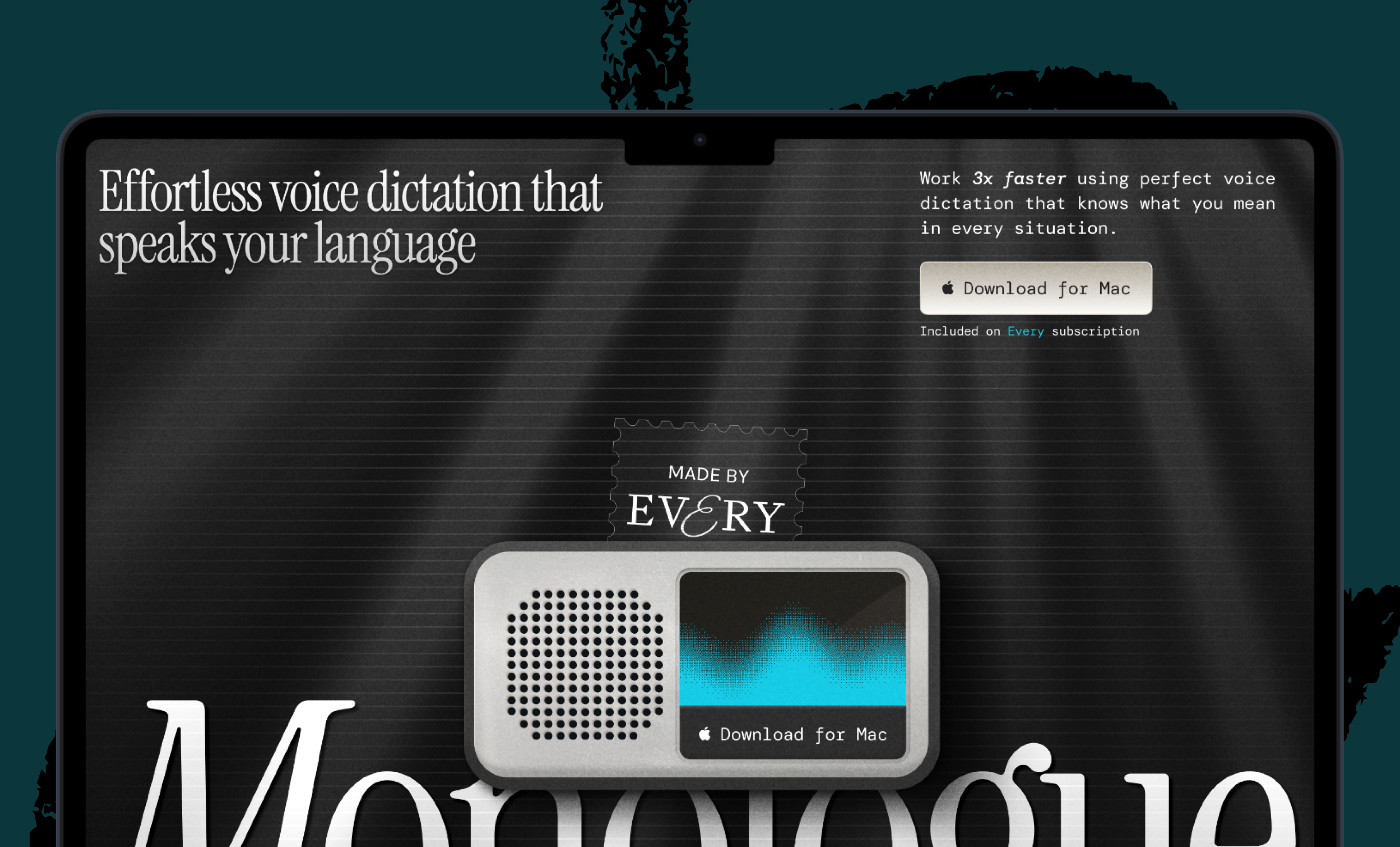
 Monologue
 Cora
Cora
 Sparkle
 Spiral
Join 100,000+ leaders, builders, and innovators

Email address

Already have an account? Sign in
What is included in a subscription?
Daily insights from AI pioneers + early access to powerful AI tools

 Front-row access to the future of AI
 In-depth reviews of new models on release day
Playbooks and guides for putting AI to work
Prompts and use cases for builders
In-depth reviews of new models on release day
Playbooks and guides for putting AI to work
Prompts and use cases for builders
In-depth reviews of new models on release day
Playbooks and guides for putting AI to work
Prompts and use cases for builders
In-depth reviews of new models on release day
Playbooks and guides for putting AI to work
Prompts and use cases for builders
 Bundle of AI software



 Dan Shipper
 Reviews of new AI models on release day
Comments
Don't have an account? Sign up!