




Sponsored By: AE Studio
This essay is brought to you by AE Studio, your go-to partner for custom-built AI-powered software. Transform your idea into reality faster than ever before, with bespoke MVPs designed especially for you.
“A flaming dumpster fire.”
“I can’t believe that company still exists.”
“A business so clearly a scam preying on unsophisticated investors that it will single-handedly cause the SEC to redo how IPOs work.”
These blunt assessments came from professional tech investors I spoke with regarding the upcoming IPO of Triller, a conglomerate of creator economy companies. Their harsh criticism reflects my own serious concerns about this company.
Even if you typically ignore tech IPOs, Triller deserves your attention. The company is supposed to serve creators and reduce the power of the big tech oligarchy. Everyone who cares about how information on the internet is monetized should hope for this company to be great.
Unfortunately, this company's questionable business practices and lack of transparency merit strong skepticism. Fortunately, its recent S1 filing to go public provides an opportunity to examine its finances and operations. Triller's antics reveal broader issues that demand reform of the IPO process to better protect investors. Though entertaining, Triller's shenanigans have consequences we cannot ignore.
So what does this company do again?
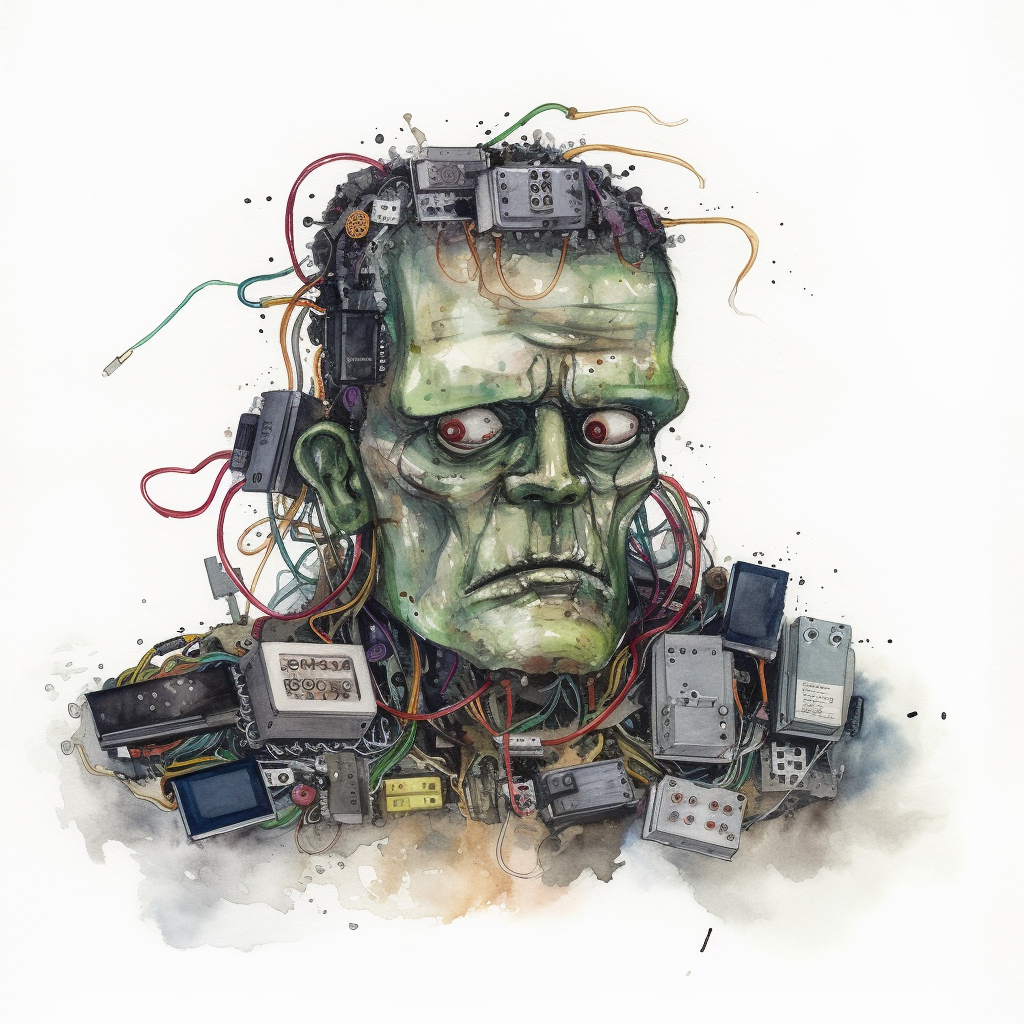
Just like how Mary Shelley’s Frankenstein monster was created by stitching together the discarded remains of people from the local village, Triller did the same thing with dead-in-the-water companies. It’s an amalgamation of, at my best estimation, 14 sorta useless companies that have been acquired and stitched together to create a creator economy monster.
You are not prepared for how stupid some of these assets are. They include:
- Triller: A vertical video app similar to TikTok that mostly focuses on music and dancing. Much more on this app in a minute, but it’s the namesake that started this all.
- Fangage, Amplify.ai, Cliqz, and CrossHype: These are all software products that allow creators to communicate with their fans. You may ask, “Why did you list all of these together, Evan?” To which I would reply, “They all appear to do the same thing.” They let creators send their fans text messages. There are different nuances and variations, but that is basically all there is to it.
- Thuzio: A party-planning service to help people book celebrities to show up in person at events. Cool! No relation to being a tech company, but who cares? The company says Jerry Seinfeld used it, so of course it will make money and somehow relates to the music video app.
- Metaverz: No, my spell check isn’t broken. This is really a company that spelled Metaverse with a Z. The company “provides ways to create digital experiences,” aka virtual events. As a personal rule of thumb: any serious public company does not use a Z as a replacement letter.
If you were feeling generous, you may say that these companies, while poorly marketed and confusingly segmented, do make a loose sort of sense: Triller for audience development, SaaS apps for marketing, etc. But there are far more bizarre assets as part of this Frankenstein monster. The company has also pursued lots of original content, some of which is on Triller, some of it distributed on other platforms:
- Verzuz (again that pesky Z appears): A competition show on which musicians perform in a battle of the bands. Interesting concept that the company acquired. Unfortunately, the founders of Verzuz ended up suing Triller for tens of millions of dollars of missed payments.
- Trillerfest: A music festival! Sure, why not.
- Triller Fight Club: YouTubers punching each other! Sure, why not.
- Bare Knuckle Fighting Championships: YouTubers punching each other, without protective equipment! Sure, why not.
Again, if you squint, you can see a loose way that these companies all connect. Triller can help creators create, distribute, and monetize, all within the confines of one company. It was technically started in 2015 but started its acquisition spree in 2019. The last four years of a booming creator economy and TikTok’s geopolitical struggles helped make this company theoretically rational. This is certainly the argument that it makes. But there is a reason why companies don’t just do everything—they’re more likely to win a market if they specialize. In doing everything a creator could possibly want, Triller is special at nothing.
So the natural question would be, what is this company’s differentiation?
The fake answer and the even faker answer
The fake answer
The company wrote in its S1 that it has an ability “to deliver a robust solution to attract Creators.” Even if each of these offerings were subpar, maybe the company can win by just being really good at getting famous people to use the app. The company tries very hard in its S1 to convince you that is the case.
Imagine merging the ingenuity of developers, data scientists, and designers into one team, dedicated to your business success. That's us, your accelerators at AE Studio, crafting custom AI and software solutions tailored specifically for you.
We don't just build tech, we work hand-in-glove with you, bringing ideas into reality faster than your rivals. From MVPs that test your concept to AI that fosters innovation, we're here to maximize your ROI.
Join the legion of founders and executives who've experienced AE's Rapid Success Model. Let's transform your business together. Free scoping session? It's on us.
The justification is in the second sentence of the overview: “Famous Creators that use or have used our Technology Platform include influencers like Charli D’Amelio and Bryce Hall, music artists like Justin Bieber, Marshmello, JLO, Eminem, Cardi B., The Weeknd, Alicia Keys and Post Malone, and athletes like Mike Tyson and Jake Paul.”
Now, that is a powerful list of names. However, when I downloaded Triller and checked on these accounts, they were all basically dead. Here is the last time all of these folks posted:
- Charli D’Amelio: 38 weeks ago
- Bryce Hall: 64 weeks ago
- Justin Bieber: 120 weeks ago (April 2021)
- Jake Paul: 120-ish weeks ago
- Eminem: Has literally never posted on Triller
You get the idea.
Triller PR would likely tell you that they said these celebs use the “technology platform” that Triller offers. However, that so-called tech platform appears to mostly be used to promote one-off fight nights. As best as I can tell, most celebs used Triller a few times and then churned. The celebrities that have longer engagement patterns, like Charli D’Amelio, are equity holders in the company.
The even faker answer
In late 2022, as the company was pitching investors, a leaked version of its deck was posted on Business Insider. The deck told a similar story as above: creators, monetization, blah blah.
However, this new S1 has something Triller has never mentioned before: artificial intelligence. AI is mentioned in the very first sentence, saying that the company is “powered” by it. It is “key to their approach of empowering creators,” which is remarkable because previous pitches of the company never mentioned the technology. If it was so key you think it would’ve been talked about, like, at all. In general, when I encounter a company that has completely pivoted its strategy because of new technology, it is when it’s at the seed stage, not when it’s about to make its public debut.
Much of this stock’s potential value comes down to how much you trust the management team.
Lies, damned lies, and user growth numbers
Unfortunately, I also don’t see any reason to trust the company’s leadership. From Techcrunch:
“Per Triller’s S-1 filing, the short-form video app has had 550 million lifetime sign-ups. But market intelligence firm Apptopia estimates that Triller has been downloaded just 73.2 million times since launch in 2015 =—that’s 87% lower than Triller’s own reports.”
But wait, there’s more. From the same article:
“This isn’t the first time its own numbers have come into question. When Triller attempted to go public via SPAC in 2021, Billboard reported that the company claimed higher user numbers to the public than it did to music rights holders. In a December 2019 press release, Triller said it had 26.5 million monthly active users, though sources told Billboard that its user base was actually half the size; then, when Triller said it had 50 million monthly active users, Billboard’s sources said this number was actually closer to 25 million.
Triller CEO Mike Lu said at the time that ‘there is no legal definition of MAU/DAU.’”
Whenever the CEO is using a “well, technically” defense for something as fundamental as monthly active users, investors should be running for their lives. It will be fascinating to see which auditing firm is willing to stake its reputation on these numbers' quality. And the numbers—if they are true—aren’t great: while the company grew its top-line revenue ~52% YoY, it was due to acquisitions, not organic growth. Creator growth on its platform has also flatlined, only adding 69,000 since Q1 2021, for a total base of about 2.4 million creators.
Moreover, Triller has been sued by Universal Music Group (ongoing), Sony Music (settled, Triller lost), and Verzuz founder Timbaland (settled, Triller lost). It even failed to pay the 300 Black creators that it supposedly sponsored as part of its diversity program.
What are we doing here, folks
All of these data points make me deeply uncomfortable. A history of questionable ethics, shaky business strategy, and mysterious acquisitions do not paint a picture of a worthwhile stock investment.
Theoretically, there is a stock price at which it would make sense to buy, but I don’t know what it is. How would you price in the risk that the users might all be fake, the numbers made up, and the company could be sued out of existence? Hell if I know.
If the management team were serious about getting legitimate capital from experienced, professional teams, there is a version of this story in which this company can work. They could break out revenue by division, show how they will acquire and retain large creators, and share why they think they’ll become cash flow-positive fast. Instead, the team listed a bunch of celebrities that don’t use the platform and farted out the phrase “artificial intelligence” a few times.
A company in this bad of shape only goes public in the hope that its previous investors can dump the stock on an unsophisticated public. It’s a shame that this is the sort of asset being offered to the general populace. As a tech optimist, I can’t help but feel that our industry should be doing better things than this.
The last few years of tech startup investing was a time of incredible excess and grift. So many companies were funded at valuations they didn’t deserve. Bad actors were everywhere. Now, with higher interest rates bringing a cold splash of reality on valuations, many investors are looking to sell these overvalued stakes to anyone dumb enough to take them. In the case of Triller, it looks like its investors are hoping those suckers are the general public. Investors, beware—both this IPO and the deluge of garbage that will be for sale over the coming months.
The Only Subscription
You Need to
Stay at the
Edge of AI
The essential toolkit for those shaping the future

"This might be the best value you
can get from an AI subscription."
- Jay S.
 Every Content
 AI&I Podcast
 Monologue
 Cora
Cora
 Sparkle
 Spiral
Join 100,000+ leaders, builders, and innovators

Email address

Already have an account? Sign in
What is included in a subscription?
Daily insights from AI pioneers + early access to powerful AI tools

 Front-row access to the future of AI
 In-depth reviews of new models on release day
Playbooks and guides for putting AI to work
Prompts and use cases for builders
In-depth reviews of new models on release day
Playbooks and guides for putting AI to work
Prompts and use cases for builders
In-depth reviews of new models on release day
Playbooks and guides for putting AI to work
Prompts and use cases for builders
In-depth reviews of new models on release day
Playbooks and guides for putting AI to work
Prompts and use cases for builders
 Bundle of AI software




 Evan Armstrong


 Dan Shipper
 Reviews of new AI models on release day
Comments
Don't have an account? Sign up!
great investigative piece journalism the way it should be thanks
ABGA (also the stock symbol) company from Hong Kong, is resurrecting the dead Twiller app. Beware of the hyped financial forecast and valuation. Twiller lost all respect with major black music artists. Nothing left but a zombie co. losing over $100M in 2022 and 2023 "net loss of $131.2 million in the nine months ended September 30, 2023 and $143.5 million for the fiscal year ended December 31, 2022"