




Was this newsletter forwarded to you? Sign up to get it in your inbox.
I’ve devoted the last four years of my life to trying to make beautiful writing. In that time, I have published 423,513 words here on Every’s site. Between rejected drafts, personal essays I haven’t published, and other miscellaneous writing, I figure I’ve written at least 500,000 words—a little more than the Lord of the Rings trilogy.
When I started, I had never published anything before. Now, I am a professional writer, and Every has grown to over 100,000 subscribers. We made a media company that people love to read, where previously there was nothing. Creation ex nihilio.
That amount of suffering—*cough* sorry, writing—has taught me a number of unintuitive, uncomfortable truths about what makes an essay succeed.
Today, I would like to tell them all to you. I do so not because I want more competition, but because I want more beauty and truth in the world. I want the world to be overflowing with independent, smart writers. If you’ve ever thought about writing online or been tempted to publish an opinion, let me teach you all that I know. Here are the four principles I’d like to share:
- Craft at every level matters.
- Pursue your curiosity, but acknowledge the lizard brain.
- People will misinterpret you.
- AI is a terrible writer, and a wonderful thought companion.
What, exactly, are you crafting?
As a writer, you have limited hours to dedicate to your craft, and deciding where to focus can be overwhelming. You might spend your time finding the perfect word that conveys your feeling, rearranging paragraphs to improve flow, or even stepping back further to come up with a better idea for a piece. But you can’t do all of these at once. How are you supposed to choose?
When writing falls short, it's often because the writer concentrated on the wrong level of craft for their desired audience. For example, carefully editing at the individual word or sentence level can create a smooth, waterslide-like flow where readers glide effortlessly from sentence to sentence, unable to stop themselves. Many writers mistakenly think achieving this effect means using elaborate language, complicated grammar, or ornate sentences. In reality, especially in online publishing, it typically means simplifying—shorter sentences, direct language. People behave differently on the internet than when they sit down to read a book. You need to work harder to hold their attention.
The challenge with simple sentence structure is that you can attract an audience that is only casually engaged in what you’re writing about. The more broadly accessible your work, the more explanatory you’ll have to be, and the less subtlety you’ll be able to employ. This may work for you! But there are risks to the approach.
If, on the other hand, your goal is to attract expert-level readers, you should write with extreme levels of idea clarity. If you make the writing deliberately boring, anyone who isn’t deeply invested in the topic itself is going to churn. Surprisingly, this is a net positive for some types of writing. When you are trying to cultivate a technical audience, using industry-specific language acts as a filtering mechanism so that only the truly invested in the idea space remain. The result is that those readers who do stick around have a deeper connection with your work.
In either case, it’s important to recognize what separates a good piece from a great one. A merely good piece can get away with containing either a great idea or great sentences. But if you really want to be in the top one percent, you have to be excellent at both sentence-level craft and ideas. The world of attention is so competitive that you have no choice but to be incredible in both if you would like to succeed in the long run. That can mean the writing is “boring,” simple, or complex. What matters as the writer is being crystal clear who you are trying to attract and what they can expect from you.
 Create a free account to continue reading
The Only Subscription
You Need to
Stay at the
Edge of AI
The essential toolkit for those shaping the future

"This might be the best value you
can get from an AI subscription."
- Jay S.
 Every Content
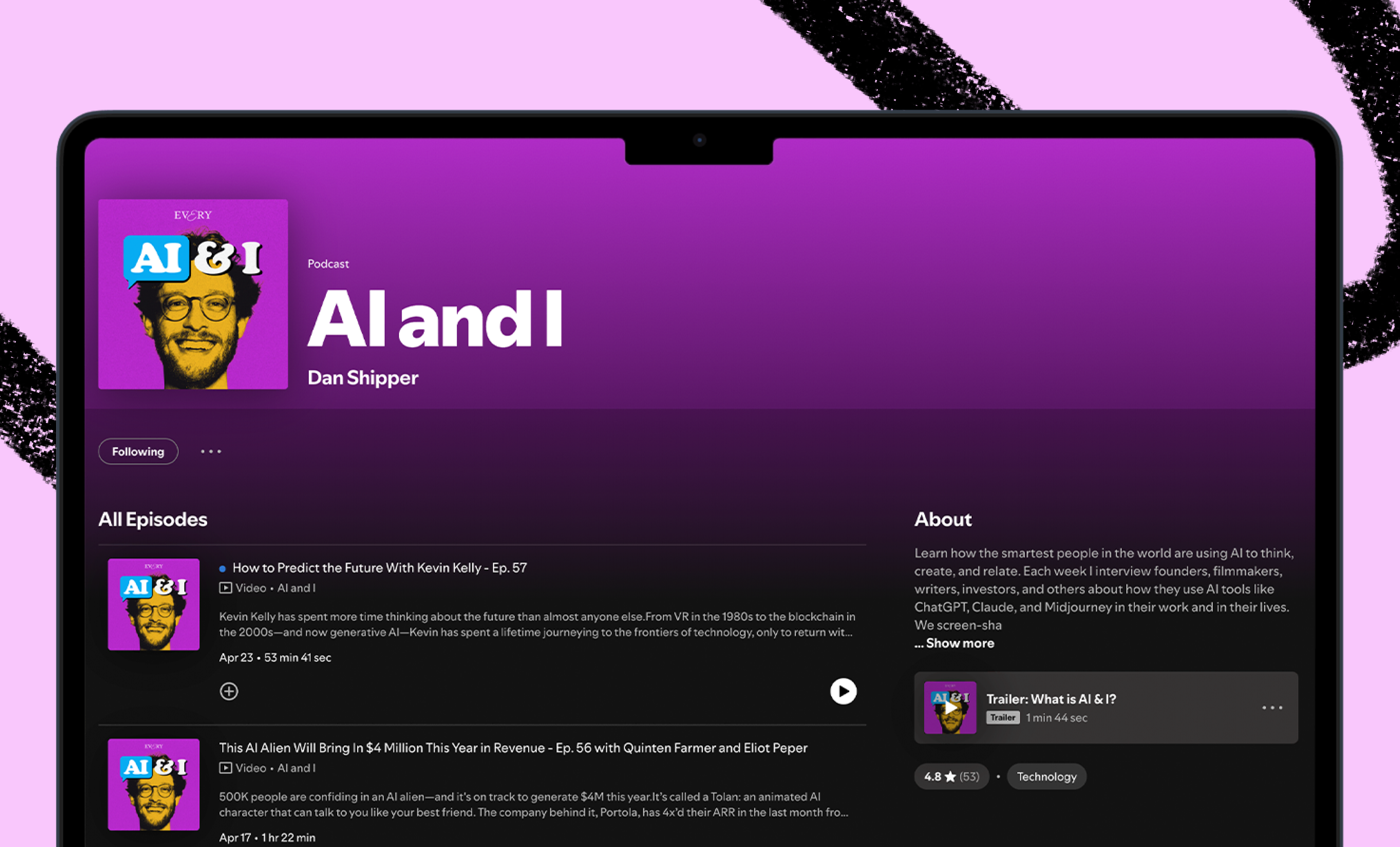
 AI&I Podcast
 Monologue
 Cora
Cora
 Sparkle
 Spiral
Join 100,000+ leaders, builders, and innovators

Email address

Already have an account? Sign in
What is included in a subscription?
Daily insights from AI pioneers + early access to powerful AI tools


 Front-row access to the future of AI
 In-depth reviews of new models on release day
Playbooks and guides for putting AI to work
Prompts and use cases for builders
In-depth reviews of new models on release day
Playbooks and guides for putting AI to work
Prompts and use cases for builders
In-depth reviews of new models on release day
Playbooks and guides for putting AI to work
Prompts and use cases for builders
In-depth reviews of new models on release day
Playbooks and guides for putting AI to work
Prompts and use cases for builders
 Bundle of AI software



 Evan Armstrong


 Reviews of new AI models on release day
Comments
Don't have an account? Sign up!
I loved this piece Evan - thanks for sharing! 2 f/up qns:
1) How did you get better with sentence-level craft? How do you measure that?
2) Do you have any suggestions on post length for beginners? Do you feel attention spans to be a problem? A lot of the folks that i know spend way too much time on short form writing than on long form (80:20, or even worse i guess) ( Addl context - i started out writing long form (on Substack), but of late realize that short form writing (on LinkedIn), gets good reception and feedback. And who reads long-form from a novice writer these days?)