





Was this newsletter forwarded to you? Sign up to get it in your inbox.
Help us scale the only subscription you need to stay at the edge of AI. Explore open roles at Every.
I operate on the baseline assumption that I’m about to be fired at all times. It doesn’t matter how many managers tell me I’m doing great or how many positive performance reviews I receive, every piece of feedback gets filtered through my self-doubt.
I had asked AI about my career before, but never about my job performance. So when I finally did, I didn’t expect to believe its answer anymore than I believed when a human said I was doing okay.
It started as routine year-end planning at Every in mid-December. Kate Lee, our editor in chief, asked me to put together 2026 goals based on the performance of my articles. My entire career, I’d been told to use numbers to show results—in performance reviews, in job interviews—but I’d never had the data fluency to do that.
Yet when I fed the fourth quarter numbers on my articles to Claude and ChatGPT and started to see proof that my work was making an impact in terms of driving traffic and sheer output, some dormant part of my brain activated like a sleeper agent, and suddenly I was three hours deep in spreadsheets.
AI helped me do something I’d never managed on my own: believe I’m good at my job. If AI can democratize business intelligence for someone with my particular brand of professional self-loathing, it can probably help you understand your own value, too. Here’s how I ran the analysis.
Yearly review gave me proof of my performance
Step one of my AI analysis: manually exporting data from Every’s content management system into Google Sheets like it was 2009. Not exactly the future we were promised, but a necessary evil.
I uploaded the spreadsheets to Claude with this prompt: “I’ve given you four different sets of data from the Every newsletter: overall performance for Q4, as well as performance for two columns I am involved with... I’d like us to conduct a thorough retrospective on my contributions to the Every ecosystem that we can use as a basis for 2026 planning.”
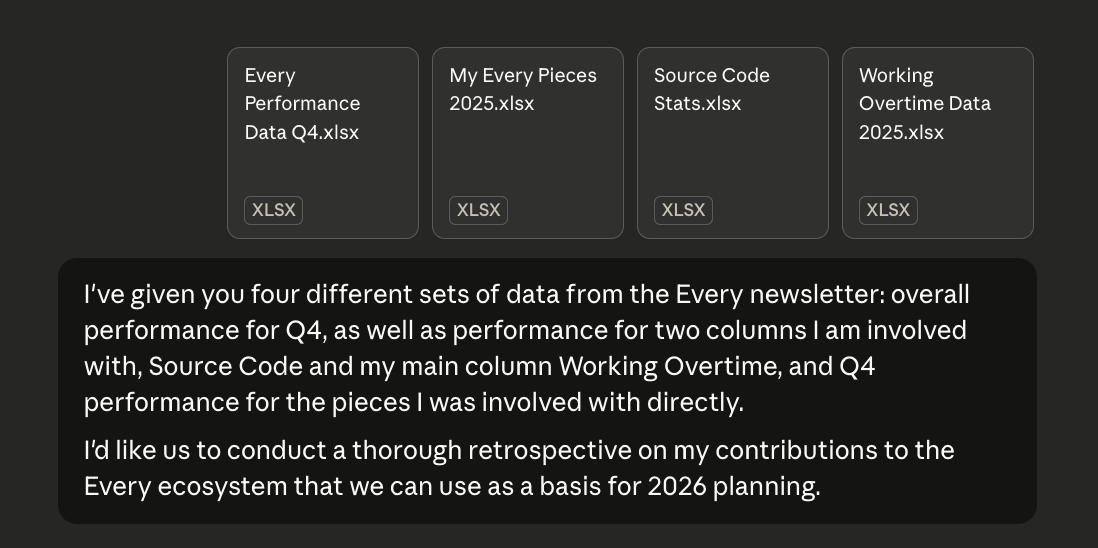
I discovered that I was driving a third of the fourth quarter’s traffic with a fifth of the content. My Working Overtime column was running 13 points above Every’s average satisfaction rating as measured by the ratings that readers can give our articles at the end of every post.
A normal person might have called it there. But at this point I was obsessed with seeing my own performance reflected back to me in the numbers. So I pulled the full year’s data and gave Claude a new role: “Act as an editorial analyst and strategist. Tell me everything you can about what this data tells us.” If the fourth quarter was a fluke, I thought, the full year would expose it.
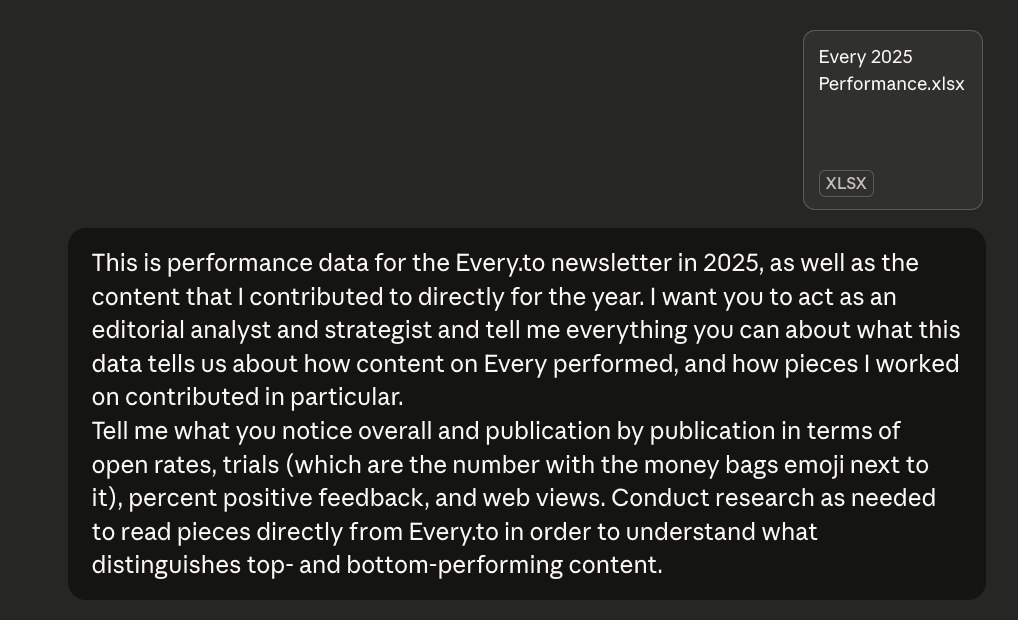
It didn’t. In 2025, I wrote 54 articles for Every—15 percent of everything we published. Those pieces drove 25 to 27 percent of our subscription trials and web views. In the final quarter alone, I contributed 18.8 percent of content output and 29.3 percent of views. Every way I sliced it, I was punching above my weight by a factor of 1.5 to two.
But the more interesting finding was how different types of work drove different kinds of value. Each column I contribute to at Every moves a different needle.
 Create a free account to continue reading
The Only Subscription
You Need to
Stay at the
Edge of AI
The essential toolkit for those shaping the future

"This might be the best value you
can get from an AI subscription."
- Jay S.
 Every Content
 AI&I Podcast
 Monologue
 Cora
Cora
 Sparkle
 Spiral
Join 100,000+ leaders, builders, and innovators

Email address

Already have an account? Sign in
What is included in a subscription?
Daily insights from AI pioneers + early access to powerful AI tools

 Front-row access to the future of AI
 In-depth reviews of new models on release day
Playbooks and guides for putting AI to work
Prompts and use cases for builders
In-depth reviews of new models on release day
Playbooks and guides for putting AI to work
Prompts and use cases for builders
In-depth reviews of new models on release day
Playbooks and guides for putting AI to work
Prompts and use cases for builders
In-depth reviews of new models on release day
Playbooks and guides for putting AI to work
Prompts and use cases for builders
 Bundle of AI software





 Katie Parrott
.png)
 Reviews of new AI models on release day
Comments
Don't have an account? Sign up!
Katie -- Again, thank you for a great, introspective piece. And I agree overall with Mr. Greene's feedback (below... including his P.S. for a better commentary tool!). I'm only gonna add that the tough honesty with which you wield your self-criticism is both unusual and refreshing -- not everyone can or will share and air their self-view and self-assessments to the degree that you've done here and before. If I was your manager &/or personal friend, I'd certainly councel dialing your level of self-doubts back a few notches... but not to zero, certainly not by too much, as this is one of your personal super-powers -- the ability to introspect with honesty, and to use that as a personal motivator. In other words, we like you just the way you are! Keep up the great work, Katie, and I certainly look forward to your Every contributions in 2026! Cheers, Happy New Year!
This has got me thinking about where I can get this kind of data for my job, which is vastly different. I'm a programming librarian by day, so the best metric I can think of is attendance at programs, but I think I need baseline numbers to compare them to, the way you can to other writers, or to the resulting action people take after reading your articles.
I really love this one! One of the few Every articles I saved to Reader and highlighted. Your conclusion feels like it misses something that it seemed like you were clear on earlier though (and which I personally am very excited about). You ended with:
"But my relationship to the doubt has shifted because now I have the data.
I can look at the numbers instead of believing the narrative that my mind tells me."
I don't think that's what made the difference. You said it yourself several times throughout, here's a key example (emphasis mine):
"At one point, the AI asked me point blank: Why are you asking this? What is it about it that’s so hard to believe? That’s when I said the thing I’d never said to a manager or a therapist or even, really, to myself:
“I don’t know. I guess just pathological self-hatred and an inability to trust that I do good work.”
**I could say it to a chatbot because there was no social cost, and I didn’t have to be worried about burdening someone on the other end with my baggage**. If I believed the data, the next step was to believe myself."
You *had* the data before, you probably even had some data on your performance in past jobs to some degree, but you never *believed it* or allowed it to influence your underlying opinion of yourself and your capabilities. And having more and more data didn't really seem to help you believe it more! What *does* seem to have helped is having "someone"/something repeatedly use the data to demonstrate to you how your self-perception was wrong. The key aspect there is not, IMO, the data, but the use of it, consistently, to reinforce a more realistic and (by fortunate happenstance) positive view of yourself. Not only that but there is clearly an element here of it working because you were interacting with more of a "something" than a *someone*, i.e. you could relate to and utilize the AIs in a way that you could not with a human. This fact in itself led to some transformation, a shift that arguably would not have been possible with traditional human resources (your boss, a good friend, a therapist; none of them are fully equipped to navigate you through this to where you ended up!).
This right here is the actual key and IMO is the stronger end (or a version of it) to this whole article and the case you're making (emphasis mine):
"Kate had already told me that we want to publish more of my column in 2026. But I wasn’t prepared to accept it. Coming from a person, I would have brushed it off as encouragement, the kind of thing a good manager says to keep you motivated. **Coming from a system that had just walked me through the data and played out scenarios for what each choice would mean, it landed differently.** "
This shifts it significantly from a fairly familiar "I just needed the data to show why I was right/wrong" message to a much more interesting and new "the social dynamics of artificial intelligence allowed me to ask a question and get an answer that simply wouldn't have convinced me coming from a person". That's fascinating and powerful because it's a *new* capability, a new paradigm, that we haven't had before. There are potential versions of it, perhaps, ranging from anonymous feedback to certain forms of therapy, certain interpersonal relationships that you really trust, etc. But for this to be a *service* that almost anyone in the developed world can access (setting aside the data, I'm talking about the mechanism of how the shift in *your* mindset worked here), that's an incredible thing.
There are a lot of people wringing their hands about AI being used in place of therapists and whether it will be helpful, or concern about people "befriending" AI, etc. And while I think there are genuinely concerning aspects of it all (not least to do with privacy and confidentiality, training data, etc.), it's stories like this - and some of my own experiences - that I think are at least as worthy of exploring and discussing. This is not a case of you doing something with an AI that a therapist could have done for you (most likely): this is a meaningfully new, different, and potentially more powerful method, if only by dint of its sheer omnipresent availability. My former coach would constantly say he wished he could be there in the very moment I would procrastinate or otherwise struggle with some challenge, and now AI *can* be in a way no human assistant ever could be. So I would love to see more in-depth explorations of this kind of thing!
P.S. I'm sure improving the comment system here is low on the list of Every.to priorities, but I would love if someone on the team could expend some AI cycles to give us some basic formatting here (italic, at least, bold) and quote ability, Being able to highlight on-page and then quote into the reply box would be awesome. Maybe there don't seem to be enough chat interactions to justify it, but that could also be chicken-and-egg. Maybe if you built a much nicer commenting/interaction mechanism you'd get more interaction...
Keep up the good work!
@Oshyan Thanks for your insight.
I am always up for reading an article with your byline. You have a distinctive voice, and you are using the tech you write about in novel ways. You are definitely one of the reasons I open my emails from Every. Glad to hear we'll be seeing more articles from you in 2026
I really appreciated this piece. Your openness about self‑doubt, and the way you used AI to turn raw numbers into a story about impact, resonated deeply. The distinctions you drew between conversion, brand building, and reader satisfaction were clarifying—and the takeaway that vulnerability can be a strategic advantage felt both brave and practical. Thanks for sharing the prompts and process; they made the analysis feel replicable. I’m rooting for more Working Overtime in 2026 and grateful for the reminder to build our own case with data.
Loved this—clear, vulnerable, and genuinely useful for self‑review.
I’d add tracking effort/energy alongside outcomes so you can sustain the mix that drives loyalty and trials without burning out.
BTW, tiny ops tip: for quick specs on merch or shoots, this Ring Size Chart is handy.