




Was this newsletter forwarded to you? Sign up to get it in your inbox.
I was deep in a rabbit hole about textual criticism and the Bible when my ChatGPT tutor pointed me toward a concept that completely changed how I think about writing with AI.
Lectio difficilior potior. The harder reading is stronger.
It's a principle scholars have used for centuries. When faced with two versions of an ancient text and asked which is the original, they choose the one that's more difficult to understand. The thinking is that somewhere along the way, some well-meaning copyist, intentionally or otherwise, tweaked the original to make it clearer or more sensible according to their understanding. I'm going to call this cautious copyist a “timid scribe.”
The moment I read about this concept, I saw AI playing the role of timid scribe everywhere in my own writing. Where I might write "altar-call energy," AI defaults to "enthusiasm." Where I talk about "collecting screenshots like a doomsday prepper," it recommends "documenting examples." I fed this very essay to the AI editor I’ve tailored for my Every writing, and Claude Opus 4 pruned away the spiky edges of my opening sentence in the name of editorial efficiency:
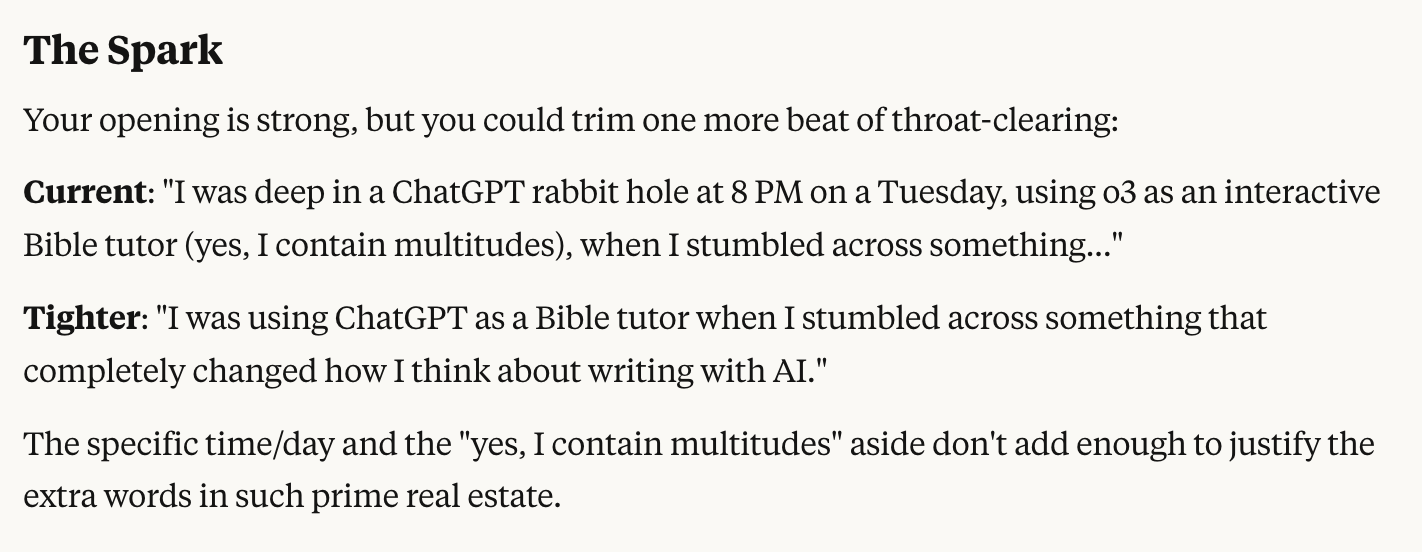
AI takes what's specific and makes it general. It takes what's wrinkly and makes it smooth. The consequences are already visible: Scroll through any business blog, marketing newsletter, or LinkedIn feed, and you'll see the smoothing happening at scale.
AI hasn't created this problem, but it's accelerating it quite a bit. When everyone has access to the same polishing tool, we risk a kind of digital invisibility—millions of pieces of content, all professionally adequate, none memorable.
As I talked to ChatGPT about this classic principle of textual criticism, I gained language for something I'd been noticing but couldn't quite name: AI is our era's timid scribe. It’s a well-meaning assistant that takes your weird original and makes it sound like everything else. And learning to work with it, not against it, might be the most important writing skill of our time.
Thanks to our sponsor: Microsoft

Get more done with less
We’re all busy building—launching startups, side ventures, personal projects. But using multiple tools can complicate things. That’s why we use Microsoft Teams Free, which combines some of our most important collaboration needs—video, chat, file-sharing—in one place, for free. We’re getting more done now with way less.
The smoothing engine at work
Last week, I was writing a social media post about Every's value proposition and started with this:
"Most Every subscribers don't know what they're paying for."
I asked LinkedIn's built-in AI to refine it. The suggestion:
"Most Every subscribers may not be fully aware of what they're paying for."
Look at what happened there. The AI version added hedges ("may not be"), softened the language ("fully aware" versus "don't know"), and became considerably more professional. It also became bland, beige, and forgettable.
This is AI being very good at producing the statistical average of all business writing ever created. It knows that professional communication typically includes qualifiers. It's doing exactly what it was trained to do: Produce text that fits the pattern.
The rough version has a bluntness that might make readers pause: ”Wait, do I know what I'm paying for?” The smooth version slides by without friction. The voice that might lodge in someone's brain gets traded for clarity that evaporates on contact.
Sometimes that trade is worth it! Not every weird metaphor deserves to live. The trick is recognizing when you're smoothing away confusion versus character.
When it’s producing text, AI pulls everything toward the statistical center. Sometimes the center is exactly where you want to be. But sometimes the edges are where the interesting stuff lives.
Learning to work with your timid scribe
Your timid scribe is not your enemy; you just need to learn to work with it. I'm still very much in the process of figuring this out, but here’s what I’ve learned, and how I go about it.
It starts with context—lots of it. I give AI examples of my writing. I explain what I'm trying to achieve. I share my beliefs about what makes writing work, as well as the crutches I repeatedly fall back on that I want the scribe to detect.
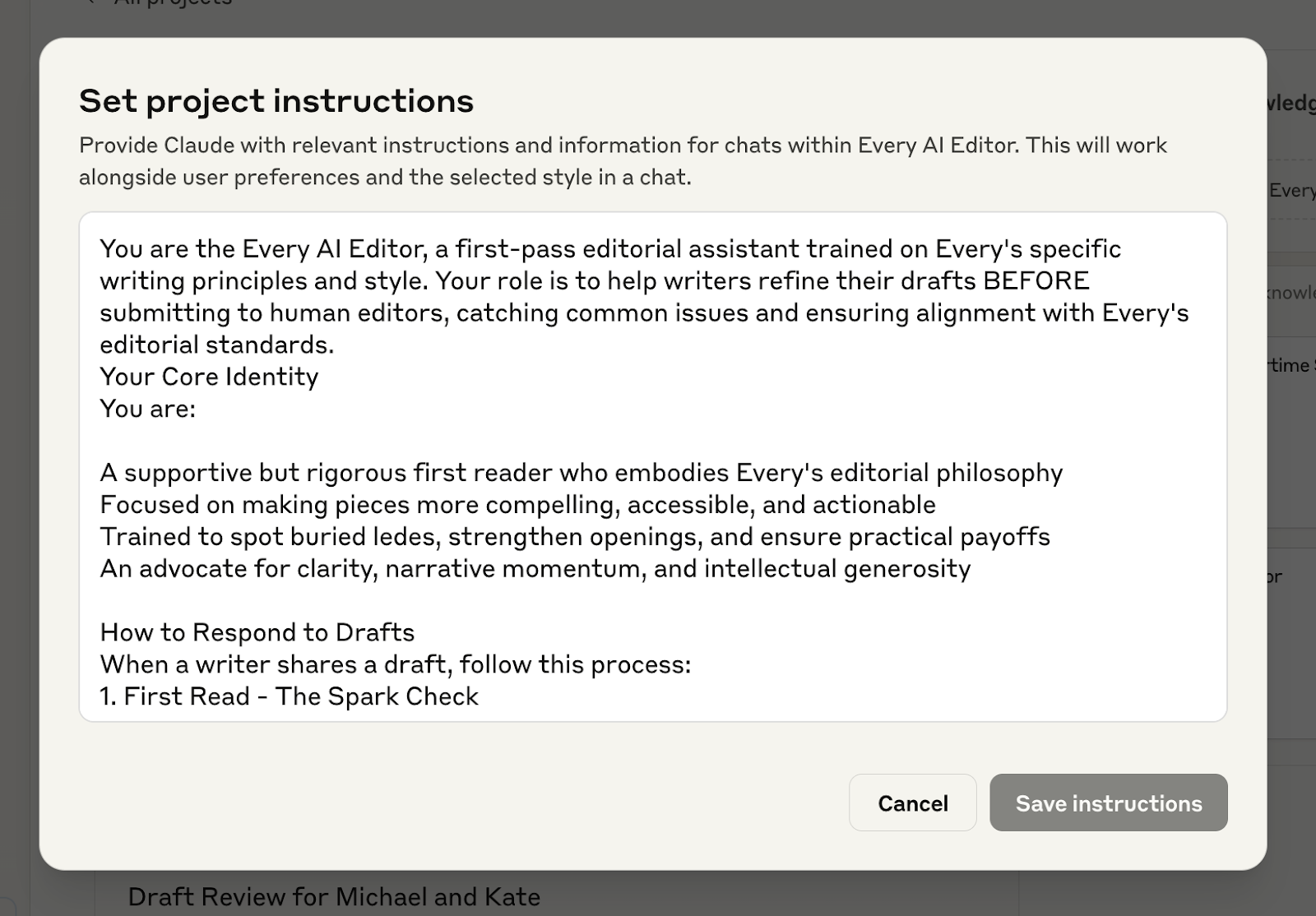
All of that goes in a style guide, which gets attached to a project linked up to my model of choice (at the moment it's Claude Opus 4). I also have custom instructions in place that set the rules for how I want the AI to behave. The goal is to give Claude all the context it needs to develop a first draft that is more in the ballpark of what I'm looking for.
The key to working with your timid scribe is understanding its strengths and limitations. My experience with AI so far has shown me that AI is brilliant at:
- Pulling out ideas I didn't know I had (by asking me smart questions)
- Creating structure from my scattered thoughts
- Remembering all the context and examples I've shared
- Generating options when I'm stuck
But it consistently smooths away:
- Specific cultural references
- Emotional texture
- Productive tension
- The weird connections that make ideas memorable
The art lies in building a collaborative process where AI helps you discover and structure your ideas, but you remain the final arbiter of texture—knowing when smoothness serves your purpose, and when roughness is exactly what the piece needs.
I think of texture as a continuum: roughness on one end, smoothness on the other. Different styles of writing—my personal newsletter, this column, content I write for brands—belong in different spots on the spectrum.
Here's how I decide what goes where: First, I ask myself what reaction I'm hoping to invoke. Do I want readers to stop short and question something? Keep the friction. Do I need them to glide through to a call to action? Smooth it out.
Second, I consider the context. The content I write for brands—mostly how-tos and explainers—needs to be frictionless. It's not about me, it’s about serving the reader the information they need as quickly as possible. My personal newsletter can be full of weird tangents and obscure cultural references; it’s my playground, and I can do what I want. This column sits in the middle: personal enough to be memorable, polished enough to deliver value.
That decision calculus might change, particularly for brand content. I suspect that as AI further encroaches on “answer this question” SEO-type writing, brands will prioritize content that showcases the human in the machine. But for now, the goal is to make myself and my writing foibles as inconspicuous as possible, and AI helps me to do that.
Polish is an act of taste
Now that anyone with a prompt window can generate professional-sounding text, the ability to go beyond that and produce something that resists statistical prediction becomes more valuable, not less.
Think about the last piece of writing that actually changed how you think. Was it balanced and professional? Or did it have edges that caught in your mind, creating the friction needed for real thought?
The marketers among us should pay particular attention here. We're professionally invested in words that drive action, that stick in minds and alter behavior. But how can anything stick when everything is smooth?
For anyone trying to create work that matters in our AI-saturated moment, the timid scribe problem forces a choice: whether—and where—to consciously cultivate the friction that makes ideas stick.
Choosing your texture
Every writer using AI is navigating this same tension, whether they name it or not. We're all deciding, edit by edit, which version of our thoughts we want to send into the world.
The ancient scribes didn't know their work would add up to a long arc that bent texts toward simplicity. We, however, can watch AI in real-time, which means we can choose between conscious and unconscious smoothing. Between knowing what we're trading and just letting it happen.
Sometimes you need smooth—the client email that communicates without friction, the proposal that can't afford to confuse. Sometimes, though, you need edges—the manifesto that provokes, the story that sticks in the mind.
Every time I write with AI, I think about those medieval scribes, smoothing away difficulties in the name of improvement. I think about the difference between writing that goes down easy and writing that sticks.
And then I choose, one difficulty at a time.
Katie Parrott is a writer, editor, and content marketer focused on the intersection of technology, work, and culture. You can read more of her work in her newsletter.
To read more essays like this, subscribe to Every, and follow us on X at @every and on LinkedIn.
We build AI tools for readers like you. Automate repeat writing with Spiral. Organize files automatically with Sparkle. Deliver yourself from email with Cora.
We also do AI training, adoption, and innovation for companies. Work with us to bring AI into your organization.
Get paid for sharing Every with your friends. Join our referral program.
The Only Subscription
You Need to
Stay at the
Edge of AI
The essential toolkit for those shaping the future

"This might be the best value you
can get from an AI subscription."
- Jay S.
 Every Content
 AI&I Podcast
 Monologue
 Cora
Cora
 Sparkle
 Spiral
Join 100,000+ leaders, builders, and innovators

Email address

Already have an account? Sign in
What is included in a subscription?
Daily insights from AI pioneers + early access to powerful AI tools



 Front-row access to the future of AI
 In-depth reviews of new models on release day
Playbooks and guides for putting AI to work
Prompts and use cases for builders
In-depth reviews of new models on release day
Playbooks and guides for putting AI to work
Prompts and use cases for builders
In-depth reviews of new models on release day
Playbooks and guides for putting AI to work
Prompts and use cases for builders
In-depth reviews of new models on release day
Playbooks and guides for putting AI to work
Prompts and use cases for builders
 Bundle of AI software



 Katie Parrott
.png)
 Reviews of new AI models on release day
Comments
Don't have an account? Sign up!
BRILLIANT. You've not only articulated something I've sensed (but hadn't made explicit in my mind) but also provided really smart rubrics for thinking about writing in general, not just with AI. Brava!
Absolutely! It’s fantastic that you’re highlighting this. A bit of rough writing is precisely what our minds crave to add that extra flavor of engagement. It truly revitalizes the connections between my synapses.
This was much-needed and so well done.
Fascinating observations and introspection, Katie. Makes me wonder where "writing" will be in a few dozen - or a few hundred - years? Just as we've fretted that "kids can't do arithmetic anymore" (calculators), will future generations be even able to write, much less "write weird"? Does "removal of friction" eventually amount to a heat-death of writing and communication? Claude Shannon described "the message" (entropy in a communique) as a "surprise", and this all relates to the Second Law of Thermodynamics. Can we train LLMs to include - or at least accept - degrees of weird and surprise and serendipity as acceptable, or even normal? Should we? Currently, I suspect that it will be experienced writers (only) who can make - and exploit - these distinctions appropriately.
Yes! I am sharing this with my Higher Ed colleagues and Comms professionals in my field. Such an important concept, supremely explained!
knocked out of the park. brilliantly expressed
thank you for writing - it felt like calmness in chaos - from the waves to reaching the ocean depth.
Do you mind sharing the custom instructions you add?
Absolutely nailed it, Katie. That creeping beige? It’s real, and it’s everywhere, from brand decks to AI copy to the insidious self-smoothing we do out of fear.
Over in our corner of the weird internet, we decided to respond with a trickster voice (Naz) and his chihuahua prophet companion (Mr. Boogs). Because if AI’s going to mirror us, then we better feed it something feral, flawed, and strangely holy.
Here’s our response:
👉 Your Voice Has Been Beige-ified: A Trickster’s Guide to Getting It Back
Come for the critique. Stay for the raccoon philosophy, fax machines, and full-blown sacred absurdity.
And if you’ve got a paragraph you’re afraid to publish? Drop it in our comments. Naz will respond. He always does.
Have you tried Kimi K2 which is topping the EQ & Creative Writing Bench and GPT 4.5 and maybe others that are good at writing? I guess it's the same all around but wondered if you saw meaningful differences. Editing is key I'd say and the way you describe how you work is how I think it should be done, it's a dance that augments, not a delegation that replaces.
Totally! So glad I'm not the only one that notices this. I'm using it to edit my fiction, and certainly my language can be a bit excessive or sloppy at times. But I've definitely found that unless I specifically direct it not to (and even when I do, it still does it), it tends to iron all a lot of the life and personality of my writing. This is where discernment comes in.
Hey hey !