




Update: We shut down the app, as it was an experiment. Thank you for your support.
TLDR: Today we’re sharing the latest experiment from Every Studio: Kairos, an AI-powered reading companion that helps you read more deeply, understand complicated concepts, and questions you on your comprehension. Kairos is built by our entrepreneur in residence (and the author of this piece) Naveen Naidu Mummana. Try it out on TestFlight and let us know what you think.—Brandon Gell
Was this newsletter forwarded to you? Sign up to get it in your inbox.
Something odd happens when you read with AI. You start having conversations with books.
I discovered this accidentally while reading on my iPad. I kept toggling between my ebook and ChatGPT, copying passages to ask questions. At first this felt like a hack—a messy workaround because reading apps haven't caught up to AI. But then I realized I was stumbling onto something more interesting: a fundamentally new way to read.
Having wrapped up my first experiment as an Every entrepreneur in residence, and with a little inspiration from an X post by computer scientist Andrej Karpathy, I decided to build a piece of software for myself: an AI-native reading tool I’m calling Kairos that would solve my own book-reading problems. Now, I’m testing how far I can push the reading experience when AI is built in from the ground up.
Speedreading the history of reading
Reading hasn't changed much since Gutenberg. Sure, we've moved from paper to pixels, but we still primarily consume text linearly, making highlights and notes just as readers did centuries ago. Digital reading platforms have mostly focused on distribution—making books more accessible through devices and online libraries. But the core activity of understanding what we read remains largely unchanged.
This seems especially strange given how much other forms of learning have evolved. We expect students to engage in discussion, not just listen to lectures. We know active learning beats passive consumption. Yet reading remains mostly solitary and one-directional.
AI changes this equation. Instead of just absorbing text, you can probe it. When you encounter a difficult passage, you can ask for clarification. When an idea reminds you of something else you've read, you can explore the connection. The text becomes a starting point for investigation rather than just information to absorb.
Sponsored by: Every
Tools for a new generation of builders
When you write a lot about AI like we do, it’s hard not to see opportunities. We build tools for our team to become faster and better. When they work well, we bring them to our readers, too. We have a hunch: If you like reading Every, you’ll like what we’ve made.
As I experimented with AI-assisted reading, I found myself asking a fundamental question: What does it mean to read well? The more I toggled between text and AI, the more I realized I needed a framework to understand how this technology was changing not just how we read, but the very nature of reading itself.
This search led me to Mortimer Adler, a philosopher and educator best known for his work on the Great Books movement, a project aimed at defining the essential works of Western civilization. In 1940, Adler published How to Read a Book, a guide to deeper reading that has remained influential for decades. His argument was simple: Most people read passively, skimming for information without truly engaging with the text. He outlined four levels of reading, each representing a more sophisticated way of understanding and interacting with books:
- Elementary—Basic comprehension. You’re just trying to understand what the words mean and follow along.
- Inspectional—A strategic skim. You get the gist by scanning the table of contents, reading a few key sections, and figuring out whether the book is worth a deeper dive.
- Analytical—Slow, deliberate reading. You break down the author’s argument, question their assumptions, and engage critically with the ideas.
- Syntopical—Reading across books. You pull in perspectives from multiple sources, compare arguments, and piece together a bigger picture.
Adler's framework provides a perfect lens to understand how AI can transform reading. To explore this, I built Kairos with an interface that feels familiar—similar to Apple Books—but with a crucial addition: an AI companion that's always ready to engage. The reading interface remains clean and focused, with a discrete AI button in the bottom left corner that opens up new possibilities for interaction. Tap it, and you'll find options to chat with Kairos, catch up on previous sections, or access chapter summaries—all while maintaining the full context of what you're reading.
The result feels less like traditional reading and more like having a knowledgeable friend reading alongside you. This friend never gets tired of your questions, has read practically everything, and can instantly recall relevant details from other books. It's the kind of reading experience previously available only to those with access to expert tutors or extensive personal libraries.
Let me walk you through how this works, using each of Adler’s reading levels as a guide.
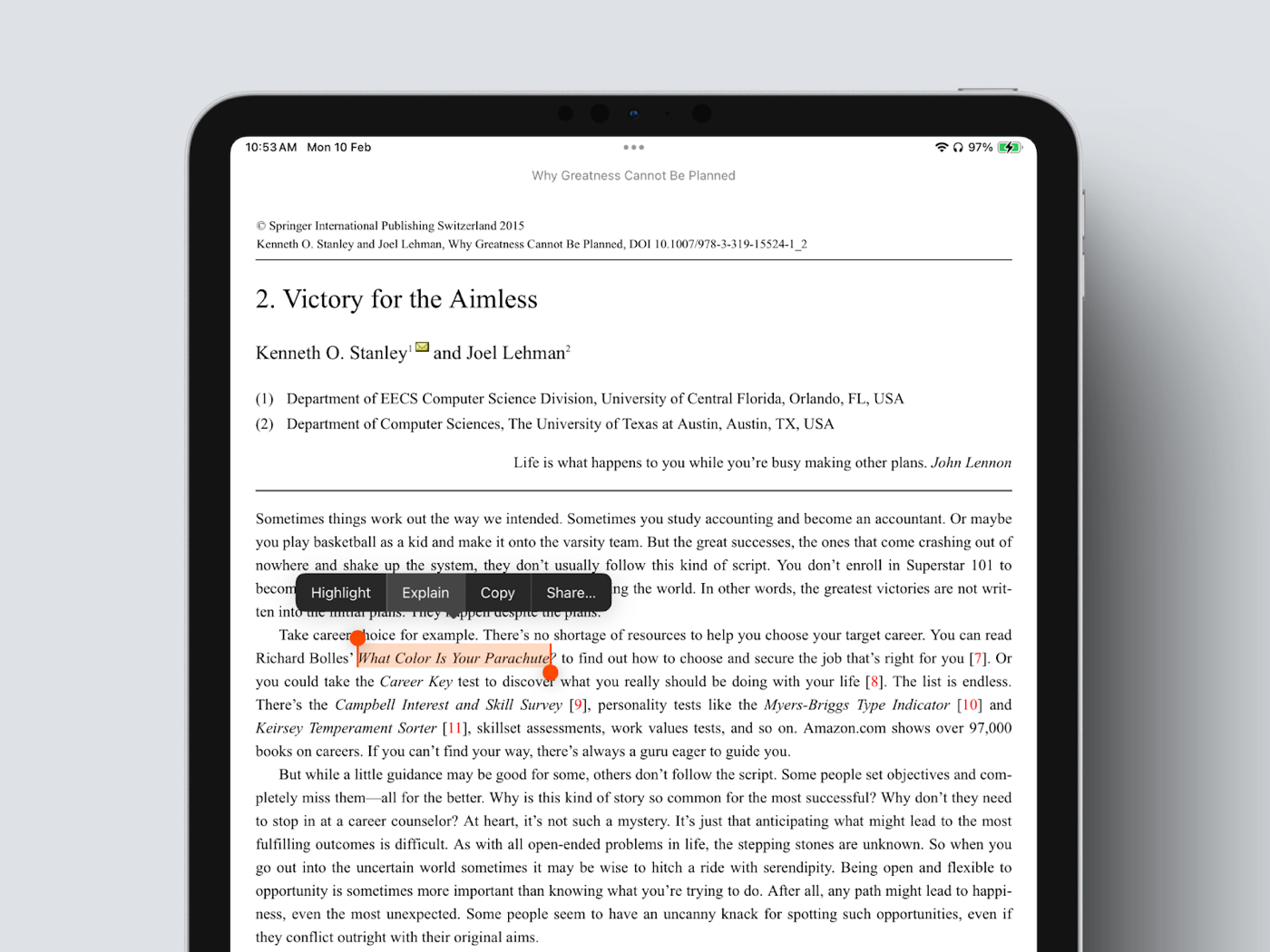
Elementary: ‘Explain this’
Source: All screenshots courtesy of the author.
Adler defines elementary reading as the most basic level of comprehension—understanding the words on the page and following along with the text. It’s the foundation for all deeper engagement, but when readers hit dense or jargon-heavy passages, comprehension can break down.
To test AI's capabilities at the elementary level, I experimented with Marcus Aurelius' Meditations—a philosophical text notorious for its dense passages and complex ideas. Take, for instance, a famous passage from Book 2, where Aurelius writes that he'll encounter "men who are meddling, ungrateful, insolent, dishonest..." When I asked Kairos to explain this in modern terms, it transformed the passage into something surprisingly relatable:
"Before I step out the door, I mentally prepare for a day filled with internet trolls, office drama, and that one coworker who just can't stop oversharing on Slack. In other words, don't be surprised if today's reality feels like a never-ending episode of a reality show—but keep your cool anyway."
What struck me was how the AI didn't just translate the words—it bridged the 2,000-year gap between Aurelius’ world and ours. Suddenly, the Roman emperor's morning self-talk felt as familiar as our own pre-coffee pep talks before facing a day of endless emails and social media debates. This kind of translation made the philosophical insights not just understandable, but immediately applicable to modern life.
Inspectional: Fast summaries and context
Inspectional reading, according to Adler, is all about efficiency—skimming a book to get a sense of its structure, argument, and main ideas. The goal isn’t to absorb everything but to determine whether (and how) to engage more deeply.
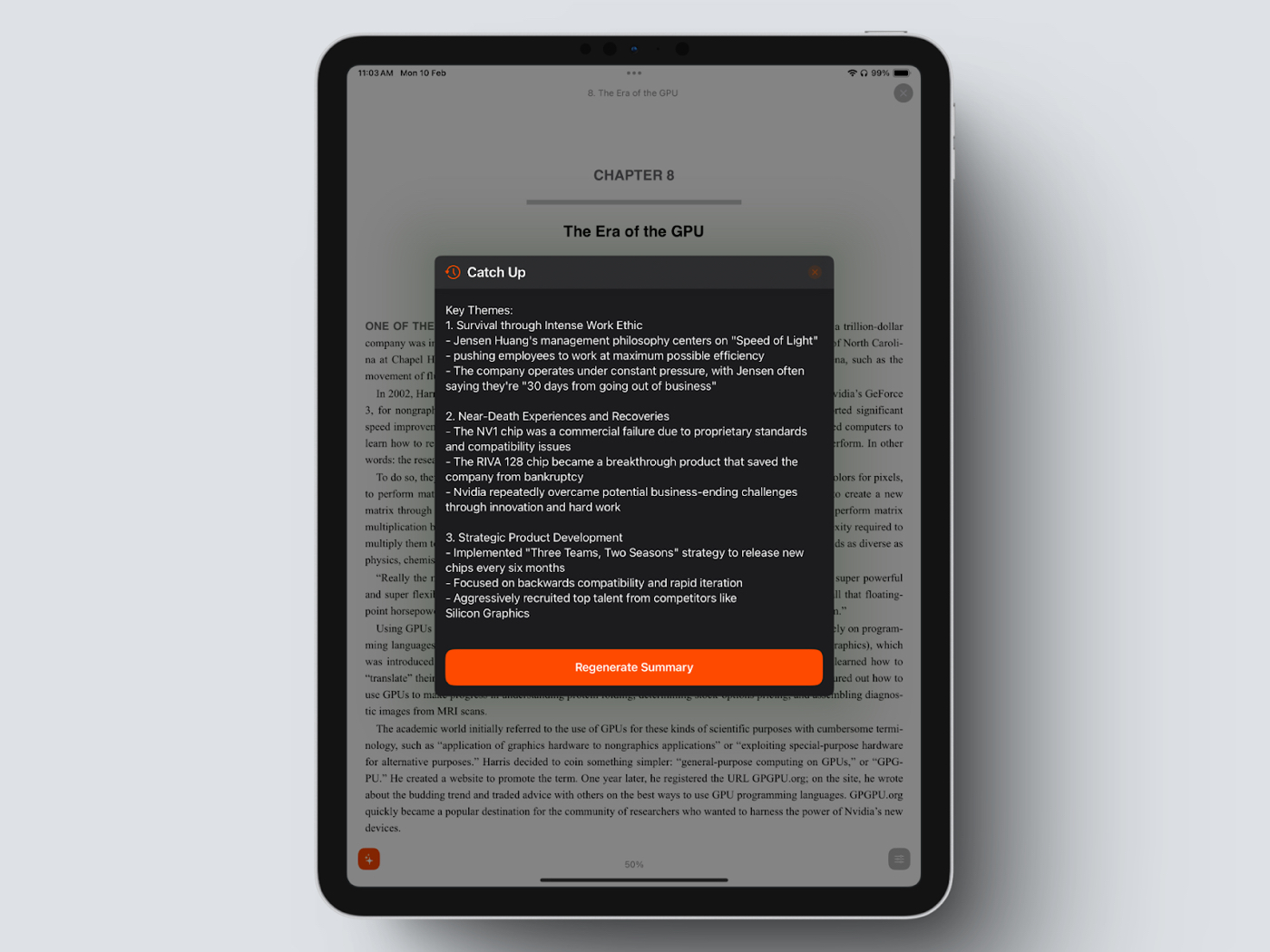
To test AI's inspectional capabilities, I experimented with two different reading scenarios. First, while reading The Nvidia Way by Tae Kim over several weeks, I discovered how having a catch-up feature could instantly refresh my memory of previous chapters. This proved invaluable for maintaining continuity and context—much like having a friend quickly recap what you missed in a TV series before watching the next episode.
Even more revealing was my experience with the book Why Greatness Cannot Be Planned, by Kenneth O. Stanley and Joel Lehman. Using a feature I added that provides chapter-by-chapter summaries, I could first grasp the book's central thesis before diving into individual chapters. This top-down approach—understanding the main theme before exploring its components—helped me better absorb and retain the author's ideas. The AI summaries created a mental scaffold that made the detailed reading more meaningful and coherent.
Analytical: Deep reading and structured thinking
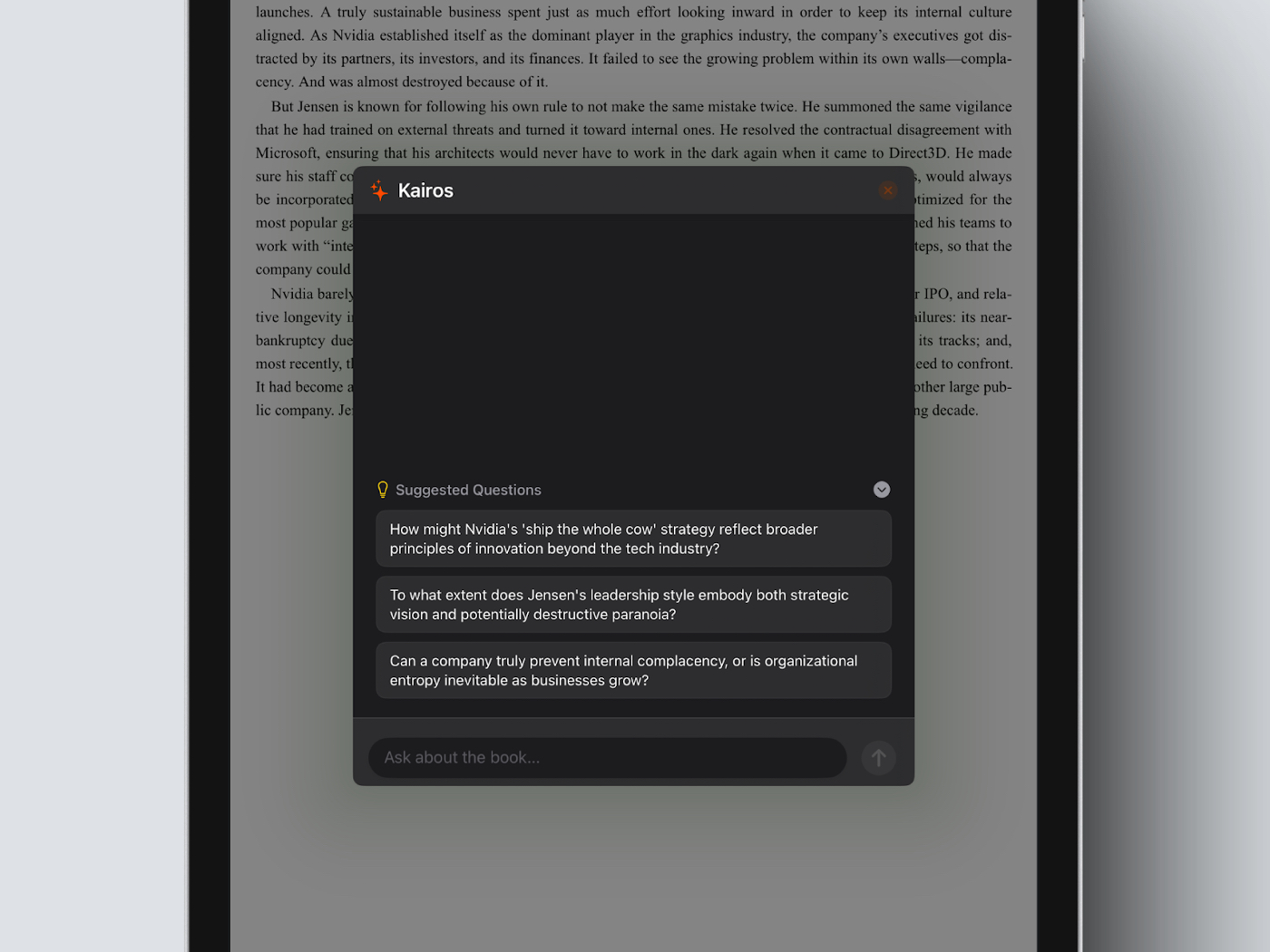
Analytical reading is about asking questions—breaking down an author’s argument, identifying assumptions, and engaging critically with the material. Adler sees this as the level where readers stop being passive consumers and start actively interrogating ideas.
To test AI's analytical capabilities, I explored how Kairos could deepen my understanding of business narratives. While reading The Nvidia Way, I discovered that each chapter conclusion opened up opportunities for profound analytical discussions. At one point, Kairos posed a particularly thought-provoking question: "Can a company truly prevent internal complacency, or is organizational entropy inevitable as business grows?"
What made this interaction powerful wasn't just the question itself, but how it transformed what could have been a simple corporate biography into a source of deeper business insights. The AI helped me extract practical lessons from Nvidia's experience, pushing me to think beyond the narrative to understand broader principles of innovation and corporate adaptation.
This approach fundamentally changed my reading habits. Instead of passively consuming information, I found myself regularly engaging in meaningful dialogue about the text. The AI doesn't just ask questions—it helps readers develop the habit of questioning, encouraging the kind of critical thinking that Adler saw as essential to true analytical reading.
Syntopical: Cross-text conversations
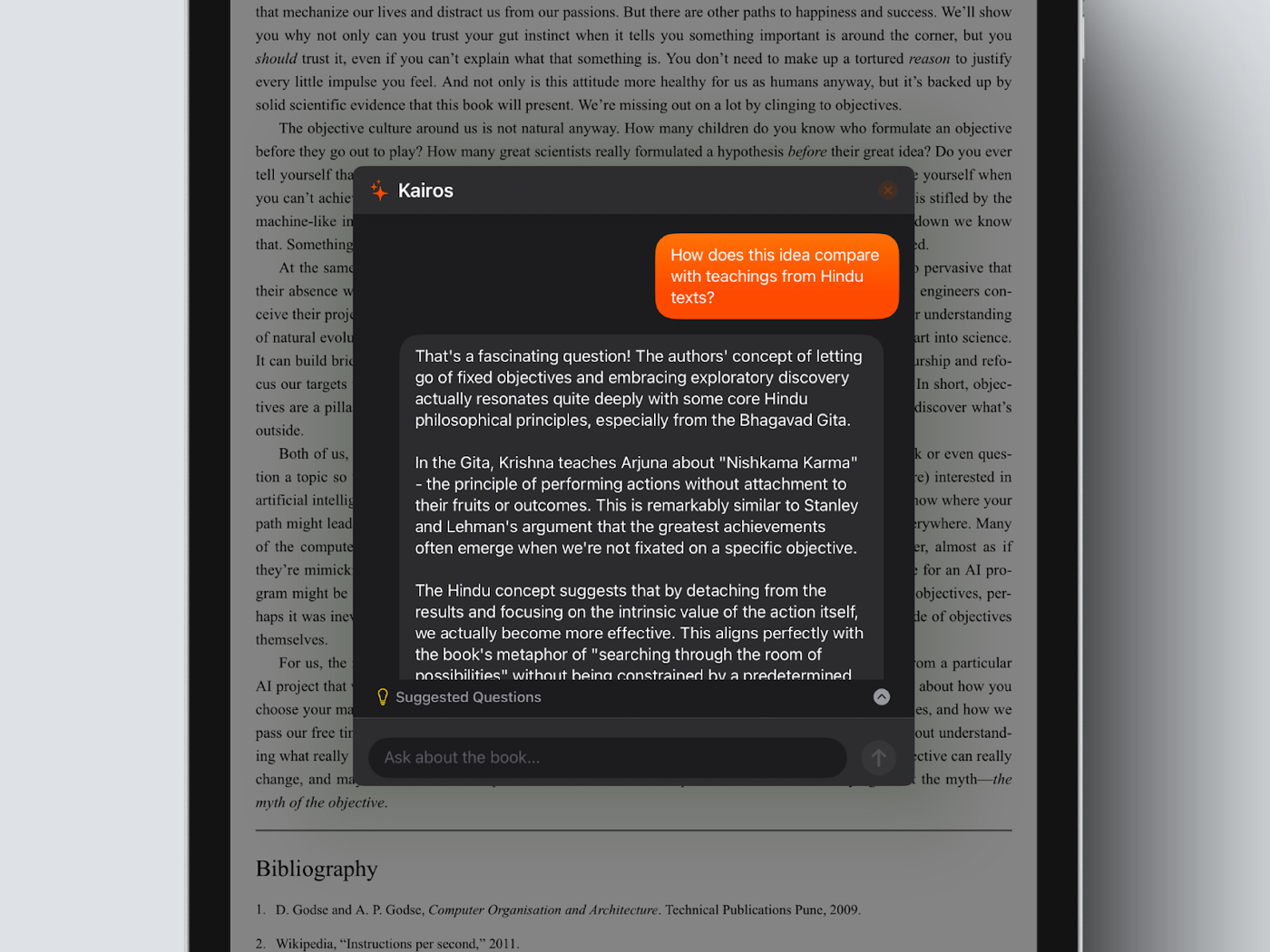
Syntopical reading is Adler’s highest level—the ability to compare multiple books, extract common themes, and develop original insights. It’s how scholars synthesize knowledge across disciplines.
To test AI's syntopical capabilities, I explored how seemingly modern ideas often have deep historical roots. While reading Why Greatness Cannot Be Planned, I was struck by its counterintuitive thesis about achievement and goal-setting. Through conversations with Kairos, I discovered fascinating parallels between the book's central argument and ancient Hindu philosophy.
For instance, when the authors assert that "sometimes the best way to achieve something great is to stop trying to achieve a particular great thing," I asked Kairos to explore similar ideas in Hindu texts. The AI immediately drew a compelling connection to the Bhagavad Gita's famous teaching: "You have a right to perform your prescribed duties, but you are not entitled to the fruits of your action." This parallel wasn't just interesting—it helped me internalize the book's message by showing how this wisdom has resonated across cultures and millennia.
What made this particularly valuable was how it transformed a contemporary argument into part of a much longer conversation about human achievement and purpose. AI didn't just find surface-level similarities; it helped illuminate how different traditions and thinkers have wrestled with similar ideas through different frameworks. Traditional reading often means relying on memory or manual research to make such connections, but AI removes that friction. By highlighting passages and asking comparative questions, Kairos turns books into participants in an ongoing intellectual dialogue, bridging gaps between ideas across time, cultures, and disciplines.
When books talk back
My experience with Kairos hints at something broader about how AI will change intellectual work. The pattern we see with reading—where AI transforms a traditionally solitary activity into a dynamic conversation—likely applies to other forms of learning and creation. The key isn't just making things faster or more accessible, but enabling new forms of engagement.
Critics worry that reading with AI will make people lazy—that we'll become dependent on AI instead of developing our own understanding. But this misses the point. Having a conversation about a text requires active engagement. You need to formulate questions, evaluate responses, and synthesize new understanding. It's the opposite of passive consumption. AI has the potential to make it much easier to achieve this deeper level of engagement.
The real challenge in the age of AI, then, isn't figuring out how to prevent people from using it so that some sort of pure, idealized reading experience is preserved. It's building tools that support this new paradigm effectively. Current e-readers are designed around the old model of solitary consumption. We need reading platforms that embrace the conversational nature of AI-assisted reading while respecting things like copyright and privacy.
Some might argue this isn't really reading anymore. But that's like saying having a discussion about a book isn't reading. The goal remains the same: understanding and engaging with ideas. AI just gives us new tools for doing so.
Centuries ago, the printing press democratized access to books. Digital technology has democratized distribution. AI might finally democratize the kind of deep engagement with texts that scholars and philosophers have practiced for centuries. That seems like progress worth pursuing.
If you're curious to explore this new reading paradigm, try Kairos on TestFlight and let us know what you think. Fair warning: This is very much a proof-of-concept with plenty of rough edges and missing features—think of it as a glimpse into the future of reading rather than a polished product. While I can't guarantee long-term support or regular updates, I hope it sparks your imagination about how AI might transform our relationship with books.
Naveen Naidu Mummana is an entrepreneur in residence at Every. He is the founder of software incubator Zeitalabs and previously led engineering teams at ThreeSides in Japan.
We also build AI tools for readers like you. Automate repeat writing with Spiral. Organize files automatically with Sparkle. Write something great with Lex. Deliver yourself from email with Cora.
Get paid for sharing Every with your friends. Join our referral program.
The Only Subscription
You Need to
Stay at the
Edge of AI
The essential toolkit for those shaping the future

"This might be the best value you
can get from an AI subscription."
- Jay S.
 Every Content
 AI&I Podcast
 Monologue
 Cora
Cora
 Sparkle
 Spiral
Join 100,000+ leaders, builders, and innovators

Email address

Already have an account? Sign in
What is included in a subscription?
Daily insights from AI pioneers + early access to powerful AI tools
 Front-row access to the future of AI
 In-depth reviews of new models on release day
Playbooks and guides for putting AI to work
Prompts and use cases for builders
In-depth reviews of new models on release day
Playbooks and guides for putting AI to work
Prompts and use cases for builders
In-depth reviews of new models on release day
Playbooks and guides for putting AI to work
Prompts and use cases for builders
In-depth reviews of new models on release day
Playbooks and guides for putting AI to work
Prompts and use cases for builders
 Bundle of AI software



 Katie Parrott

 Katie Parrott

 Kieran Klaassen
 Reviews of new AI models on release day
Comments
Don't have an account? Sign up!
I think this is one of AI's killer applications. It will take some time until applications like that become the mainstream. This is why I think some people still underestimate the impact of AI and how it is really going to change everything.
Omigosh, I'm so in. I can't wait to see this product out in the wild.
In a Skool community, there was a whole discussion on using ChatGPT to interact with books we are reading. This takes it to the next level. Well done.
Great idea to read with narrator second voice, thoughtful partner or a guide to assess you're assimilating concepts as you read (students).
Are there options for Android or Windows?
@kiowasol Not yet! Right now Kairos is iOS-only through TestFlight. As this is still very much an experimental proof-of-concept, I'm focusing on refining the core experience before expanding to other platforms
Such a cool idea! I think the fear that was mentioned about AI making people lazy, is the concern that some people will strictly rely on summarizing works into a manageable concentrated chunk of knowledge that fits their needs. This could be good (what is War & Peace about?) or maybe less good (my assignment was to read this book, instead I'm taking the shortcut, but missing the detail, color, mood, etc.). I look forward to AI integration in my reading tools.
@dbuchter Thanks Drew! You're right about the tension between shortcuts and depth. But I believe reading tools can actually shape behavior - if we design them to encourage deep engagement rather than quick summaries, we can build better reading habits. That's exactly what I'm aiming for with Kairos - not replacing reading, but making it richer and more meaningful.
This sounds amazing! Using AI to transform our reading experiences in ways we've never imagined. Count me in for updates on the Kairos project.
@@theotao thank you!
Love the idea. I find myself in these spots of passive reading. Downloaded the TestFlight and have downloadedr a book in it! Excited to read it with Kairos!
@ajay_3395 Thanks for giving kairos a spin. Drop me a note about your experience!
@naveen_6804 is it possible to make the reading part easy? Perhaps increase the text size to fill up the blank space on the side and top bottom. I find myself too much zooming on each page.
How to I request TestFlight access?
i read about Kairos ai application. it does promises a lot. but i am not able to test it. because i do not use apple products like iphone, ipad, mac, etc. i will wait till it becomes available for other products.
Amazing article, concept and early stage product. Pondering the future of this.
Imagine you keep each book with the context of all your conversations with you as an expert so you can bring it back over time when needed. For example: Chris Voss' book on negotiation. Love it but don't feel like I need it immediately. Occasion arises, now I wish I had the book and all my notes with me.
Another one, we all have stuff we read and some stuff is really good and deserves a special place in our library. What does this all in aggregate mean for us? What can it tell us about ourselves? Would it be easy to spot gaps in knowledge? For example: This could help one find new books to read whilst avoiding an echo chamber or one could maybe understand oneself at a deeper level than any personality test could ever.
It says new testers aren't accepted at this time. @naveen_6804 What's the latest on Kairos?
Is there anyway to get into the beta still? The TestFlight link says it’s full.
I have plans for similar idea I’ve been making notes on. Interestingly also reading how to read a book as it was recommended by my kindle unlimited subscription and has integrated complexity value to other topics iMm writing in and things I’m building.