





The transcript of AI & I with Brandon Gell is below.
Timestamps
- Introduction: 00:00:56
- Dan’s childhood dream—to build a Microsoft competitor: 00:03:36
- The first app Dan built in middle school: 00:07:07
- The story of Dan’s first company that he sold in college: 00:18:52
- How Every came to be: 00:33:56
- The start of Brandon’s journey as a builder: 00:49:15
- Brandon’s first software app—and why you should launch first, and iterate later: 00:57:05
- Everything Brandon learned from running a B2B business for seven years: 01:08:49
- What brought Brandon to Every—and the email he sent Dan before joining: 01:18:00
- Every’s master plan to be a successful creator-run business: 01:29:15
- Live demo of Spiral, the app that automates 80 percent of repetitive creative work: 01:38:11
- Brandon and Dan’s take on how AI startups can find a valuable niche: 01:44:00
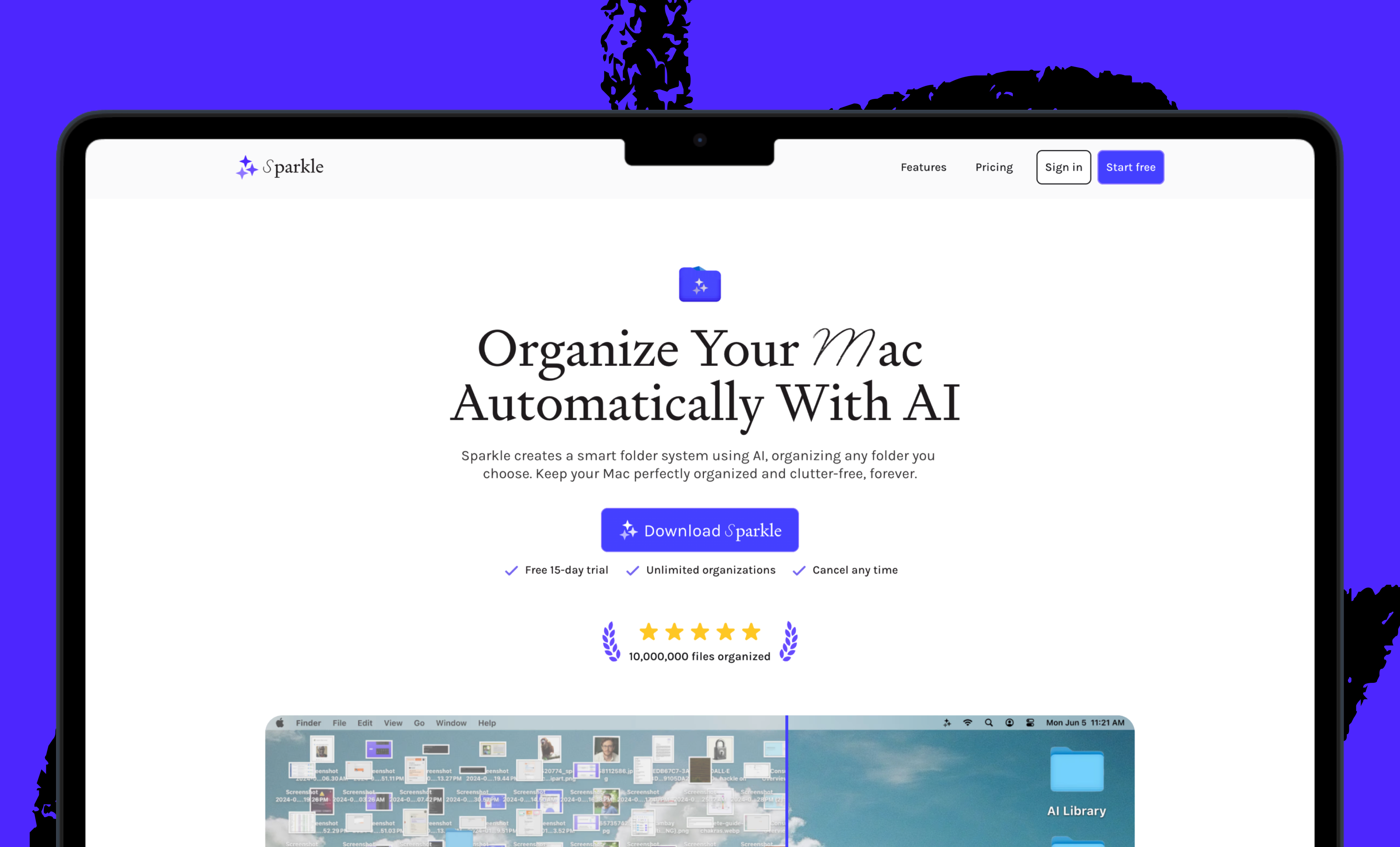
- Live demo of Sparkle, the app that organizes your files for you: 01:50:52
Transcript
Dan Shipper (00:00:57)
Brandon, welcome to the show.
Brandon Gell (00:00:58)
Thanks, Dan. Thanks for having me.
Dan Shipper (00:01:00)
So, for people who don't know, you are Every's very first entrepreneur-in-residence. You're also a really talented entrepreneur. You started an insurance tech technology company called Clyde about seven or eight years ago—you raised about $50 million. You had 100 employees. You sold it in March, right?
Brandon Gell (00:01:21)
Yeah. March 14.
Dan Shipper (00:01:22)
You sold it in March and then you joined Every and it's been kind of an amazing ride since you've joined. I feel like we've really, really accelerated everything we're doing. So I'm just psyched to have you on, psyched to talk about what you're doing with us, talk about everybody generally, talk about our relationship, because there's just a lot of cool stuff going on.
Brandon Gell (00:01:45)
Yeah, we surprisingly go pretty far back, actually. But, yeah, this has been kind of a dream come true for me, honestly. I've watched you go from Superorganizers to whatEver is today. And just having this creative playground has been an amazing opportunity.
Dan Shipper (00:02:08)
I love it. I love it. So, I think the way we'll structure this— This a little bit of a nontraditional AI & I interview because we'll do some AI use cases, but it'll be specifically around some of the products we've been building together inside of Every. But to get things kicked off, I thought we would sort of turn the tables a little bit and have you actually ask me a few questions so that I can kind of lay out Every, what it is, the background is, how we got to where we are today, and then I'll turn the tables back to you and you'll talk about some of the product work we've been doing, and demo some of the things we built.
Brandon Gell (00:02:42)
Yeah. Honestly, before even getting into where Every started, I feel like nobody actually really knows who Dan Shipper is, and the fact that you're this technical prodigy. And actually I don't even know if people know that you're really technical and build stuff, let alone sold a company at—whatever—14. So I feel like you should just give me the— I don't even know the full story, but I know you started a company in college, so maybe we start there.
Dan Shipper (00:03:16)
Well, I can also go back and— First of all, that's very, very generous of you. I love being gassed up like that. I'm gonna have to gas you up a little bit later, but I think technical prodigy is maybe stretching it a little bit. But why don't I go back, I think, usually where I start on this kind of line of questioning is when I started getting into tech stuff in general, which is when I was in middle school. I read a Bill Gates biography and I was enamored. I was like, I want to be Bill Gates. I wanted to start a Microsoft competitor and I was going to name it Megasoft. Great name, I know. And I actually still have the notebooks from that time period. And I had a whole plan for how I was going to start this company. And the plan was “Step 1. Write softly.” I didn't even finish software. Just write soft. Step 2.—
Brandon Gell (00:04:15)
“Write soft.” This was just— You wrote that in the notebook and it was just “write soft.”
Dan Shipper (00:04:19)
Yeah “Write soft.” Because I was going to build an alternative to Windows. That was my goal. So I was doing the plan. So write soft and then “Burn it to CDs,” because it was— I don't know if you remember— Do you remember the days when, in every grocery store, you could get a little AOL disc and then you would install it. So, I wanted to do that. And then the third step was “Distribute mailboxes.” Which makes sense.
Brandon Gell (00:04:54)
Sure. You're following a set game plan here that's been successful. It was really successful until it wasn't.
Dan Shipper (00:04:59)
Yeah. “Distribute to mailboxes,” and then the last step was “Wait.” And that was my whole strategy. But that's basically why I learned to code. Because I wanted to build this Microsoft competitor. And I made my dad go out and buy me a book on BASIC, the programming language. And I was sort of off to the races from there. I quickly realized that I was not going to build a Microsoft competitor, but I kept doing it because I was always interested in building businesses and being technical. At that point, it was the only way that I could build a business where the only cost was my time. So, as a middle schooler, it empowered me to build businesses where I could actually make money. And I thought that was the coolest thing ever.
Brandon Gell (00:05:45)
Yeah. I mean, I think that's amazing, as a middle schooler, that you were so obsessed with this. I was certainly not. I don't even think I knew what coding was. I don't even know what I was doing. I was like—
Dan Shipper (00:05:59)
Yeah, what were you doing in middle school?
Brandon Gell (00:06:00)
I was tossing a Frisbee somewhere. I was a very sporty kid.
Dan Shipper (00:06:07)
Yeah. See, I was not athletic at all, which may have helped me get into being technical because otherwise I would have been outside with friends.
Brandon Gell (00:06:16)
Yeah. I don't know about friends, but I was playing sports. And also I think it's important for everybody to know that you are, I mean, I don't know if you're actually still obsessed with Bill Gates, but we do do something at Every called “Think Week” once a quarter and I know that— And, I mean, I actually didn't know when I started here that that’s what Bill Gates used to call it when he would run away to a cabin. So, there's still that through line. He’s still inspiring some stuff here.
Dan Shipper (00:06:48)
Yeah. Still Gates-inspired. Have not unseated Windows yet, but there's still time.
Brandon Gell (00:06:54)
Totally. Yeah. Our next incubation.
Dan Shipper (00:06:54)
I think the next kind of stop on the trajectory is: I was programming for a while, I built a bunch of little dinky stuff that didn't really matter, and then when I was in late middle school, early high school, I started noticing that smartphones were becoming a thing. So, Nokia smartphones and BlackBerrys and that you could actually start to build software for those phones, like third-party apps. And I remembered from my Bill Gates days that new hardware platforms are often really good opportunities to build interesting software businesses. And so I got really obsessed with building software for phones. And this was before the iPhone came out, so there was no word app. It was just like BlackBerry software. And so, the first piece of software that I built was called FindIt. And basically I kept losing my BlackBerry in my house and it would be on silent and I couldn't make it ring. So, FindIt was a little app that sat on your phone and it listened for emails to come in with a special string in the subject line saying like, I'm lost, please help. And if you sent that email, your BlackBerry would ring, even if it was on silent, which I thought was the coolest thing ever. And I eventually sort of iterated that—it had a full-fledged web interface, you could track your phone on a map, you could lock it, you could back it up, you could make it call you, which was kind of a cool feature. And I had like a bunch of customers. It wasn't a huge business or anything, but it's how I paid for gas and food in high school. And I think what's really funny about that story is it was a one-time purchase. So, it was like $10 or $20 bucks forever instead of being SaaS because Stripe didn't exist. So, it was way-too-hard to build subscription software. And yeah, I would have had a lot more money if Stripe had existed when I was in high school.
Brandon Gell (00:08:56)
That's coming back, that form of paying for software, so maybe you were just really, really early to that trend. Well, I think that's— One thing that's been really cool working with you is I just think that being able to identify problems is actually really hard. Not because there's not infinite numbers of problems that exist, but because it's actually a muscle to recognize that something that you are experiencing is even a problem vs. just your experience—your lived experience. And I feel like that's something that I know that you're really good at, and it turns out you've been— It's a muscle and you've just been working on that muscle for a very long time. It's certainly a muscle that I'm still pretty early-stage and I sort of feel like a lot of the ideas that I sort of fall into vs. I feel like you have a bit of a practiced refined muscle of even identifying, okay, this a phone is a new platform that people will need to be able to build stuff on. It’s a new interface and yeah, it's pretty, pretty cool that you've been doing that for so long.
Dan Shipper (00:10:15)
Thank you. I really appreciate that. That means a lot. I've not really thought about the problem identifying muscle, but it definitely is a muscle. I mean, maybe it's partly my Jewish neuroticism. I’m just constantly complaining about things so I can see the problems. But yeah, it's been something that I've been doing for a while. And I actually just love looking at the world in that way. Because it makes me sort of think there's a way to look for problems in a way that's like, oh, this sucks. And like the world sucks or whatever. And then there's a way to look at the world and see problems and be, but we're empowered to fix them. And that always makes me really excited. Because I'm like, ooh, there's something new to do. I have a new project to do, you know?
Brandon Gell (00:11:03)
Right. There's also a difference between– So it's easier obviously to problem-solve something once you're put into a box. But it's really hard to identify what that box is sometimes. And so, I studied architecture in college and what I got really good at was being put into a box. It's like, hey, here's a building that we need to renovate or here's a space that we need to put a building on. And here's the box. And now we can think about all of these interesting ways to solve the problem within the box. But we never really were like, hey, go out and try to figure out what the box even is, because then you're just looking at the whole world and its sort of infinite possibilities. And it's really quite hard to define a box.
Dan Shipper (00:11:47)
I think you're totally right. And I think that’s, in general, one of the things that school doesn't give you. And I'm kind of happy that I didn't spend a lot of time doing side projects and stuff as a kid because I had to define the box because at that point there were no there— You couldn't even take a computer science class. There are no real business classes for kids, there's nothing on the internet. So it was just me kind of like being like, how can I do something that would actually work? And so I think that’s another skill— That's really interesting that you feel that way about architecture. One of the things that I think is really cool about architecture programs and people who have studied architecture is it's a very multidisciplinary thing. It’s sort of halfway between art and engineering. And I feel like you kind of incorporate that in the way that you think in the way that you build products and stuff like that. How has that sort of affected the way you look at the world?
Brandon Gell (00:12:39)
I think the biggest thing that I learned through architecture is just being iterative and not getting stuck on a solution. And, I was the type of kid growing up that would— If I had to write a paper, I'm writing one at a time and I'm not even editing it. I just wrote it and submitted it. And that's how I did homework. And then I went to college and I studied architecture and I was like, oh, I'm not going to get to the best solution if that's how I operate. My first design is going to be the worst—or the best. I won't know until I throw a bunch of stuff at the wall. And it would be a big mistake to try to get caught—or to get stuck—on what my first solution is. So just being comfortable, iterating a lot is probably the best thing I got from architecture and then being able to take critiques—a lot of criticism in architecture.
Dan Shipper (00:13:44)
Isn't architecture school really intense? They're yelling at you a lot and there's late nights and stuff, right? Or am I wrong?
Brandon Gell (00:13:55)
Yeah, there's a lot of studio time. I also went to Middlebury, a liberal arts architecture school, which was kind of a bit of a janky version of architecture. I wanted to be an industrial designer, so it was sort of a path to do that. But yeah, it was still pretty hard. And a lot of feedback—definitely.
Dan Shipper (00:14:15)
So the thing I'm kind of keying on, and the thing I'm interested in on the iteration front is: How are you taught to do that? Are they just telling you you have to do a lot—a lot of these things—or, what is the process by which you just learn to iterate?
Brandon Gell (00:14:32)
It's all sketching. It's just a lot of sketching. And, I really like computers and I was, from a very young age teaching myself video editing software and all types of video effects software and a ton of 3-D software and rendering software. And then I was like, great, I'll go to architecture school and be able to use that. And that'll be so much fun. So, freshman year, we had a project and it was immediately brought up on my computer and was like, great. I'm going to start rendering something and my teacher was just like, this is not what we do. You're going to spend the next quarter just sketching and drawing and I sucked at drawing. So it's just building muscle constantly. Looking at the world eyes wide open and being able to see interesting things, process those interesting things, draw them, take pictures of them, sort of store them away and then keep going forward. And not getting stuck on them because any sort of innovation that you have in architecture or even what we do is sort of going to be the amalgamation of a bunch of different inspirations that you've sort of pushed together. And when you get stuck on something, it's impossible to come up with something new. You're just going to end up coming up with a derivative of that thing that you're stuck on. So for me, it was just a ton of drawing and building the muscle of being able to let stuff go, flip the page, go for a walk, try to think about the next thing.
Dan Shipper (00:15:15)
I love that. I think it really also connects back to the thing you were talking about. For me, seeing the problems to solve, it helps you look at the world in a certain way. And I think that that's always the start to doing really great creative work.
Brandon Gell (00:16:32)
Yeah. And you're actually really good at that. A lot of times I'll see you go for a walk— And you've told that story of just talking to ChatGPT and using it as a recording device, but one that gives you feedback and that’s a pretty amazing way to let stuff go and then process through your stuff. I do want to go back to the fact that you started a company in college and talk a little bit about that. And maybe you could go off on what that was like.
Dan Shipper (00:17:00)
Totally. So basically, by the time I got to college I had built this first company. It was called— I mean, it wasn't a company, but it was a little business called Convenience Software and I had all these different apps or whatever. And then when I got to college that's when it was— In 2010 is when I got to college. And that was right around that time was when Facebook started to really take off. And the idea of web apps and software as a service apps and all that kind of stuff started to really take off. Stripe had just started. I actually had John Collison, the one of Stripe's co-founders, who needed to get a visa to stay in the U.S. and so he needed to do speaking engagements to show that he was legit enough to stay. And so he came to Penn, and I brought him to Penn, and he came and spoke to us and we went to dinner with him and all that kind of stuff. It was really awesome.
Brandon Gell (00:18:02)
Why has he not been on the podcast? You made Stripe possible, basically.
Dan Shipper (00:18:06)
John, if you're listening— No, I mean he used to try to— Actually we kept in touch. He asked me to join Stripe a couple of times, which I said no to, which was probably one of the biggest mistakes of my career. Now that he's a billionaire, he doesn't return my emails. So John, if you're listening, I love you, come back into my life. We'll have you on. I would love to learn how you use ChatGPT.
Brandon Gell (00:18:32)
I mean, he owes you. Basically.
Dan Shipper (00:18:34)
He does. Yeah. I should frame it that way.
Brandon Gell (00:18:36)
Yeah, he does. Anyway, he's a good guy.
Dan Shipper (00:18:42)
He's a good guy. Yes, So anyway, I just did a bunch of projects. I was working with a couple of different friends doing a lot of different things. But then, in my sophomore year, I decided I really wanted to focus on building B2B software. Because I was like, I want to learn how to build a real business. I want to learn how to build something that makes money from day one that I can grow from school that I can mostly bootstrap—all that kind of stuff. And I was on the phone with my dad and he was complaining to me. So, when you complain, it’s a good way to find startup ideas. He was complaining to me about— So, he runs a cemetery and funeral home company. And so he spends a lot of time— He's an entrepreneur himself, and he spends a lot of time on the phone talking about architectural diagrams and layouts—cemeteries and stuff like that. And he really wanted something where if he was on the phone, he was talking about a diagram that he had up on his computer and the person on the other end also had the diagram up. He wanted a grid to come down from the top of his computer screen, sort of like a battleship and be able to say, okay, look at cell E5, or whatever. And he was like, can you build that for me? And I was like, dad, that's dumb. That's a stupid idea. And–
Brandon Gell (00:20:07)
That's how most great ideas start, I feel like.
Dan Shipper (00:20:10)
But I told that to the people who ended up being my two co-founders at Firefly, which is the company that I started in college. And they actually built the first version of that at a hackathon at PennApps. We were working together on another SaaS product at the time. And they sort of took the weekend to build that. And at the hackathon a company came up to them and was like, we want to use this for our customer service. We want to integrate it so that if people have problems with our website, we can help them through the site. And so they came back and we were all talking about it and we were like, okay, do we do this or the other one, which was— The other one was email signature marketing. So it was like, you could put like a banner ad in your email and companies would have their employees put it in and advertise their products or whatever. And we're like, I don't know, it's hard to sell email signature marketing products. Why don't we just like to try this one?
Brandon Gell (00:21:08)
Right. You got a buyer.
Dan Shipper (00:21:10)
Exactly. That’s the first thing where you're like, oh wow, this is really cool. What's funny is they just let us on for six months and never actually bought it.
Brandon Gell (00:21:20)
Classic SaaS B2B buyer.
Dan Shipper (00:21:28)
Yeah. I had a lot to learn. And so we took a summer just renting a little apartment in Philly. And we worked on this product. And by the end of the summer, we had a really well functioning product. The product, that technology we built, is called co-browsing and co-browsing is sort of like screen-sharing, but instead of sharing what's on a desktop, you share what's on a web page. And it doesn't require any downloads or installations. It's all JavaScript based. And it's cross-platform. So you could be on a PC or a Mac or an iPad or whatever. And we've applied the technology to customer service. So if a customer is having a problem with the website, we allow the agent to— Basically whoever they're talking to on the phone or over chat to basically look over their shoulder, see what they're doing on the website in real time and help them through the site in real time. And it was a very, very cool technology. And it was incredibly hard to build. It's very, very difficult to make it work cross-platform and cross-browser and with any kind of update or whatever. And it had to work back to Internet Explorer 8. So I can't even tell you the late nights that I spent with my co-founders, trying to fix some random bug in IE8 and on some customer's website. Truly traumatic. But we basically ran that business for a couple of years, got a bunch of customers, got a bunch of traction, especially for where we were. Because we didn't take any money. We raised $20,000 in total from the Dorm Room Fund, which is a first round capitals— We were the first investment of the Dorm Room Fund. And then we sold the company to Pega, which is a big public enterprise software company. And they have a big CRM that they sell to banks and insurance companies and they wanted— But it’s a five- or 10-year sales process for them that takes it to a $10 or $50 million sale. And they wanted a cloud solution that they could sort of sell as a tip of the spear into those companies.
Brandon Gell (00:23:42)
And how old are you when, when they approach you and say, we want to buy this?
Dan Shipper (00:23:46)
I was 22 when they approached me, and I was 23 when we sold it. I flew from my college graduation to Boston to finish negotiating the deal.
Brandon Gell (00:23:57)
And put us in that room. You're 22, you know nothing, basically. I mean, I started my company at 22 and I knew nothing. So, you knew a little bit more than me, but relatively nothing. And so, you're in that room. I assume you had a lawyer.
Dan Shipper (00:24:15)
I mean, we definitely had a lawyer during the negotiations. I'm thinking about, yeah, I mean, honestly, I haven't thought about this in a long time. But it was basically the way it all happened is part of the way we got traction for the business. We sold this co-browsing tool to companies that had big platforms like chat platforms or CRM platforms, they would integrate it into their platform, and then sell it to their customers. So we were kind of an OEM into other big platforms. And basically what had happened is we were working with a couple of partners and one of them was like, hey why don't we just buy you? Because, we want this as part of the platform. Instead of integrating, I wanted to just buy the company outright. And that was a really big live chat customer service company. And we kind of went through the diligence process with them, which was like, freaking— It was wild. I remember—
Brandon Gell (00:25:25)
You're in college at this point, going through finals and stuff. Did you even care about schoolwork? Or is it nothing compared to, I'm selling a company right now. This is crazy.
Dan Shipper (00:25:36)
I did. I like school. I majored in philosophy. And I wanted to be really well read. And so the really fun part of majoring in philosophy is you just read tons of books. And I actually thought there was a lot of overlap between philosophy stuff and entrepreneurship stuff. Because at the time, the big methodology for starting companies was the lean startup, which is a startup is like science. And, for example, some of the things that I was really into in college philosophy-wise was philosophy of science, which is like, what is science actually? And so if you want to do a lean startup and you're hypothesis testing or whatever, then you're like, oh wait, but how does science actually work? We should take that metaphor really seriously. And then you're like, well, then you're just reading—
Brandon Gell (00:26:21)
For the listeners out there, Dan reads the hardest books to understand that are simultaneously super interesting and so boring and he just loves them.
Dan Shipper (00:26:35)
I do. It's my happy place to read extremely boring, extremely fancy books for some reason.
Brandon Gell (00:26:39)
This is my nightmare.
Dan Shipper (00:26:44)
I know.
Brandon Gell (00:26:48)
If I'm not reading a Three Body Problem-style book, it's like—
Dan Shipper (00:26:52)
Look, I'm just taking one for the team, you know. I read it so other people don't have to.
Brandon Gell (00:26:55)
Yeah, definitely. Someone's got to read them.
Dan Shipper (00:26:57)
So, back to that live chat company. They were very, very serious. I went in to negotiate that deal—again, still in college. And, we were in their lawyer’s offices with, you know, the glass that’s electrified, so it gets frosted automatically when you go in and then it defrosts itself. So I was in one of those and the head of a biz dev guy came in and he's just a really intimidating, intense Israeli dude who rides a Harley and he plugs his laptop in and I'm trying to remember the exact words, but he had his Evernote up by accident. And I can't remember the exact words, but it was like something like “be aggressive, letting them know that we have other options.” It was something like that. Tell them that they suck and that we have other options.
 Create a free account to continue reading
The Only Subscription
You Need to
Stay at the
Edge of AI
The essential toolkit for those shaping the future

"This might be the best value you
can get from an AI subscription."
- Jay S.
 Every Content
 AI&I Podcast
 Monologue
 Cora
Cora
 Sparkle
 Spiral
Join 100,000+ leaders, builders, and innovators

Email address

Already have an account? Sign in
What is included in a subscription?
Daily insights from AI pioneers + early access to powerful AI tools



 Front-row access to the future of AI
 In-depth reviews of new models on release day
Playbooks and guides for putting AI to work
Prompts and use cases for builders
In-depth reviews of new models on release day
Playbooks and guides for putting AI to work
Prompts and use cases for builders
In-depth reviews of new models on release day
Playbooks and guides for putting AI to work
Prompts and use cases for builders
In-depth reviews of new models on release day
Playbooks and guides for putting AI to work
Prompts and use cases for builders
 Bundle of AI software





 Rhea Purohit

 Dan Shipper
 Reviews of new AI models on release day
Comments
Don't have an account? Sign up!