





The transcript of AI & I with Nabeel Hyatt is below. Watch on X or YouTube, or listen on Spotify or Apple Podcasts.
Timestamps
- Introduction: 00:01:32
- Why Nabeel doesn’t invest in more than two companies per year: 00:01:50
- Why the words you use to describe your business matter: 00:06:49
- What does a product with soul look like: 00:13:45
- Patterns in the remarkable founders Nabeel has invested in: 00:16:48
- How Nabeel evaluates popular coding agents: 00:24:12
- AI has broadened the horizons of what Nabeel can do: 00:32:29
- How funding models are changing as AI makes it cheaper to build software: 00:36:28
- Nabeel’s framework for when to trust an LLM: 00:45:43
- Guide AI to provide context (and not just quick answers): 00:55:39
Transcript
Dan Shipper (00:01:32)
Nabeel, welcome to the show.
Nabeel Hyatt (00:01:33)
Good to be here.
Dan Shipper (00:01:34)
So for people who don't know you are a partner at Spark Capital.
Nabeel Hyatt (00:01:38)
That's right.
Dan Shipper (00:01:39)
You've made a bunch of impressive investments including in Cruise, Discord, a very recent one is Granola. And before we started, you said something I didn't know about you, which is that your investing strategy is not prolific. You only do a couple a year. Why is that?
Nabeel Hyatt (00:01:57)
First of all, I just think that— So, I was a founder before becoming an investor. And I found that I had no horror venture capital stories that sometimes investors have or entrepreneurs have. But I also basically had a bunch of no ops. I had investors that were fine and great board members and maybe offered a random piece of advice, but weren't in the muck enough and in the nuance enough to give good feedback because they were investing in 15,000 things.
Dan Shipper (00:02:25)
What does “no ops” stand for? No opposition?
Nabeel Hyatt (00:02:28)
Yeah. They were just fine. There was no damage. I don't have a horror story, they did no harm, but it was also like, would the company have been exactly the same if they were not there? Probably. And there's a thing on our website that I think we collectively believe at Spark, which is that there aren't really any startup playbooks. I think as a founder you're doing something super unique with Every, so you probably already believe there's really no playbook for what you're trying to do, but generally every single journey is unique and the devil’s in the details. And so I think for me, the proxy is if you're a startup CEO or running a small org, you can manage eight or nine direct reports where you kind of understand everything they're doing. And outside of that, the edges get fuzzy and it's just the same thing. I want to work with eight or nine or 10 companies really closely as much as a founder really wants me around and I go away if it's not. And so you try to make the rest of the math work and construct life about the way you want to live and then see if you can make it work vs. letting somebody's financial or business model force you into working on what you don't want to work.
Dan Shipper (00:03:43)
I like that. I mean, I think it takes some balls. It's better than I think, obviously, the sort of spray and pray, small checks into a lot of things, that's a well trod strategy. But taking enough risk to be concentrated and to actually call your shot is, I think, quite cool.
Nabeel Hyatt (00:04:05)
Well, spray and pray even on the front end. I mean, basically the whole venture capital industry, since I joined—I've been doing this for a little over a decade now—is basically doing that at both ends of the spectrum, right? You've got the, I'm going to write $100,000 checks into a million things. And then you have the, well, if I raise $100 billion, then I can own a proxy of the whole market firms, which is like a lot of our peers that started there at the same time we did. That's been their strategy to mitigate risk over time. And I'm like, look, the whole point of this thing is risk—accept the risk and go do the work you want to do with good people.
Dan Shipper (00:04:37)
That is interesting. Something about what you said about doing something unique triggered something for me. I think you'd have good thoughts on this, which is I feel like I've been grasping for words for how to describe what Every is for a while. And I think that that's a really interesting place to be because we're doing something that's working and there isn't yet a word for it. The closest thing I've come up with is “multimodal media company.”
Nabeel Hyatt (00:05:05)
Wait, what was the other idea you had a little while ago that was not good?
Dan Shipper (00:05:15)
Malleable media.
Nabeel Hyatt (00:05:16)
That's terrible.
Dan Shipper (00:05:17)
Meta media. Multimodal media is my—
Nabeel Hyatt (00:05:18)
I like multimodal media.
Dan Shipper (00:05:20)
But there’s a lot of m’s in it, which is a problem. So like it's multimodal publishing maybe? I don't know. We're working on it, but the point is we publish writing, we publish videos, we publish podcasts, and we publish software.
Nabeel Hyatt (00:05:30)
But that's of the time, right? Publishing software is a lot closer to publishing articles in 2025 than it was 10 years ago, right? That’s a new thing.
Dan Shipper (00:05:40)
Yeah. So there's not really a word for it. So I'm trying to figure that out, but there's this interesting thing where I'm realizing that working on something that I don't have a word for is actually really valuable and really cool, especially because it's starting to work. But then there's also this trap that I think you can get into sometimes. And I've definitely fallen into this too, where it's like, you think you don't have a word for it, but there is actually a word and it's been done a lot before. And you can't fool yourself.
Nabeel Hyatt (00:06:11)
Do you have an example of that in your head?
Dan Shipper (00:06:15)
I don't have a specific example off the top of my head, but I don't know— When we started Every, for example, we were like, oh, this kind of media company has never been done before. We wanted to be a bundle of different newsletters. And like, it's a magazine.
Nabeel Hyatt (00:06:31)
A bundle of newsletters is a magazine.
Dan Shipper (00:06:35)
Yeah. And so, there were some things that were different about it, but about a year or two in, we realized that all of the complexity that we had built into the model didn't need to be there, and the way the newsletter worked was sort of like a magazine.
Nabeel Hyatt (00:06:49)
That's the tension, though, in anything new, which is like, of course it proxies to something that's pre-existing. Of course it proxies something that— But if you then adhere— Did something change in you when you start calling it a newsletter? Because that's also a trap. The early days of— We were an early investor in Postmates and back in this on-demand lane you had Postmates and Uber and DoorDash and Lyft and the Twitterati looks at that and is like, that's just a delivery company. That's the same thing as a taxi company. And yet, if those founders had internalized that and just been like, yeah, we're just a taxi company, you just wouldn't have done any of the things that you ended up doing over time. And so, I think the definitions really matter if you're doing something new, which I think you are trying to grasp for something new right now. I would find the weird words that are capturing that essence inside of you, right?
Dan Shipper (00:07:54)
I think for me, actually calling us a newsletter was quite freeing because we were doing all this complicated stuff to not just be a newsletter. And then once we just dropped it and it was just like, no, it's just a newsletter. And it's a bunch of creative people writing stuff and we're going to do interesting stuff. We just don't know what it is yet. But for now we're just going to write, because that's what we love to do. That was really helpful because I think what's been quite important for me entrepreneurially is to start to be really comfortable with whatever it is that I authentically believe in and want to do as opposed to triangulating between what I believe in, what I think will sound okay, and what I think I can justify basically. And thinking like being able to say, no, it's a newsletter and I'm going to write a lot was an expression of that. That's what I want to do. And everything else flowed from that. And then we found some new stuff that we're doing that is like, oh, I can't really describe what this is, but it's really cool. And there's this creative soup happening and I'm really excited. It's so fun. So yeah, obviously, in entrepreneurship in general, there are no hard and fast rules. Sometimes you don't want to call yourself a newsletter because you want to find the magical thing, but you don't want to force it.
Nabeel Hyatt (00:09:04)
Yeah. And the irony of this conversation is that what you're doing to find what you really want to do is a little bit rooted in the past, but also this awkward new thing you're now trying to describe. And then, what I found that I really want to do is also anachronistic, but because it's the old way of venture capital used to be like, I just want to invest in a handful of companies, work really close to those founders in a smallish firm where I trust my partners. We all work together on something. There's only seven of us on the venture team at Spark and that was how Sequoia was 40 years ago, and it worked well, it's just not the way people are building firms today.
Dan Shipper (00:09:40)
Yeah, what does that do now that the ecosystem is these gigantic megafunds that look at seed investing as loss leaders for big growth rounds? How are you thinking about how that changes—or it seems like it doesn't really change what you're doing, but how does it affect your approach?
Nabeel Hyatt (00:09:57)
I think an important start of this is we're still good citizens with all of these players as well. You end up co-investing with people.
Dan Shipper (00:10:07)
I really wanted you to shit on them.
Nabeel Hyatt (00:10:10)
I know. I was like, I must hold back slightly. I think those firms are a viable strategy. I think they are a different product. And as long as a founder understands what product they're buying, then I'm super happy with all of them existing in the ecosystem. I think the things that make me frustrated is when I'm in a conversation, sometimes it's with the current founder. I'm on the board of this company, they're going out to raise. So nevermind I'm competing with them. They're going out to raise a Series B or a Series C and. And the stories they're being told by investors about what the product is without going through the whole— It's just not entirely true. You cannot be investing five times a month and operating out of a $10 billion fund and get anything more than a random phone call every four years on a thing. And there are firms that are very good at being transparent about that transactional relationship. You get the money and you run away. I think actually Founders Fund is very good at being pretty transactional. I mean, they’re very honest about this. And there's lots of other people that do a lot of storying around what they're selling. So as long as people know what they're buying and what they're selling, it's fine. We sell a different thing. And for some founders that's really important and it's wonderful and they want that process and some don't—you have a connection, a kismet with anybody or you don't. And we work on those things.
Dan Shipper (00:11:40)
That makes sense. Well, I want to talk about one of your latest investments, which is Granola, which is one of my favorite AI products. And I think it's becoming one of everybody's favorite AI products. We've had Chris on the podcast. Chris wrote an article for Every that did really well. It's like really amazing stuff. I think he's super talented. What did you see in that when you invested? Well, when did you invest? Was it before they had the product they have now? Or was it after?
Nabeel Hyatt (00:12:08)
So I've known Chris for over a decade. Chris was a founder of a company called Socratic back in the day, a kind of previous AI generation. And that was actually a Spark portfolio company. And so he's been part of the family for a really long time. And his first attempt at making this—as he'll talk about now—was a little bit of a misfire. So he got to notes as a canonical thing that you can work on. But it was very interruptive and the use flow without going through it all just wasn't the thing. It was like the place to play, but not the thing. And so I hung out with him a bunch at seed. We played and talked about product and looked at early prototypes and so on and so forth. And, for us, it just wasn't over the line, and so he did raise a seed from somewhere else. And then we just connect with certain people, and so we just kept in touch. And then probably about four, five, six months—something like that—after the seed, he stumbled into what is now Granola. As soon as you play with that, and if you have any taste or product sense, you're like, oh, this is the thing. That's great. Let's go. And so we then catalyzed around really quickly at that point.
Dan Shipper (00:13:25)
And that was a big round, right?
Nabeel Hyatt (00:13:28)
I don't know what big is.
Dan Shipper (00:13:30)
It was like $20 million, right? That's pretty big.
Nabeel Hyatt (00:13:32)
The thing that felt so unique— And I know you're somebody that— I listen to your podcast. We've caught up a bunch. I know you're somebody that struggles with it as well, there's a— I don't know. Rory Sutherland says there's like three types of innovation and his canonical way of talking about the world, which is, there's faster horses and which, obviously, just make the thing go faster. And, then there's teleportation, which is this thing that you don't know. You want it to exist, you don't know how to get there. But if I tell you you want teleportation, you want teleportation. Everybody wants teleportation. Should we have a colony on Mars? It'd be awesome! I don't know how we're gonna do that. And then there's Japanese toilets, which is like, you didn’t know you needed Japanese toilets in your life until the first time you went to Japan and you’re like why isn’t this everywhere? And it’s not even that complicated. And that’s Granola.
The thing is it's not like the execution is actually really subtle. It's really hard. But I think for me, the things I'm wandering around and trying to find are the Japanese toilets of AI. The faster horses are mostly what's getting funded. It's mostly what's come out of this B2B SaaS big industrial machine that we have in venture capital is churning out startups after startups and incubator after incubator and most of that stuff is fine and it'll also be arbitraged out of existence in four years and who cares. And so mostly I am looking for mostly new experiences, things that surprise you with the place that they're playing. And so, for me, when I use Granola, I’m like, oh, this is so intuitive. It's the 50,000th AI note taker. Did the world need another AI note taker? It's like, yes, except I didn't want to use any of those other AI note takers.
Dan Shipper (00:15:36)
Ugh. When Fireflies joins my Zoom meeting, I never let it in.
Nabeel Hyatt (00:15:42)
Oh the anger. The immediate anger. And whereas this is just like, no, it just basically looks like Apple Notes. And it's just going to append a little extra to the things that you took notes on and make you a little smarter along the way. Yeah, that's brilliant.
Dan Shipper (00:15:55)
How do you think you become someone who makes a Japanese toilet vs. a faster horse? I was talking to Chris about the way he thinks about the soul of a product and the way his intuition works and all that kind of stuff. And I'm kind of curious. I assume you've invested in other people that have that same kind of archetype. What have you learned about that?
Nabeel Hyatt (00:16:19)
Yeah, there's a similar journey to Andrew Mason of Descript. There's a similar journey to an investment I did that was just announced recently called Wordware. They have a similar milieu, which is very different from, I would say, Kyle Vogt at Cruise. That's an example. That's a teleportation pitch. That's self-driving cars—amazing, probably impossible. Can you do it? That's a very different kind of pitch.
What are the habits of those kinds of founders or what are the journeys that they're on? I would say that the remarkable thing that comes out about a person like that usually comes out when they're talking about how they got to whatever solution that they're talking about. What is the right answer here? What's the authentic answer here? Why is Chris or Andrew really special? I'm trying to think about this through the lens of when those kinds of founders come into our firm, you can feel it in the room. It's not just me. The whole team, and this is partially because we cast for these types of people, but the whole firm rallies pretty quickly. And so what are the patterns in that pitch? It's usually that they are telling you insightful reasons why they put things into the product that you would have never normally thought of from customer development calls.
Dan Shipper (00:17:54)
So it's some combination of storytelling and attention to small details in a way that levels up into something that makes all make sense together?
Nabeel Hyatt (00:18:02)
Yeah. There's some connectivity between the choices a person made in the product that you can feel and some insight about a customer. If they're listening very, very closely to the behavior of what’s happening. And so in Chris's case, it's just noticing, for instance, the very first version of Granola was a tab complete, almost like Copilot, right? So you type a couple words in, and you type tab, and it starts filling out. Seems actually kind of magical when you first look at it. But if you just like listen to yourself closer, if you're self aware enough closer, especially if you're the user of the product and you're your own customer, you've realized I'm kind of super distracted in this meeting because every time I press tab, it fills out things and it makes an error and then I want to correct the error and now I'm not paying attention. I'm making eye contact. It's not why I'm on this zoom call. It’s not brilliance. It's not even creativity in a canonical definition of creativity where you come up with 15,000 ideas. It's more like investigation—
Dan Shipper (00:19:18)
A word that's coming to mind is sensitivity. You're sensitive to what's actually going on. You’ve got your hands like all in the milieu and you can kind of feel the changes in the weather patterns or something like that.
Nabeel Hyatt (00:19:27)
Yep. Yeah. The spectrum scale is like how much kinetic energy do you have? Because you have to move very fast. But we all know people that are just all horsepower. They're just kinetic energy. They're the people that are like, I want to start a startup. And the way I'm going to start a startup is I'm going to come up with a new business plan every single day for the next three months until I find the right thing. And I'm going to push it to that. And that's good kinetic energy without a lot of sensitivity. They're trying to plow through the problem. They are very, very uncomfortable with the fog of war, with wandering in the wilderness to find the thing. So the opposite spectrum is sensitivity. And the problem is that sometimes if you go too far on the sensitivity side, then you're the artist who just has absolute analysis paralysis. You just think and think and think and think and think and think and think and think and think and think and you, and it's just too slow. Your iteration cycle is too slow. And again, you're trying to solve by listening closely—that fog of war. You're trying to just listen to every single animal in the forest to figure out how to track it before you walk in. I think those types of founders you're trying to sense for are, they have a pronation to movement. They will move, but they will move while still listening.
Dan Shipper (00:20:55)
I love that. That's beautiful. Tell me about Wordware because I have a feeling that there's something very spiritually aligned between Wordware and whatever it is that I'm doing.
Nabeel Hyatt (00:21:05)
Really? Yeah. So I'm not diving into Wordware until you start answering that. What do you mean?
Dan Shipper (00:21:10)
Well, I've been thinking a lot about, okay, what does it mean to be a multimodal publishing company or media company? That kind of thing. And the way that I've been thinking about it is, as you can start to code in English, writing is building. And I think the opposite is true. Building becomes— At Every, it informs all of the writing that we do. So there's just like sort of feedback loop. and usually in most organizations you have builders over here and writers over here, or they're in totally separate organizations and at Every there's a lot, a lot, a lot of overlap because all of our EIRs, everyone that works at Every, they write articles. They don't just write articles, they write code by writing prompts. And so if I have to pull on that thread a little bit, the commonality is writing, but underneath that is storytelling, having a perspective and bringing a perspective to the medium or the craft, the thing that you're doing, whether the output is actually writing, whether it's podcasts, whether it's building. And so that's like the unifying thing between all of the different parts of the organization and something about Wordware, the way it's phrased, just expresses that really cleanly.
Nabeel Hyatt (00:22:30)
It's certainly trying to put people in the role— Wordware is certainly trying to open up the idea that everybody is a maker. And that you should— It's still really frustrating to me that—and I'm sure you bump into this a lot—nobody's really using Cursor and Windsurf and Replit agents and Claude for code and all of these things. I had a random— Look, during lunch today, I made an app. I had 15 minutes and I was like— Somebody had tweeted out a couple of days ago, the right way to structure 01 prompts. You probably saw this tweet, right? Seems great. So I took a whole article on that and I just shoved it into a Replit agent and I was like, here's your PRD. Make me an app so that I can just write here and then pitch to Claude to give back an expanded product. Took 15 minutes. It was while I was waiting for my next call. And that's nothing that would even pass through my head a year ago.
Dan Shipper (00:23:35)
That's the thing, writing is building, but software is now content. So, one of the really cool things is, we just launched this app called Cora. That has 10,000 people on the waitlist. Those are all now Every subscribers. You can't write an article that's gonna get you 10,000 new subscribers. But you can write software that does. And that's incredible. But yeah, I interrupted you. Where were you going with that?
Nabeel Hyatt (00:23:57)
So, anyway, I think, the vast majority of people, just simply if you sit down and show them Replit agents, which is a great, brilliant product—Michele’s amazing.
Dan Shipper (00:24:10)
I've never used it, actually. I used Replit a lot a year ago-ish and, but I have not used their new agent stuff. How do you compare it to a Cursor Composer or Windsurf?
Nabeel Hyatt (00:24:24)
I think it's in the same category. These are direct competitors. If you put a spectrum on all the coding agents today, the spectrum I would put on them is basically how long are they allowed to work before they ask for feedback. And so if we're starting at the low end, you have Microsoft Copilot, which is trying to finish one line of code. And on the other end of the spectrum, you have Devin, which is trying to run away for four hours. And I actually think when I talk to people today, when we're going through product sessions and I'm working with teams about this, on whatever they're trying to innovate on, that’s the spectrum I first start from, which is like, hey, for whatever problem you're trying to solve, let's try and think about what is the reasoning of our current SOTA models. Let's think about how long do you think you can leave them? How good are your evals internally? Because if you can evaluate longer and better, and how good the code base is, you can let it work for longer. So how good are your evals internally? And then let's set a mark. Are you letting this thing go for an hour? Four hours? Three days? One sentence? Three days? 16 seconds? … based on whatever you're trying to solve. And that's a really interesting new heuristic. I found a couple of different product innovations from startups I'm working with come out of literally just that thought exercise.
And so I would say the interesting thing about Replit is it generally works far less than Devin. For most people, they find Devin breaks a lot, unless it's very specific. It's a little slow. It will be an amazing product over time, they've made a long bet, but right now, they probably set the mark a little bit too long on how long they should go. I find, for me, Replit agents even though the models probably aren't as smart and so on and so forth, the kind of time variance they give before they come back and ask questions is a little bit longer than Windsurf, a little bit shorter than some others. They just set the right— Michele, who was the head of AI there, now the president, just did a great job setting a variance and really that sounds simple. They do a bunch of really other good things about the product that I won't get to right now.
Just literally that—setting the right altitude of reasoning is everything for getting really good results out of it. Because they're all using— Well, most of them are using Claude in the back end anyway. It's all Claude and full disclosure, we're an investor in Anthropic. Love it. Build more things on top of Claude. So I'm going to loop that back to Wordware.
So Wordware is starting from a different orthogonal, which is what do I have to give this thing for it to be able to understand what I really mean? And it turns out if you open up Windsurf or if you open up Cursor or if you open up Replit agents, it's a chatbot. It looks like a chat window. And so what is the normal thing that a person who doesn't talk to ChatGPT or Claude all day long like you and me do, they type in one, three sentences, two sentences, which is like plenty just enough room for a model to hang itself. It's exactly the wrong amount of information to give a model to go then code and make a bunch of things.
Dan Shipper (00:27:40)
That's the thing is I find with the Windsurfs or Cursors of the world, the agent experience, it will just start without‚ I kind of wanted to start in a, we're going to define together a little bit more precisely what I actually mean before you start coding, but it just really just starts the code. Often, at the end of the initial prompt, I'm like, if anything is unclear, ask me questions before, which helps.
Nabeel Hyatt (00:28:15)
My other very common prompt there is: give me five ways to solve this. I would say every second or third prompt into one of these coding agents is, give me five options so that it doesn't run ahead.
Dan Shipper (00:28:25)
And so is Wordware like a Google Docs instead where it's like a little, a big empty sheet of space? And then does it prompt you with how to fill that in?
Nabeel Hyatt (00:28:40)
Yeah, there, it is working on that as a second stage right now. Right now, the way it approaches you— I would say the first big trick it does, that's very simple, is by approaching with a blank doc. Maybe there's a commonality between Descript and Wordware and Granola that I think has blank sheets of paper. There's something about a blank page, man, that then AI helps you fill out. But, Wordware, literally the conceit of, please just write down in plain English the way that you would maybe write a long email to an engineer on your team about what you want built. Let's start with that. You can already imagine. Your brain can do all of the things that Wordware is going to do over time, which is right now you have to do @ symbols to call different functions and say which inputs and outputs you want. And honestly, Wordware and the founders would say this. It's a little overly technical today, but the thread that they will pull with their customers over the next couple of years, and this is why they're seeing so many people use it right now, is that once you have that blank page filled, it's pretty easy to then learn the syntax of how to use Wordware, how to call certain functions, how to fill it out, and how to really build like a usable product.
Dan Shipper (00:29:55)
And is it intended for programmers, or is it intended for PMs who took a coding class in college? Or is it intended for an 18-year-old who's never coded before and it's just like, I want to get—
Nabeel Hyatt (00:30:05)
I would say today's level of functionality is very good for somebody who is just slightly technical. I don't think you need to have been a coder, but it is better if you understand what an input is and an output is, and you think in if-then statements just a little bit. That's going to help you an awful lot. That stuff gets glossed over time pretty easily.
Dan Shipper (00:30:29)
Going back to that agentic spectrum— It sort of reminds me of those dogs with the leashes that extend out. How much leash do you give? How do you find the right setting? Are you just trying different things or, when you're working with people, how do they find that sweet spot?
Nabeel Hyatt (00:30:52)
Oh, isn't that the wonderful journey that we're all on with AI that changes every quarter. I have a company right now that will go nameless because they're about to release a pretty awesome new thing that actually had an aha moment relatively recently about this, that they've been in AI for a while, they're doing really well. But they realize that it’s a short-leash product. And they kind of had the epiphany a month and a half ago. Oh, these models are good enough that if we just stitch them slightly differently, what would a longer leash product version? It's not just that it thinks differently. It's like, oh, that makes different demands of the UI and the UX. It's just a different thing.
The whole flow is a different flow and it'll feel like a different product.
Dan Shipper (00:31:40)
Try it out, see if it works, and then in three months when a new model comes out, try again.
Nabeel Hyatt (00:31:45)
Yeah, if you aren't reevaluating, how would I destroy my own startup six months later, every six months, right now during this Cambrian explosion of stuff, that's the way you have to navigate things today.
Dan Shipper (00:31:54)
Have you gotten o3 yet?
Nabeel Hyatt (00:31:56)
I do not have o3. We have somebody on the team who has o3.
Dan Shipper (00:31:58)
What did they say? What are the early early signs?
Nabeel Hyatt (00:31:40)
That is not a conversation we're having. Not my place
Dan Shipper (00:32:08)
Okay I had to try. I had to try. Okay, and then, I know you're playing around with— So you're doing a lot of work with these coding agents and thinking a lot about agentic workflows. What else are you learning or what else are you excited about in that whole space?
Nabeel Hyatt (00:32:28)
Well, the first thing that I've noticed in my own behavior over the last six months, and this is definitely how you're running Every, is because we can code so quickly and make so quickly, we just make so much more. I am simultaneously working harder on Spark than I've ever worked. And also, I'm building a card game with my kids. I'm also opening a board game library with a handful of friends. It's not just code. I'm opening a fricking retail space. We'll see if that works at all.
Dan Shipper (00:33:05)
For board games?
Nabeel Hyatt (00:33:10)
Yeah, for board games. It's called Tabletop Library. It's a private library for people who play board games together.
Dan Shipper (00:33:13)
Where is it?
Nabeel Hyatt (00:33:20)
It’s in Berkeley—of course it is. It's on a block in Berkeley. The other things on the block are a science fiction and fantasy bookstore and a comic bookstore. It's the nerdiest block in America. That's the best.
Dan Shipper (00:33:25)
Do you live in Berkeley?
Nabeel Hyatt (00:33:28)
I live in Berkeley. Yeah, but that's a good example of, there's no way that I have enough available time. And the other people involved in the product are all startup people. There's no way any of us have available time to ever do this before AI. And so, that's a strange thing because it's not an AI project.
Dan Shipper (00:33:40)
But yeah, what part of it is AI making more efficient for you?
Nabeel Hyatt (00:33:49)
Literally every single thing from the beginning, from the more boring bits that are, oh, we just got a lease draft on retail. I've never looked at this. I'm going to drop it in ChatGPT and ask questions. That's the normal stuff.
Dan Shipper (00:34:01)
Are you going to ChatGPT for that? You're going to o1. Are you using Claude? Who is your legal advisor right now?
Nabeel Hyatt (00:34:14)
Legal advisor would be o1.
Dan Shipper (00:35:15)
Not o1 pro? Too expensive?
Nabeel Hyatt (00:35:17)
Yeah, pro. Legal advisor o1 pro. I mean, come on, it’s a real contract. Most everything else where I actually care about the output in terms of its language, the way it speaks to me, things I might reuse, that's all Claude. Everything's Claude. Coding's also Claude. Everything's Claude. But the obvious one is just like, please analyze a contract. I'll give you an example. But over Christmas break, we started to get a floor plan back of the space. And so I fed the floor plan into Claude, started coding that turned into a Windsurf project, which turned into an actual demand model to try and project how many members we would have in the space before we maxed out demand, which then boiled into, oh, well, we have six to eight personas for different types of people that come at different times. And that turned into a price sensitivity test. These are all Python apps now. And, this is all a model that then I can go fix and change and rerun. And that would have never happened.
Dan Shipper (00:35:20)
I mean, you could have done that before, but you would have had to hire people and think about it. Or you just had to spend your own time, hours and hours and hours and hours. And now you can just be like, I want to see what's the sensitivity analysis. And you're like, oh, here it is. That's the best.
Nabeel Hyatt (00:35:33)
Another one exactly in the same project, just to rat hole on board games clubs, is: We went through a process where we then talked to all of the SaaS companies that exist out there, vertical SaaS companies that exist out there that help you run a membership club, run a coworking space. There's that kind of thing and all of them after evaluating them, they do what all SaaS software does, which is kind of good. They're not ever perfect for me. So on and so forth. And about halfway through, we realized the four of us could just build this ourselves. And so we're building all the custom bespoke software for running the space. And so now you can do things like make a voice phone call and say, hey, I want to play Arcs with three friends Wednesday at 3 p.m. It checks an Airtable, agentically looks at the thing, writes it in the table—like, all of it. It's just all bespoke.
Dan Shipper (00:36:28)
What does this do in your mind to funding models for software businesses now that software is so much cheaper to make?
Nabeel Hyatt (00:36:38)
I mean, I don't know. I think the precise amount of people that should work at any company is eight.
Dan Shipper (00:36:45)
We just passed that. But I think— Around where we are, I love it. It's so much fun.
Nabeel Hyatt (00:36:55)
And I've been an operator and founder everywhere from one to hundreds. There's something incredibly magical about that one pizza stage And that's where it feels like a team. That's where it feels like literally just one cohesive pod team And so I don't know. I think the challenge is how much can we use AI to solve all of the things that are really just faster horses.
I have this story that stuck in my head for many years. It's Paula Scher, the designer. She has a story we should talk about the difference between art and craft and how. She's a very famous graphic designer, logo designer. Back in the day, she did some really famous record covers in the seventies and you fast forward and she did the Shake Shack logo and stuff like that. So, just legendary.
She used to talk about back in the day, someone would come in with an album cover and they'd be like, oh, there's a new Led Zeppelin album. We need a cover for it, blah, blah, blah. And then she talked about what it would take to get that done. And back then, this was obviously pre-Adobe, pre-Photoshop. There's a person that spent a whole week just on the lettering, just literally hand drawing every single letter on this cover. There's 20 people working on that project. And she's like, listen, the truth is that. only one to two of those actually, they were all quote unquote artists and they all quote unquote went through art school. All that's craft.
There's really only one person making artistic decisions and making the core decisions. Almost everybody else is just execution and the execution goes away when the craft is not covered by software. That's already happened. Now I've opened up Illustrator and I pick from fonts and maybe I tweak a font or I custom a font, but like it all happens in a day or two, and instead I get faster iteration cycles where we then work on this to make it better. If you fast forward today, it's the same thing at a company level. If I'm at 16 people or 20 or 200, you have to ask yourself how many of those people are actually making the core decisions of that company and how many of them are involved in just literally whittling the wood?
Dan Shipper (00:39:17)
That’s sort of where we are internally. Everyone at Every is a generalist who's multidimensional, many of them are technical and we have three products that we run internally, aside from the media product.
Nabeel Hyatt (00:39:40)
There's that whole other thing where we're writing some of the best stuff in the industry that you should all subscribe to.
Dan Shipper (00:39:50)
Thank you, I appreciate that. That was not a paid promotion.
… And each one of those has a GM. And the GM is doing everything from writing the code to writing the release notes to whatever. And then we have our creative lead who does all the design for everybody. And then we have writers who will go in and do some reporting on what we are releasing this week? And then write that up in Context Window, which is our Sunday newsletter. And then we have a bunch of writers. But it's interesting. It feels very cohesive, but everybody has their own little domain or their little universe where they're responsible for a lot of things. Instead of one person who just, their job is just like to tweak this one knob basically. And I really love working with people. Those kinds of multidimensional people and it's quite common I think for early-stage startups to have a bunch of generalists and you replace them with specialists and whatever. But I think it's quite uncommon. I think we will be able to get further than we would have before with the sort of generalist vibe. But it's also quite uncommon for a really early stage company to be able to have three products and a media product that it can do. I think we can do them at a high level. And that's totally new and it's driven by generalists who have these like special power tools that can do all of the execution work so that they just need to know what to do and then they can get it done really quick. We've done, I think, three real releases for Cora so far this week. And that's one guy, Kieran, he's super talented. It's one guy and o1 pro.
Nabeel Hyatt (00:41:42)
To be clear, it’s also this many billion-dollar model doing a thing in the background.
Dan Shipper (00:41:49)
But yeah, I think there's something new happening where those kinds of, yeah, eight-person, one-pizza companies.
Nabeel Hyatt (00:41:58)
And do you always use o1 pro by the way? Is that your go-to?
Dan Shipper (00:42:00)
Well, it's interesting. So, I use o1—o1 is my go-to model. I rarely use Claude anymore, which is really interesting cause I was a big Claude guy for like a long time. Actually, the place where I use Claude the most frequently is actually not in Claude itself. It's in Lex, which is the AI writing app that we incubated and that default model is Claude. So I do use it a bit, but I'm mostly o1. I use o1 pro a little bit. I do this exercise every year where I reflect on things that I've learned and I set goals and do all that stuff, right? Yeah. It's really cool because I've been doing it for five years and I can just go back. Right before I started Every is when I started doing it. So I can just go back and just look through each year and there's so much juicy stuff in there. So I just took that and I put it in, I put it in Claude, I put it in o1 and I put it in o1 pro. And o1 pro is definitely the best. I cried. I cried a little. Especially o1 and o1 pro because they can do chain of thought and they can retrace their steps or whatever, they're much better at following a progression and seeing how something changes and putting together a narrative that they find. And Claude's a little more because, just saying what it sees, it's less good at that.
Nabeel Hyatt (00:43:17)
Yeah. Deeper, deeper reasoning. That's what it should be at. Without going through the whole structure, that's just literally what it's programmed to do. It's something else that's programmed to do that more. So, of course, it does that more. It's not magic.
Dan Shipper (00:43:40)
Some of the people that work at Every that are doing more coding than I am, they definitely can just one-shot a file and it will fix all the bugs and it's crazy. I've had that a little bit. I'm doing some apps that are light incubations. Maybe they'll become an Every product or maybe not.
Nabeel Hyatt (00:44:00)
I get like one of those a week. We don't have one right now, but for a while we had an AI hacker in residence at Spark for the same reason that you guys have people like that, which is just because the number of particular things that you just want to take a quick one-shot is more than I have available time in the day, so please can we play with whatever's new, build things out, half of them will get thrown away, but you gotta be playing.
Dan Shipper (00:44:26)
And so sometimes I'll build something with o1 or with Claude or whatever. And the particular example I'm thinking of, had some complex stats that it was doing. I'm not like a big stats guy. So I was just like, I think this looks right, but I don't know. And I just put it into o1 pro and I was like, check the work here. And I just trust that if o1 pro says it's OK that it's fine. Because there's a trust problem, right? It's like, it's the same thing for a manager when a human manager is managing someone to do work that they don't know how to do themselves. That's why technical managers have a much easier time managing engineers and what's really interesting about AI right now is I can really cheaply manage an intelligence to do a lot of things that I'm not qualified to do. And there's a question of, how do I know if it's right? And that's a really interesting question to figure out.
Nabeel Hyatt (00:45:22)
But that's trust based on like— Have you ever found a set of prompts that are good at asking the model? Whether it thinks its previous work was good and getting a good response out of that because obviously if you say hey, are you sure that that tilts the model towards not being sure so it almost always comes back like, no now that I've rethought it And it gives you almost like the wrong answer.
Dan Shipper (00:45:45)
Yeah, that is interesting I mean, I'm mostly like I do say are you sure so maybe I shouldn't do that or like I will take it and put it into another bottle and I'll just be like, do you see any problems with this? This is what I'm trying to accomplish. Are there any issues in this code, basically or the way this is set up? Do you have anything like that?
Nabeel Hyatt (00:46:00)
I have trended towards asking for confidence intervals and pluses and minuses. How confident are you in your answer? Give me a reason why you could be right and give me a reason why you could be wrong. Again, kind of chain-of-thought-y, and that usually gives me enough information, which is again, proxying back to human behavior. If you don't understand something, get somebody to explain their logic around it a little bit more and you can kind of try to figure out whether they made an error or not.
Dan Shipper (00:46:25)
Is this for code or for what kinds of problems?
Nabeel Hyatt (00:46:30)
Literally everything. Whenever I'm unsure about a response back, because you're talking about trust. And one way of talking about it is to use a model you have more trust in. But we're always going to be wandering into weird territories. And so you kind of have to develop some techniques for trying to figure out what they're right about.
Dan Shipper (00:46:50)
That's interesting because the reason I ask is one of the things I found with Claude, if you ask it for editing feedback and you're , can you grade like this? It pretty much always gives you a B-plus, A-minus no matter what. And then even if you only change a little bit, I'll give you like, oh, now it's an A or whatever. That's right. And then if you give it a rubric, like it still does the A-minus thing. And so I think o1’s a bit better at that. But yeah, I haven't yet had a lot of success with—
Nabeel Hyatt (00:47:11)
So I find that it's very bad at grading its own work that way. How, how good was this writing? Subjective reads. Objective logic it’s quite good at. So, hey, you just answered a question about The history of startups. How correct were you about that? First, give me your reasoning and then afterwards give me a confidence interval, usually in that order, and it's quite good at that. Yeah, but again, all these models, it's like trying to figure out what they're good and they're bad at. I will find out if I care about the answer, being specific, then maybe o1 is better right now. Because basically because it's doing reflection and thinking about it longer. So, great. Think about it longer. Awesome. You saved me five more chats to get you to think about it longer to get the right answer. Sure. Shortcut. If I actually care about the words that are being used—I might reuse those words or I'm literally trying to brainstorm how to talk about something or storytell something—Claude is still so much better at it.
Dan Shipper (00:48:18)
Yeah, I think you're right. I guess I don't really—
Nabeel Hyatt (00:48:20)
But you might not be using it that way right now, right?
Dan Shipper (00:48:30)
I do. When I use Claude it's in Lex and I do use it to sort of— I'll often be writing something and I'll have it sort of complete— Lex does the, it's sort of Copilot-y, so it'll complete maybe three more sentences or whatever. And I find that to be helpful. But I think o1 is getting better at writing. If you give it a big enough sample, it'll be much better than I think it used to be somehow. I know that doesn't make any sense, but that's my experience.
Nabeel Hyatt (00:48:54)
Are you sure that's not just a skill issue? You've gotten better at feeding it stuff.
Dan Shipper (00:48:59)
But I know you saw the prompt o1 article—you mentioned that was going around. Do you have any specific things you've learned about o1 that have gotten you better results?
Nabeel Hyatt (00:49:13)
No. I'm just a student there, honestly.
Actually I’ll put it this way. I read the tweets about how to use o1 and I read the guides on how to use o1. Say more. And for anybody who plays with these things every single day and is really out on the edge, I was already starting to do that anyway. So mostly it was like a head nod, yeah, I should probably do that more than it was some kind of big epiphany or some unlock. I'll let you know if I get an unlock on o1.
Dan Shipper (00:59:54)
Any other startups or products or research-y type advances that you're thinking about or interested in right now?
Nabeel Hyatt (00:50:05)
The areas that I really think about right now, and we'll go back to this from earlier. I'll give you an example directly from earlier. You have an annual review thing. Is it the same five questions or 10 questions or something that you ask yourself, or is it just more of an exploratory conversation?
Dan Shipper (00:50:30)
The format is I will do goals. I'll do some value exploration of what I want to move toward in my life. What is important to me? And then I'll also do a bunch of, what are the things that I learned about myself or about the world or whatever? And so it's not necessarily a pre-prescribed set of questions, but it is a sort of prescribed output format. And then I'll use a bunch of different questions in a bunch of different ways to get to those answers.
Nabeel Hyatt (00:51:15)
Yep. So, it's quite possible that existing out there in the world is a best practice for how to do your annual review. And it's quite possible that there's no one answer. There would be one that's better for you than somebody else. But there's probably people that have really, really thought about this. And one of the reasons that coding models work as well as they do is because we actually have lots of books about best practices in coding. We have popped up one altitude and we don't just have a bunch of samples of code that get fed into a model. We actually have a bunch of examples of PRDs and descriptions and documents that describe how to do coding well and how to make this thing well and then the output afterwards. And I'm looking for markets where either a company or somehow we have that. And so it is one thing, for instance, to build an AI therapist. It's another thing for me to start an exploration at an altitude one level above that, where I get to figure out what the right therapist is for me with what area of knowledge that I want to bring to bear for this journey. And there's very little that operates at that altitude. Most of them try to get to a solution really, really fast and let you wander very, very low in the altitude, the same as just starting to give you code without saying—to go back to the Wordware example—why don't you write down all the things you want here and then we'll get started.
Dan Shipper (00:52:39)
Interesting. Well, I mean, let's take therapy for example. There's a lot of books about how to do therapy—how to be a better therapist. Is that an example of a field you're interested in?
Nabeel Hyatt (00:52:50)
I picked it because there is an incredible amount of academic literature and other literature about ways to do therapy that are more effective and not effective and so on and so forth. Now that has to be translated into model language and so on and so forth. I'll tell you another area that's actually quite hard: What makes a game fun? If I pick up and play– It's called ludology. There's no great ludology that would explain Super Mario Bros. on a spreadsheet, I can't look at Super Mario Bros. and we don't have a language for even describing how you get to have fun there.
Dan Shipper (00:53:24)
I think that touches on some of the stuff we've talked about in previous conversations about— So for therapy one of the problems is that there's no one answer to that because the thing that makes therapy effective is the therapeutic alliance. It’s like, do you like your therapist? Do they like you? Is there a fit? The form and the context is a fit.
Nabeel Hyatt (00:53:50)
You think it's literally just personality fit? You could bring any theory of therapy to practice, but if we vibe, we're good?
Dan Shipper (00:53:55)
Yes. What I think is that really skilled clinicians can reduce some part of their skill to rules and ways that they make decisions. But actually what's going on is totally sub-symbolic and it's totally intuitive. And the way that a non-skilled clinician would apply that rule is very different from the way that an actual skilled one will apply it. And so the way to, for example, create a model that does really good therapy is, I think, to some degree the methodology or whatever can be helpful, but it's really to capture all of the nuances of a lot of really high-quality interactions and then have the model learn all the little sub-symbolic rules that no one can really talk about to apply in the appropriate contexts. It's very contextual and it's it's there's no answer to that to those questions of what should you do in in this situation that can be made explicit it's thousands and thousands of different answers that you apply at the right moment, which is exactly what AI models are really good at and exactly what was previously incredibly hard to transfer between humans and that's why we love rules and logic and scientific explanations and all that kind of stuff.
Nabeel Hyatt (00:55:27)
Okay, so we kind of agree there, but let me disagree a little bit. So yeah, you're pulling on a thread that we've talked about before and I actually do agree with, which is like there's this incredible opportunity by capturing enough knowledge that the model itself will understand things about the world that we can't understand. The only way we pass down science and the way science works is because I found a way to verbalize the thing so I could tell you about it and then you can go do the thing again and so there are just going to be a new set of things that we still don't have the words for and it's awesome. There's new knowledge that's being created, even if we can't describe it. Awesome. Love that. I think that's quite different from the point I'm trying to make. I think the point that I'm trying to make is that there are times where the user's choice about the knowledge that they want to navigate or use themselves has value.
And so a good example of this is just thinking about the key words that we use. Sometimes when we're trying to tell a model to go somewhere: Can you please rewrite this essay in the style of Paul Graham? We are using a keyword to try to normalize a bunch of behaviors and to try to give it an indication. Where is the Wikipedia of all of the APIs that exist in the world and all of the chains of thought that exist in the world so that I can navigate and look at that library myself. I don't necessarily trust ChatGPT to pick the right modality of therapy or whatever it is. Just as much as I don't really trust them to pick the restaurant for me.
I want to talk about the theory of what kind of restaurant I want. And similarly, there's millions of things in the world where there's a set of five different ways you could go do the task. And certainly sometimes it's like just pick whatever. But many, many times incorporating that into a flow where I as a user now have control. Just tell me the five different best practices for how this could be done and let me pick that vs. your weirdly amalgamated LLM version of best practices all merged together.
Dan Shipper (00:57:40)
Yeah. You want to be able to allow— You can't make the entire terrain of possibilities explicit because it's going to be too big basically. But you do want to make— I think what you're saying is like, rather than have the LLM zoom right into a specific—
Nabeel Hyatt (00:58:00)
Answer! I'm supposed to give you the answer.
Dan Shipper (00:58:02)
Yeah, get better at making some of the implicit stuff explicit, so you can explore within reason. And then dive a little bit more deeply.
Nabeel Hyatt (00:58:10)
Yeah, I'll give you a really simple side project. I think there’s actually a real startup opportunity here but my little side project, the first thing I ever built in Wordware was a startup investment mentor.
So basically a little webpage you go to that you say, this is the startup decision I'm trying to make right now. It just says like, what decision are you trying to make? What in your gut do you think it should be? And then hit go. And then instead of just doing the ChatGPT thing, which is just like, I'm just going to splurge out an answer, I fed it very simply, like a bunch of PDFs of HBS articles and a bunch of other stuff, which is basically decision theory.
What are the 20–30 best practice decision theories, SWOT analysis, blah, blah, blah, blah. And so the first order of business it does is actually just trying to figure out three or four decision theories that you could use to come to the decision, make a recommendation on those and then walk you through the steps that those things do to get you to the answer. It's like a pop-up one altitude. Help me learn from the things other people have used to structure whatever discipline they have been working on for 100, 200, 300 years.
Dan Shipper (00:59:22)
I love that. That's really interesting. What it makes me think of, actually brings me back to the agentic continuum you were talking about. It's like how much of a leash—
Nabeel Hyatt (00:59:30)
It’s exactly the same thing!
Dan Shipper (00:59:48)
I was thinking, maybe a related continuum, which is, how do you want it to have a microscope go right in or do you want to look through binoculars or do you want to look through panoramic theater glasses or whatever? And you need both, you need to get both of those dimensions dialed in. Now, the models are like only doing the microscope thing. They're only zooming in right away for you unless you ask it specifically, don't do that. Start with the decision theories or whatever. but yeah, I love that. I think that's really cool. Are people working on that?
Nabeel Hyatt (01:00:08)
I come across it very rarely. I would love to— If you're thinking that way, let's jam.
Dan Shipper (01:00:19)
Cool. Well that's actually a really good place to start to wrap it up. If people are looking to jam with you on any of these ideas, where can they find you?
Nabeel Hyatt (01:00:30)
You can email me at nabeel at SparkCapital. I'm on the web. It's not hard to get to.
Dan Shipper (01:00:35)
Great. Thanks so much for coming. This is awesome.
Nabeel Hyatt (01:00:40)
Yeah. And thanks so much for doing what you're doing. We need more multimodal media companies in the world.
Dan Shipper (01:00:45)
I appreciate that.
Thanks to Scott Nover for editorial support.
Dan Shipper is the cofounder and CEO of Every, where he writes the Chain of Thought column and hosts the podcast AI & I. You can follow him on X at @danshipper and on LinkedIn, and Every on X at @every and on LinkedIn.
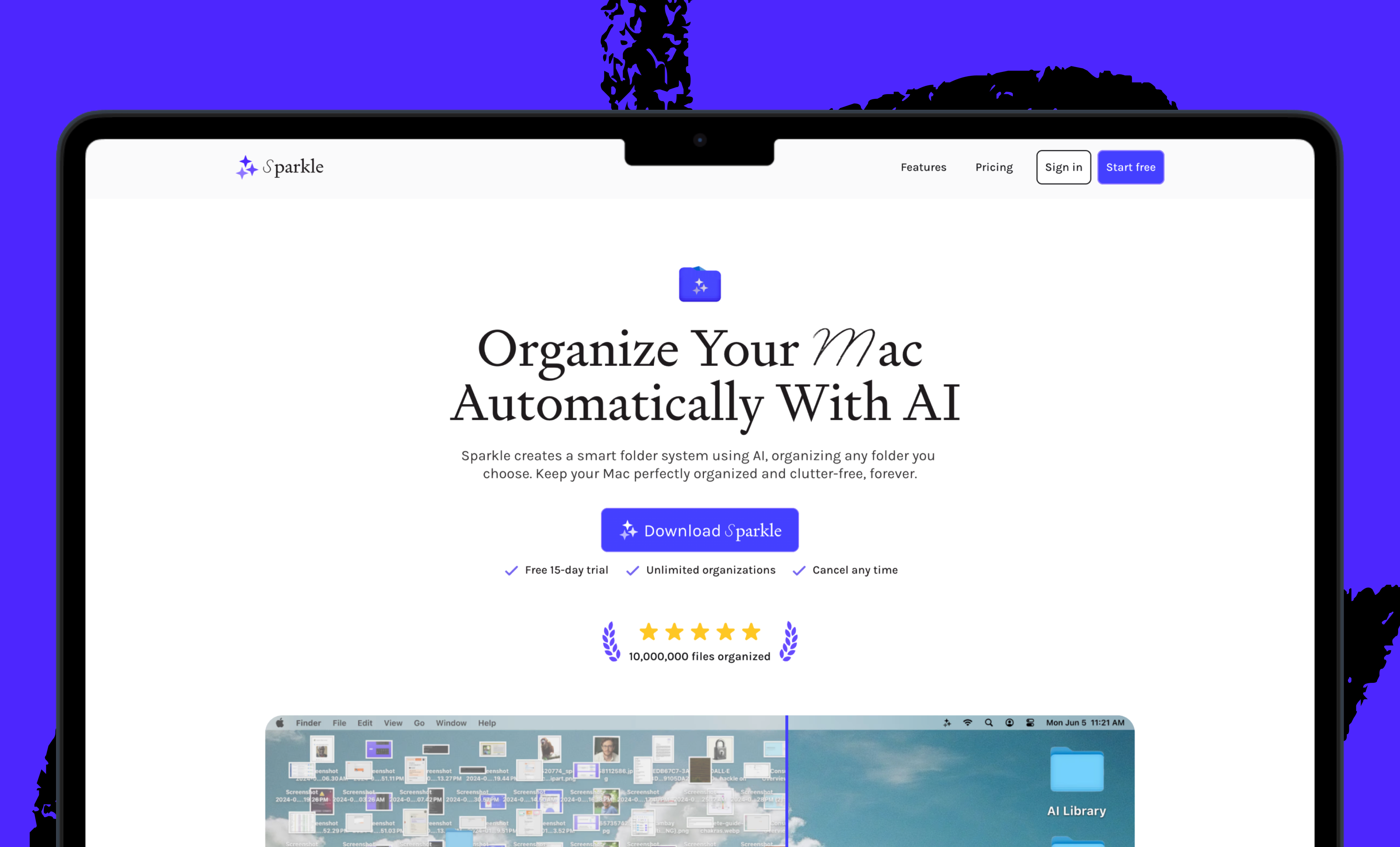
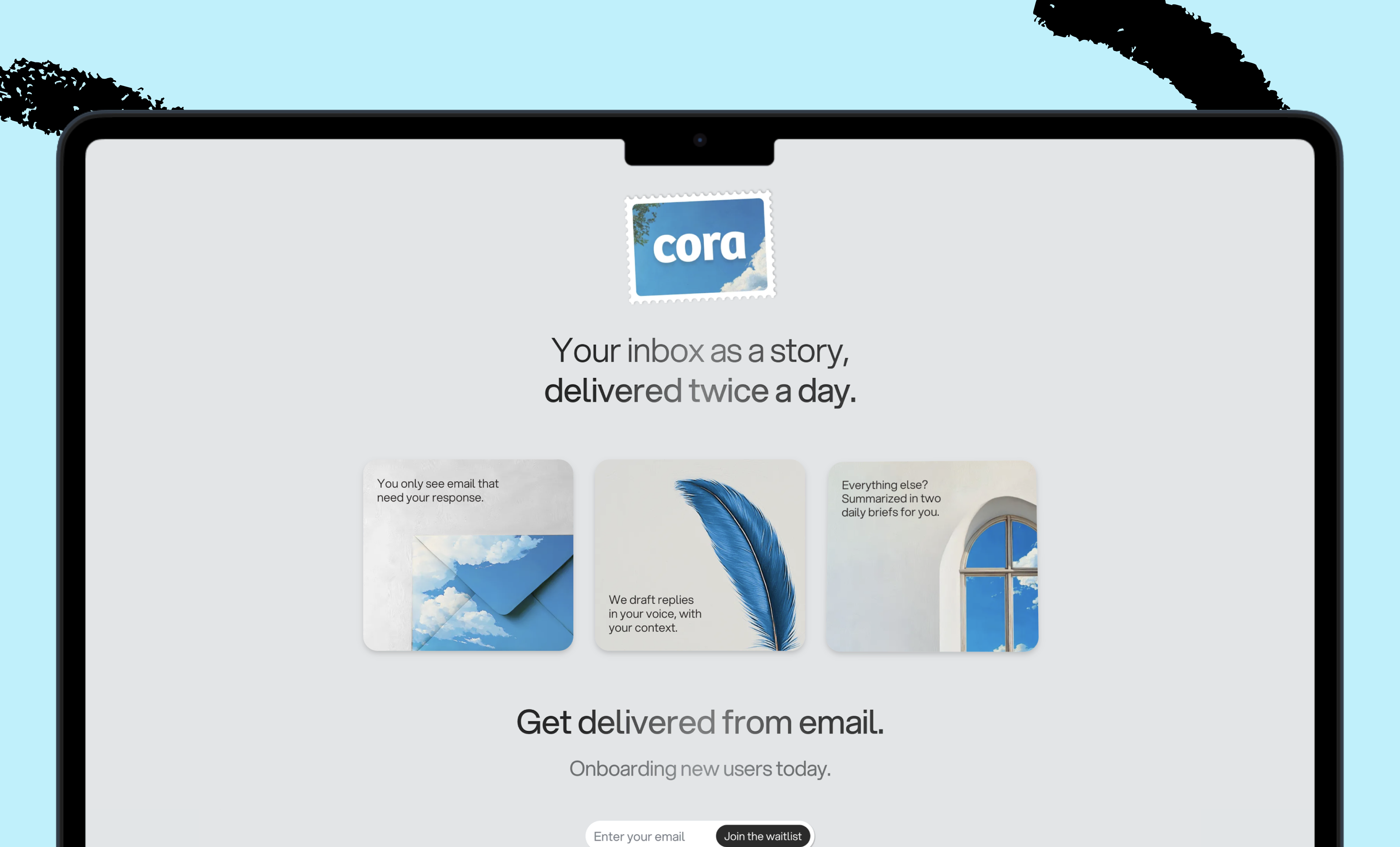
We also build AI tools for readers like you. Automate repeat writing with Spiral. Organize files automatically with Sparkle. Write something great with Lex. Deliver yourself from email with Cora.
The Only Subscription
You Need to
Stay at the
Edge of AI
The essential toolkit for those shaping the future

"This might be the best value you
can get from an AI subscription."
- Jay S.
 Every Content
 AI&I Podcast
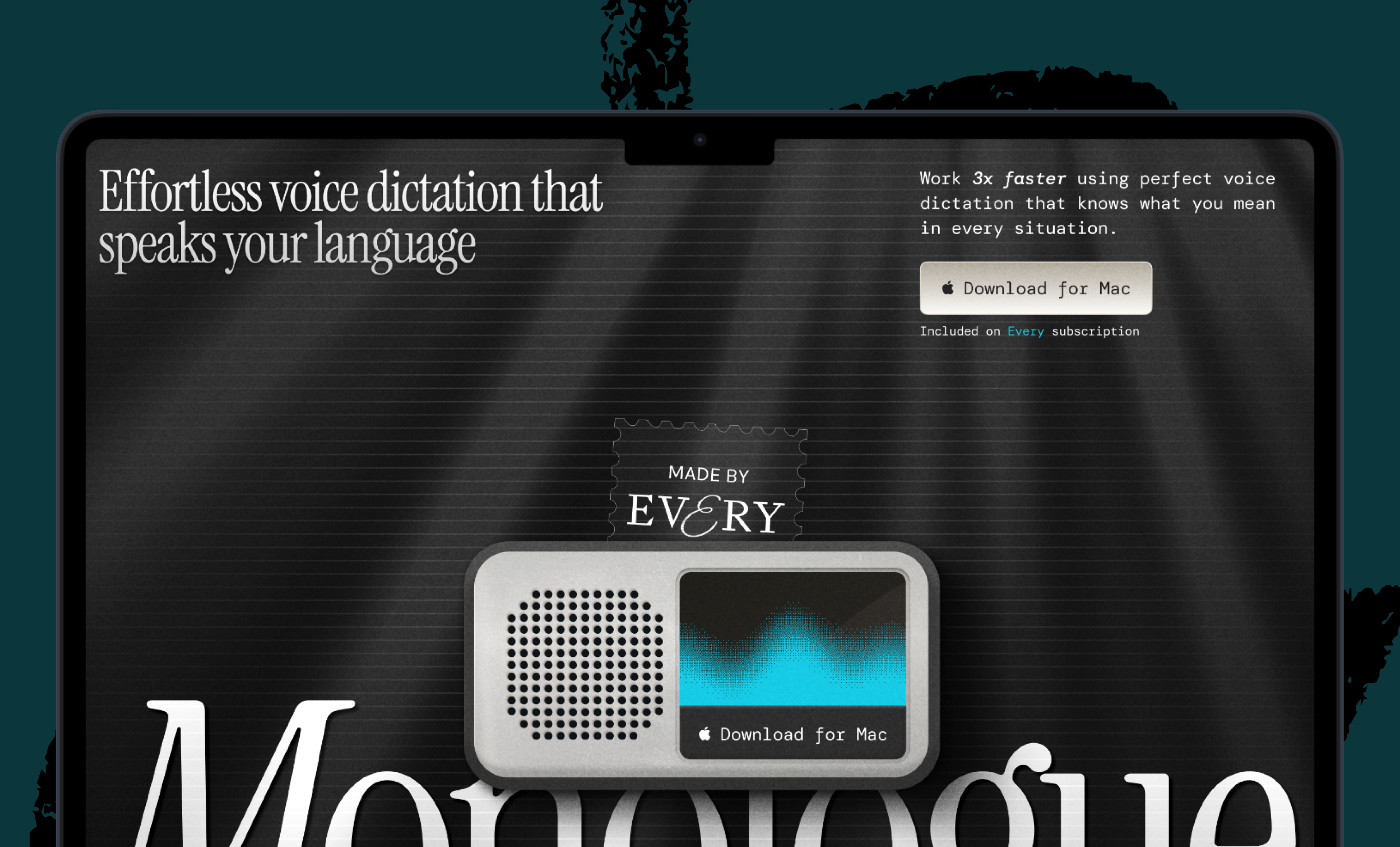
 Monologue
 Cora
Cora
 Sparkle
 Spiral
Join 100,000+ leaders, builders, and innovators

Email address

Already have an account? Sign in
What is included in a subscription?
Daily insights from AI pioneers + early access to powerful AI tools


 Front-row access to the future of AI
 In-depth reviews of new models on release day
Playbooks and guides for putting AI to work
Prompts and use cases for builders
In-depth reviews of new models on release day
Playbooks and guides for putting AI to work
Prompts and use cases for builders
In-depth reviews of new models on release day
Playbooks and guides for putting AI to work
Prompts and use cases for builders
In-depth reviews of new models on release day
Playbooks and guides for putting AI to work
Prompts and use cases for builders
 Bundle of AI software




 Dan Shipper

 Rhea Purohit

 Reviews of new AI models on release day
Comments
Don't have an account? Sign up!