




Sponsored By: Summit
This essay is brought to you by Summit. Summit is an AI-powered life coach that supports you on the journey to becoming the best version of yourself. Imagine having a 24/7 available coach, infinitely customizable and personalized specifically to you, who helps you shape, manage, and achieve your personal and professional goals. That's Summit.
There are only two types of entities on the internet, and both face the same dilemma: publishers (people who make stuff) and platforms (people who distribute stuff). Both must utilize ever more extreme content in order to drive user engagement.
Another word for extreme is spiky. The thing grabbing your attention has to have some quality that makes you pay attention—what I call a spike. The easiest variable to spike on is being edgy—i.e., violating social or moral norms. The need to spike is business plutonium. You either have to be crazily skilled at handling it or your company decays over time.
I call this problem “double bind theory”: publishers will naturally make their content more extreme to gain attention, even if it puts them at the risk of being banned. This puts platforms in a double bind, too. If they ban such content, they lose engagement. If they allow it, they may face negative business impacts from advertiser complaints or social pressure.
Importantly, extreme doesn’t mean edgy. All content that wins on the internet has to be exceptional at something. But, because it is damn near impossible to consistently produce extremely exceptional content, sensationalism usually wins.
In the Darwinian bloodbath that is the internet, the double bind is the rule of the jungle. Once you grok how this force is at the central tension of all online behavior, from Facebook’s content moderation to B2B SaaS marketing, you’ll see how much of your own life is determined by it.
It starts with the lizard king
To see this theory in action, take this 2018 Facebook note from Mark Zuckerberg:
“One of the biggest issues social networks face is that, when left unchecked, people will engage disproportionately with more sensationalist and provocative content. This is not a new phenomenon. It is widespread on cable news today and has been a staple of tabloids for more than a century. At scale it can undermine the quality of public discourse and lead to polarization. In our case, it can also degrade the quality of our services.
Our research suggests that no matter where we draw the lines for what is allowed, as a piece of content gets close to that line, people will engage with it more on average [emphasis added]—even when they tell us afterwards they don't like the content.”
Zuckerberg’s comments were accompanied by this chart:
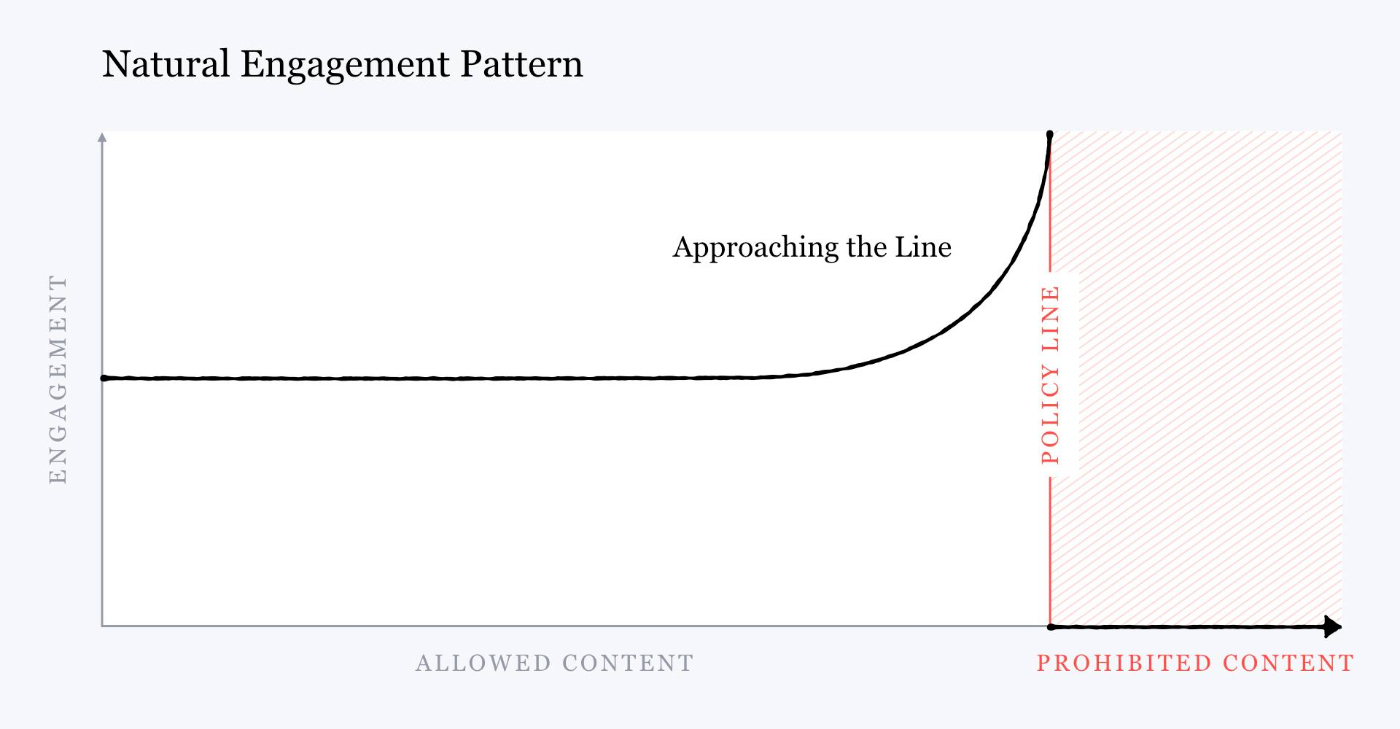
What Facebook found is a key rule in double bind theory. Content creators on a platform will naturally toe their way ever closer to the policy line for prohibited content. The content closer to the line will be rewarded with more attention, resulting in a content Darwinism where the extreme thrives. That extreme would ideally refer to an extreme in quality, but it is usually easier to go extremely controversial.
The people who don’t create content that doesn’t go extreme—whether in quality or topic selection—go out of business or hit an audience plateau earlier than they would have if they were more shameless. Many of YouTube’s most popular creators thrive off of drama and crossing the line. Logan Paul filmed and cracked jokes about a suicide victim in Japan despite his audience being largely children. David Dobrik was accused of enabling, filming, and monetizing a video of a sexual assault.
It also works in the B2B context: Basecamp controls a large part of software culture by writing rants about things the company doesn’t like and neatly translating that into software sales. Peter Thiel’s Founders Fund is a top-performing venture capital firm while seemingly all of its employees are rude to people on Twitter (and get deal flow from that trolling!).
The most popular content and creators will be flirting with the line, and platforms will experience pressure to let it slide by. If they stand firm, they risk losing out to more permissive platforms. They’ll also lose out on the revenue that the content would have generated. If they let edgy content stand, they’ll be pressured to shut down by advertisers (Twitter/X), or some other repercussion.
 Create a free account to continue reading
The Only Subscription
You Need to
Stay at the
Edge of AI
The essential toolkit for those shaping the future

"This might be the best value you
can get from an AI subscription."
- Jay S.
 Every Content
 AI&I Podcast
 Monologue
 Cora
Cora
 Sparkle
 Spiral
Join 100,000+ leaders, builders, and innovators

Email address

Already have an account? Sign in
What is included in a subscription?
Daily insights from AI pioneers + early access to powerful AI tools
 Front-row access to the future of AI
 In-depth reviews of new models on release day
Playbooks and guides for putting AI to work
Prompts and use cases for builders
In-depth reviews of new models on release day
Playbooks and guides for putting AI to work
Prompts and use cases for builders
In-depth reviews of new models on release day
Playbooks and guides for putting AI to work
Prompts and use cases for builders
In-depth reviews of new models on release day
Playbooks and guides for putting AI to work
Prompts and use cases for builders
 Bundle of AI software




 Evan Armstrong
.08.31_AM.png)

 Dan Shipper
 Reviews of new AI models on release day
Comments
Don't have an account? Sign up!
Well argued. Question: is survival of the fittest the only leg of evolution or, as many have suggested, is survival of the cooperative also valid? If so, does cooperation elevate quality? In other words, does a strategy promoting quality do better if they emphasis sensationalism or cooperation? I don't know, but that's what popped into my head when I read this! Thanks!
@nanh I think it is impossible for 99% of firms to cooperate on a large enough scale to make a long-term, defensible advantage. That said, short-term stuff works.
Really well written. In an age of generative AI I am curious though, if the publishers could potentially pivot in a way by mass-personalizing their content to their viewers preferences. I imagine users of websites being able to customize the content automatically in length, style, complexity and so on based on their personal likings. It would be interesting if such a change could mitigate the disadvantage of publishers.
This is an incredible piece. Thank you. I work at meta and have never seen this problem framed so clearly.
Oh my goodness you had me cackling like a hyena.
..."Facebook’s content moderation to B2B SaaS marketing, you’ll see how much of your own life is determined by it.
Title: It starts with the lizard king"
My sides are in orbit, thanks for the delightful chuckle.
I think you're argument runs true:
"If you have made the unfortunate choice to participate in this bloodbath of an industry, you have two options: create a process to consistently deliver truly incredible products or listen to the siren song of sensationalism. For most people, option two is easier."
Hopefully with the rise in AI capability, quality will become as accessible as sensationalism.
Although, it doesn't hurt to put a little bit of icing on the cake!