





The yassification of killing robots makes me queasy.
Last week, Anduril, a prominent defense technology startup valued at $8.5B, announced that it had acquired the “Fury” line of autonomous airplanes. Think of the plane as a Roomba that can fly, substituting its vacuum for missiles. While the product is not yet deployed, the acquisition was clearly done with the hope of selling these machines by the hundreds.
In my naivety, I expected the tech community to have some reservations. After all, these planes are powered by an AI technology whose sole purpose is slaughter.
Instead, X was full of comments showering the announcement with adoration. A sampling of real tweets:
“This makes me so horny”
“*laughs in American asymmetric advantage*”
“This is beautiful. I love the military industrial complex so much.”
I do not want to paint with a broad brush. The dialogue around Silicon Valley’s relationship with the military almost always devolves into tribal warfare, with little space for nuance. My family has a history of military service, and my father-in-law was in the Air Force. Additionally, I’ve argued for years about the power of technology to pull society forward. Ultimately, I feel that war and the technology that supports it are sometimes necessary, but always complicated.
The hyperbole starts with the marketing: the Fury aircraft launch could’ve been ripped from the latest iPhone event. The landing page brags about “reduced emissions.” There is a slick YouTube video with sensual, slow-mo shots of the product. Brand advocates hyped up the product to their followers. For anyone who has read a software marketing blog or two, it was clear that Anduril was following a playbook that is battle-tested in Silicon Valley.
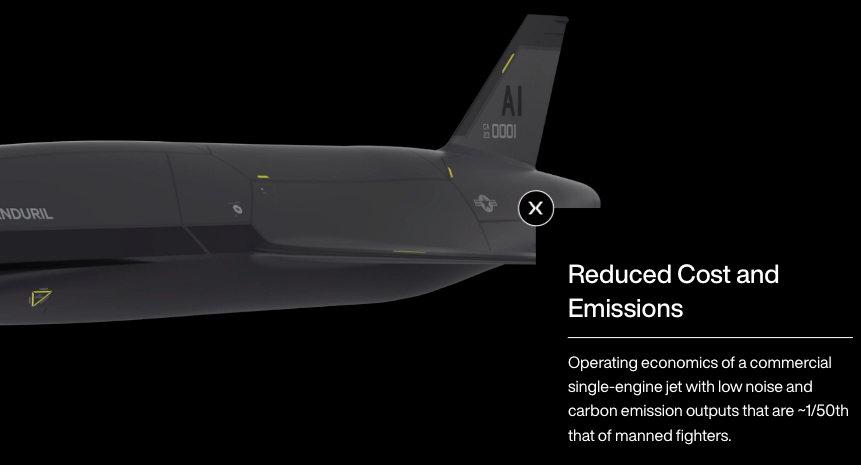
Image source: Fury launch page
Beyond Anduril, there appears to be a cognitive dissonance about what the defense sector does. Defense tech isn’t building weapons designed to more efficiently kill people—it is supporting “American Dynamism.” Venture capitalists who engage in lobbying aren’t throwing parties for the military-industrial complex; they’re “one of the leading voices” who just so happen to have hundreds of millions in capital. I personally have received outreach from multiple funds asking for help spinning up content around why they are good partners for defense technology companies. Everyone wants a piece of the murder money pie.
Let me be clear: it’s morally bankrupt to view defense as an exciting market. This sector is not bald eagles and Abraham Lincoln riding a grizzly bear. It is death and pain and blood soaking into the mud. Defense technology should be a sober, honest affair. Instead, some in Silicon Valley view it as a vaguely nationalistic way to make billions of dollars.
 Create a free account to continue reading
The Only Subscription
You Need to
Stay at the
Edge of AI
The essential toolkit for those shaping the future

"This might be the best value you
can get from an AI subscription."
- Jay S.
 Every Content
 AI&I Podcast
 Monologue
 Cora
Cora
 Sparkle
 Spiral
Join 100,000+ leaders, builders, and innovators

Email address

Already have an account? Sign in
What is included in a subscription?
Daily insights from AI pioneers + early access to powerful AI tools






 Front-row access to the future of AI
 In-depth reviews of new models on release day
Playbooks and guides for putting AI to work
Prompts and use cases for builders
In-depth reviews of new models on release day
Playbooks and guides for putting AI to work
Prompts and use cases for builders
In-depth reviews of new models on release day
Playbooks and guides for putting AI to work
Prompts and use cases for builders
In-depth reviews of new models on release day
Playbooks and guides for putting AI to work
Prompts and use cases for builders
 Bundle of AI software





 Evan Armstrong



 Dan Shipper
 Reviews of new AI models on release day
Comments
Don't have an account? Sign up!
Definitely guilty of this myself, looking at now and the past. Military engineering can be so fascinating and excellent (existential threats will do that) that it's hard not to get excited and damn near giddy when I look at a beautiful weapon. Probably a deflection mechanism in part too, like comedy; don't know how to deal with the true nature of the stakes (and so far removed) that I default to some mix of "OMG beautiful engineering" analytical and "big explosion boom fast jet zoom" caveman mind that really tickles my fancy. I have decent appreciation and respect for war (obviously nowhere near somebody who's directly or closely felt the impact), yet I have trouble squaring my excitement for weapons with hatred of destruction.
One aspect left out from the article which I believe to be especially true now (though has also been thought and proved wrong countless times in the past) is that this new breed of technologically advanced weapons remove people and increase accuracy, and therefore may be saving lives relatively (though yes, they thought dynamite, machine guns, and bombers would save lives too). Alas maybe drones would just mean we can create more weapons than ever before and destruction will only increase, but whereas those previous examples only increased scale with little change to decision-making, accuracy, or human risk, these increase scale while improving all of those significantly. The dream of the Bomber Mafia may finally be coming to fruition. Further, companies like Anduril are challenging the entire military-industrial complex system, which costs hundreds of billions a year in inefficiencies.
I think most people even drawn to these companies don't have it lost on them what their work truly means. I imagine they've thought about it extensively and had existential crises on the matter. Through the lens of "transforming war from a battle of humans to robots and disrupting one of the most corrupt, damaging institutions in America" I believe excitement and damn near glee is warranted.