




Sponsored By: Brilliant
This article is brought to you by Brilliant, the app that boosts your analytical skills with bite-size lessons in math, logic, CS, and more.
Author’s Note: In newsletter writing you are supposed to get to the point, set a strong hook, and make sure there are immediately obvious takeaways. I wondered what would happen if I deliberately violated each of those rules—this post is the result of that experiment. Thank you for being patient with this column's ceaseless experiments with form and function.
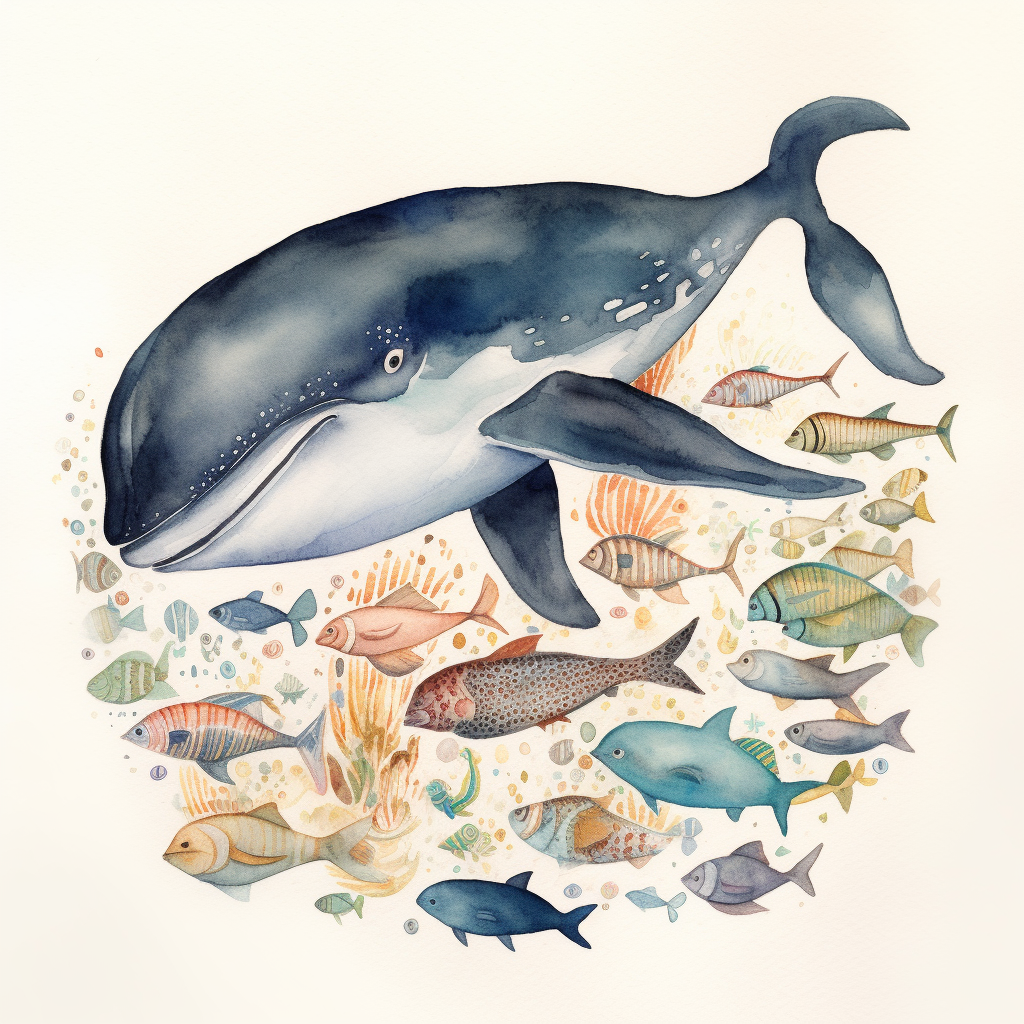
A blue whale is a big son of a gun. Over the course of its 90-year life span, it hauls its 300,000-pound body across 450,000 miles of ocean. To help visualize this, that would be like driving coast-to-coast across America 180 times. Each swish of its ginormous tail is powered by the 12,000 pounds of krill that is its daily brunch.
Their feces is also impressive. After digesting four Volkswagen Beetles worth of seafood each day, the blue whale will ascend to near the surface and, if I may be so crass, let loose. Marine biologists have given these explosive events the delightfully euphemistic nickname of a “whale pump.” This event is surprisingly vital for the health of the ecosystem by providing nutrients for plankton growth. Plankton in turn feed many other species of fish and, eventually, turn into long-term storage of carbon that sits on the seafloor for decades. Essentially what I’m saying is that if we gave enough blue whales enough black coffee, we would no longer need solar panels. That point is totally irrelevant, but it is one I am compelled to make nevertheless.
Perhaps the most important part of the blue whale’s life cycle occurs when it dies. Assuming it dies of natural causes over deep water, it begins a process known as a whale fall. As the corpse slowly, slowly, slowly descends to the ocean floor, a swarm of ocean scavengers begin to feast. They include, but are not limited to, the following: sleeper sharks, hagfish, giant isopods, lobsters, crabs, octopus, polychaetes (what is this? I have no idea), shrimp, prawns, sea cucumbers, and squat lobsters (not to be confused with its cousin, the incline bench press squid).
AI is getting smarter. Are you?
Brilliant is the app that boosts your analytical skills in minutes a day with bite-size lessons in math, logic, data science, CS, and more. Thousands of visual, interactive lessons sharpen your mind while helping you master the concepts behind AI, neural networks, computer logic, and beyond.
Join 10M+ and try Brilliant with a 30-day free trial.
Each stage of descent and depth is marked by a different type of feast. Rather than begin with an amuse-bouche of some small part of the blue whale, the first diners go immediately for the entree—the soft tissue. Sharks and hagfish will slowly gnaw on the muscle fibers and globby bits of fat.
Next, a coterie of sea creatures begins to nest within the whale’s corpse. These bottom dwellers' names are so ridiculously challenging to pronounce that when said quickly you may inadvertently cast a curse of Poseidon on your home. (For your safety I have deemed it necessary to remove them from this text). Along for the ride, bacteria and fungi also start breaking down the bones, muscle, and other tissues. As all of these creatures have their fill, the soil underneath the carcass becomes rich with nutrients, leading to additional life. This phase can last for two years or so.
Finally, we reach the final stage, one that may last up to 50 years, given the enjoyably alliterative sulfophilic stage. Here, various bacteria break down the lipids contained within the whale’s bones, and up to 30K various microorganisms will settle in around the whale’s carcass. The decomposition can take so long because of two factors unique to the bottom of the seafloor: enormous pressure and a total lack of sunlight.
In total, a dead whale can sustain thousands of creatures, fertilize the soil, solve climate change, and potentially give you nightmares when you view it.
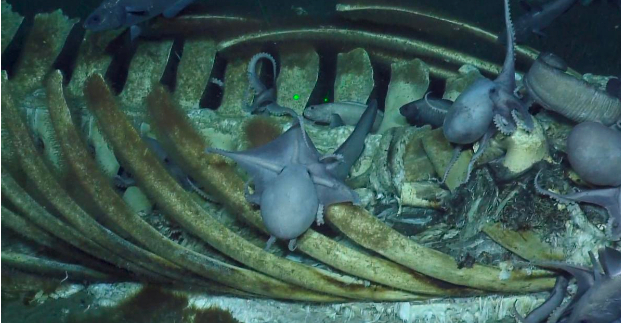
Watching this bloated, big-ass blue whale slowly picked apart by scavengers reminds me a lot of what happens to rich people when they die. In particular, it reminded me of Sumner Redstone.
A Corpse of a Person
Redstone was a multibillionaire who inherited a very small chain of drive-in movie theaters and parlayed that into the following media assets: Viacom, Paramount Pictures, the CBS network, MTV, Comedy Central, Nickelodeon, the Simon & Schuster publishing house, and of course, the National Amusements movie theater chain. If you are looking for a fictional comparison, I would say he is Logan Roy, but a far, far worse person. In particular, there were many troubling relationships with women. A brief and nonexhaustive list of his personal sins:
- Calling his daughter a cunt multiple times in front of his executive team
- Amending his trust 40 times to add or remove women he was courting. Several received $20M, “a lot” received $10M, and “many, many” received over $1M. (Many of these women were under 25 while he was in his 80s)
- Trying, multiple times, to date his grandson’s girlfriends. It appears that he did so successfully.
- Using his money and power to coerce women to sleep with him
- An incident with a flight attendant whom Redstone pressured into a date ended when he “lunged at her and tried to get his hand under her blouse.”
On the corporate side, there was a constant abuse of company resources. He forced MTV to produce shows so he could sleep with actresses. There were constant demands of payments, planes, and favors. While it has never been made explicit, to my eyes, it feels highly unlikely that there weren't worse, unreported actions. This behavior went on for over 20 years.
He was also the subject of the recently published Unscripted: The Epic Battle for a Media Empire and the Redstone Family Legacy. The book is 344 pages of deeply reported, well-written, wholly lurid gossip. In the first half of the book, we mostly learn about all of the harm in Redstone’s immediate orbit. The tales of sex and exploitation are so voluminous, that frankly, I had to keep a notebook next to me so I could keep track of all the women and payments. Look at this paragraph and a half. Multiply this by about 150 pages and you’ve got the gist of the first half.
“Sumner showered [19-year-old Rohini Singh] with Viacom stock, as well as a reported $18 million in payments. The same year Sumner also started seeing Terry Holbrook, a brunette former Ford model and Houston Oilers cheerleader. Sumner bought her a $2.5 million house and paid for her stable of show horses. Manuela Herzer, who'd become one of Redstone's live-in companions, maintained that Sumner paid Holbrook $4,500 a month in cash and those and other payments eventually amounted to $7 million.”
Near the end of his life, Sumner’s situation was reversed. Two women, Sydney Holland and Manuela Herzer, took advantage of him in his old age. They gained Sumner’s confidence, took over his life, and slowly drained him of over $150M.

They were part wives, part nurses, part sexual coordinators. “Holland, in turn, used cash to pay seven different women who visited Sumner on a regular basis. To keep track, [an employee] kept a spreadsheet listing the various women and payments. In a year, they totaled more than $1 million.”
Maybe you can now see why I thought of the whale fall. As Redstone’s mental capacity decayed, more and more scavengers appeared, attempting to drain him dry. It feels like a fitting end to Redstone’s life that the gender that he spent 20 years exploiting got him back in the end. It may be that he was more of a shark than a whale, but the idea of a behemoth being slowly picked apart feels appropriate.
A similar dynamic occurred in his companies.
The bloated org
The second half of the book is devoted to the people sucking the corpse of Paramount dry. It was a mix of abusers cut from Redstone’s cloth, and yes, men were paid millions to look the other way when abuse occurred. There were a lot of these creeps.
Most of the narrative is focused on Les Moonves—the heir apparent to the Paramount throne. Right as he was about to take everything over, Ronan Farrow published a Me Too article about him in The New Yorker. In many ways, reading about Moonves was totally unsurprising. He was raised in a corporate culture created by Redstone, so of course those who climbed the ranks replicated Redstone’s treatment of women. After spending half of the book reading about the behavior of an 80-year-old man with 40+ women, Moonves having six or so women come forward seemed relatively blasé. Frankly, I’m not an expert on the fine line between pressure, coercion, and assault, but the power dynamics exploited by these men were disgusting on all levels.
It was also surprising to read about how the board of CBS enabled this culture. For example, when there were rumors that the New Yorker article was being written, the board conducted an “investigation.” This investigation consisted of a lawyer asking Moonves if he had done anything, him saying not really, and that’s it. Nancy Drew this is not. There was no follow-up. There was no discussion with sources. The lawyers said this was good enough and that was it. Even as rumors started to accumulate and more evidence arose there were more complaints by board members about cancel culture versus actually engaging with the accusations.
The remarkable thing is that they were all doing this while the business was falling apart. The writing was on the wall in 2012 that streaming was the future of media. While they eventually launched streaming in 2014 with CBS All Access (which is now known as Paramount+), it was and is a paltry effort. The entire TV industry had grown fat off the teat of cable subscription packages. To grab hold of the future and abandon that in favor of digital would require bold, decisive executives. The leadership teams at these companies were too busy ignoring Moonves’ sexual misconduct to care.
Again, I think of a whale fall. The business was being picked apart by scavengers, of the species professional managers, family Harvard MBA. In contrast with the women coming after Redstone’s personal fortune, almost all of these corporate scavengers were male. Animals of this variety specialize in extracting every last remaining bit of a value from a brand that is dead in the water. Through golden parachutes and corporate jets, they take and take and take until there is nothing left but bones drifting on the seafloor.
Their work is evident in the stock price—Paramount’s value is down 72% over the past five years.
Death
Examining the blue whale's life cycle and Redstone's corporate empire, a pattern emerges—one that mirrors the laws of nature and the stark realities of power. The decomposing bodies of these behemoths, one from the natural world and the other from the realm of industry, essentially become a feast for scavengers, whether they be marine critters or high-flying execs. However, the repercussions diverge: The blue whale's death provides valuable nutrition and contributes to the rich biodiversity of marine life, while Redstone's personal and corporate value mostly ends up captured by a small group of middle managers who contribute nothing.
These stories serve a dual purpose. They're sober reminders of certain immutable truths of existence. The blue whale eventually meets its end, transforming into a charcuterie board for deep-sea scavengers. Similarly, the power and wealth of a billionaire like Redstone ultimately dwindles, leaving behind remnants that attract a flock of opportunists.
The Only Subscription
You Need to
Stay at the
Edge of AI
The essential toolkit for those shaping the future

"This might be the best value you
can get from an AI subscription."
- Jay S.
 Every Content
 AI&I Podcast
 Monologue
 Cora
Cora
 Sparkle
 Spiral
Join 100,000+ leaders, builders, and innovators

Email address

Already have an account? Sign in
What is included in a subscription?
Daily insights from AI pioneers + early access to powerful AI tools




 Front-row access to the future of AI
 In-depth reviews of new models on release day
Playbooks and guides for putting AI to work
Prompts and use cases for builders
In-depth reviews of new models on release day
Playbooks and guides for putting AI to work
Prompts and use cases for builders
In-depth reviews of new models on release day
Playbooks and guides for putting AI to work
Prompts and use cases for builders
In-depth reviews of new models on release day
Playbooks and guides for putting AI to work
Prompts and use cases for builders
 Bundle of AI software





 Evan Armstrong



 Dan Shipper
 Reviews of new AI models on release day
Comments
Don't have an account? Sign up!