





Sponsor Every
Do you run a software company looking to reach an audience of early-adopters? Consider sponsoring our smart long-form essays on tech, AI, and productivity:
Have you ever witnessed a performer walk on stage, look out at the audience, say and do nothing, yet still captivate you?
It’s not quite true that they’re not doing anything. Whether they know it or not, they’re using their awareness to connect with the audience in a powerful way.
Here are some practical, yet hopefully novel, tips to help you level up your public speaking skills and connect more deeply in conversations.
Let yourself be coordinated by others
Picture a cat stalking a bird. Its attention, locked on the bird, is aligned with its intention to pounce upon the smaller animal. Its body, pressed against the ground with its head low, has just the right amount of muscle tension so that when the opportune moment comes, it can spring forward and, perhaps, catch the bird.
There is one important thing that the cat is not doing: it’s not consciously deciding how to do any of this. The cat isn’t coordinating itself, choosing where to put its feet or how to move its head. Everything about the cat as it sneaks up on the bird is a natural response to its desire to catch the bird. All the cat has to do is to allow itself to be coordinated.
As creatures with a powerful capacity for metacognition, we seem to find this much more difficult than the cat, which is why it’s so easy for us to get in our own way. Consider the elite baseball player who chokes at a crucial moment. It’s not because they’ve forgotten how and when to swing the bat, but that something is interfering. The batter switched from allowing themself to be coordinated by their intention to hit the ball to trying to coordinate themself to hit the ball—and failing.
Our minds and bodies are coordinated by what we attend to and what we intend to do. By learning to consciously control these aspects of your internal experience—in conversation with others, on stage, and even on camera—you can indirectly change a lot about how you are perceived and the level of connection you can create. Instead of trying to control every micro-expression, tone, and gesture, you can choose to attend to the world around you—and the people in it—and allow these things to emerge by themselves.
Let yourself be witnessed by others
When you look out at the world, what do you see? I see my laptop, ceramic coffee cups atop wooden tables, the sun setting over the Indian Ocean, and people chatting, eating, and working. It’s easy to assume that all of these are made of the same stuff—that the tables, ocean, and people are all atoms bound together in the physical forms that I see.
This is true, of course, but it’s more complicated. While the world is indeed made of all that stuff, my own subjective experience of it is not. Although there are physical correlates in my brain and nervous system, my first-person experience isn’t physical at all—instead, it’s made of sensations, perceptions, thoughts, and consciousness. This distinction holds the key to a radical shift in how you relate to others.
Your habitual way of seeing others is, probably, to treat them like trees that can hold a conversation. I don’t mean this pejoratively, but to highlight that it’s easy to forget that other people are also having an experience. The shift I’m proposing is to talk to them while remaining aware that they are having a conscious experience of you of exactly the same kind as you are of them.
 Create a free account to continue reading
The Only Subscription
You Need to
Stay at the
Edge of AI
The essential toolkit for those shaping the future

"This might be the best value you
can get from an AI subscription."
- Jay S.
 Every Content
 AI&I Podcast
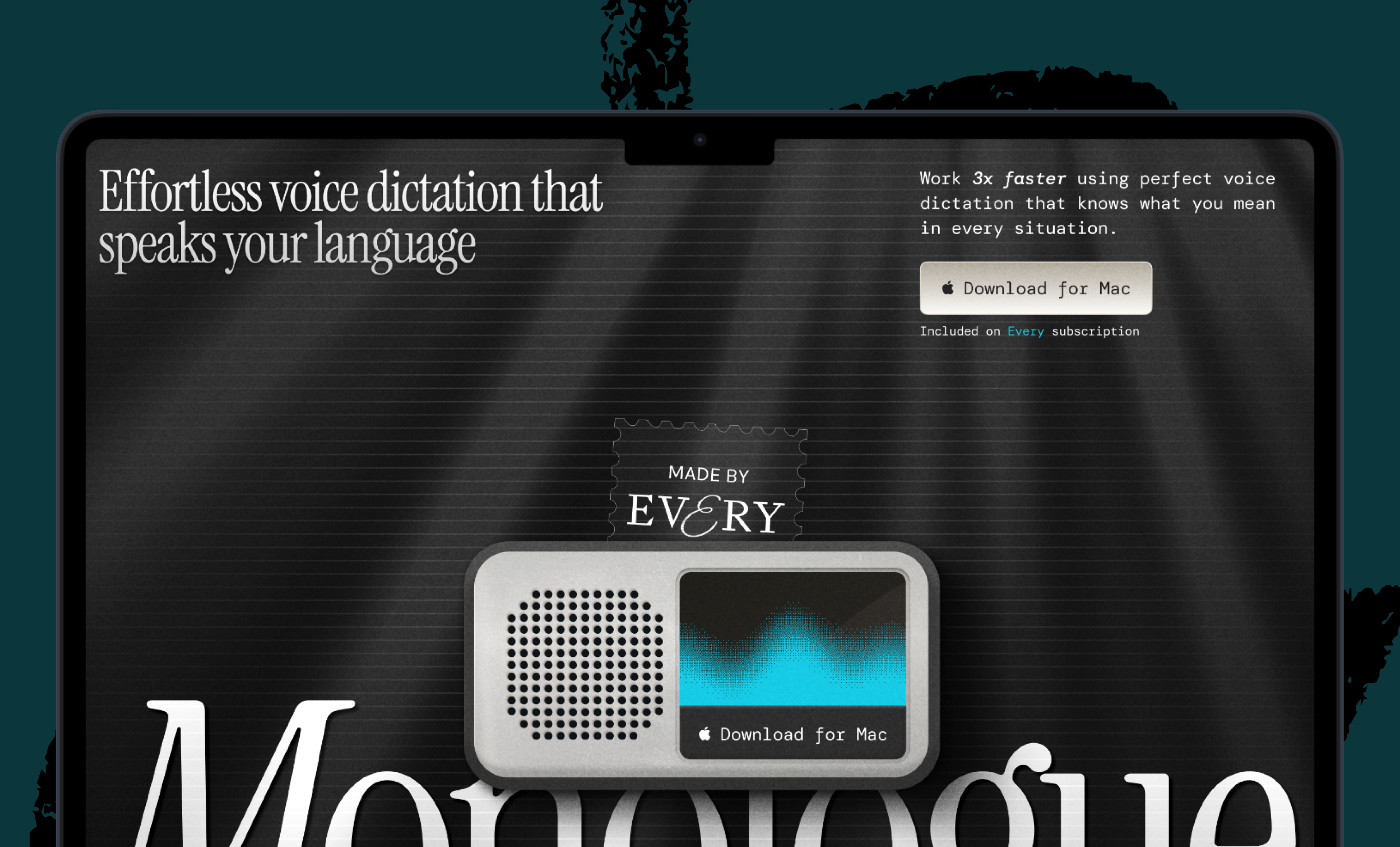
 Monologue
 Cora
Cora
 Sparkle
 Spiral
Join 100,000+ leaders, builders, and innovators

Email address

Already have an account? Sign in
What is included in a subscription?
Daily insights from AI pioneers + early access to powerful AI tools





 Front-row access to the future of AI
 In-depth reviews of new models on release day
Playbooks and guides for putting AI to work
Prompts and use cases for builders
In-depth reviews of new models on release day
Playbooks and guides for putting AI to work
Prompts and use cases for builders
In-depth reviews of new models on release day
Playbooks and guides for putting AI to work
Prompts and use cases for builders
In-depth reviews of new models on release day
Playbooks and guides for putting AI to work
Prompts and use cases for builders
 Bundle of AI software





 Evan Armstrong
 Dan Shipper
 Reviews of new AI models on release day
Comments
Don't have an account? Sign up!