





Sponsored By: Lever
Hire smarter with Lever—the only complete hiring solution that provides modern talent acquisition leaders with complete ATS and robust CRM capabilities in one product: LeverTRM
I have ambitious goals and I work hard. I like this about myself! But honestly? I struggle with the anxiety and restlessness that seem to come with the territory.
Perhaps you can relate. Do you ever find yourself, at the end of a long week, wondering why you’re baseline stressed so often? Like you have no time for anything? Case in point: I spent an embarrassing amount of money on an espresso machine a few years ago, and I hardly use the dang thing. Too much effort for not enough liquid. (It takes ~5 minutes and it’s delicious.) Instead, every morning I make a quick pour-over while I fuss over emails, and the espresso machine looks up at me with sad, lonely, overpriced eyes. Do you have your own version of this routine, where you sacrifice moments of joy for marginal productivity gains?
I would love to flow through my day with a sense of peace, safety, and spaciousness. But I’m not willing to give up my goals, and I fear they’re the cause of the problem. When success is statistically unlikely and the stakes are high, is it inevitable for a person to get wound up?
I hope not. I want to find some way to have my cake (serenity) and eat it (ambition) too.
My cofounder Dan wrote about this a few years ago. He shared some science-backed ways to decrease stress that are a lot more helpful than “take deep breaths” (although that is good advice, too). It remains the most popular thing we’ve ever published.
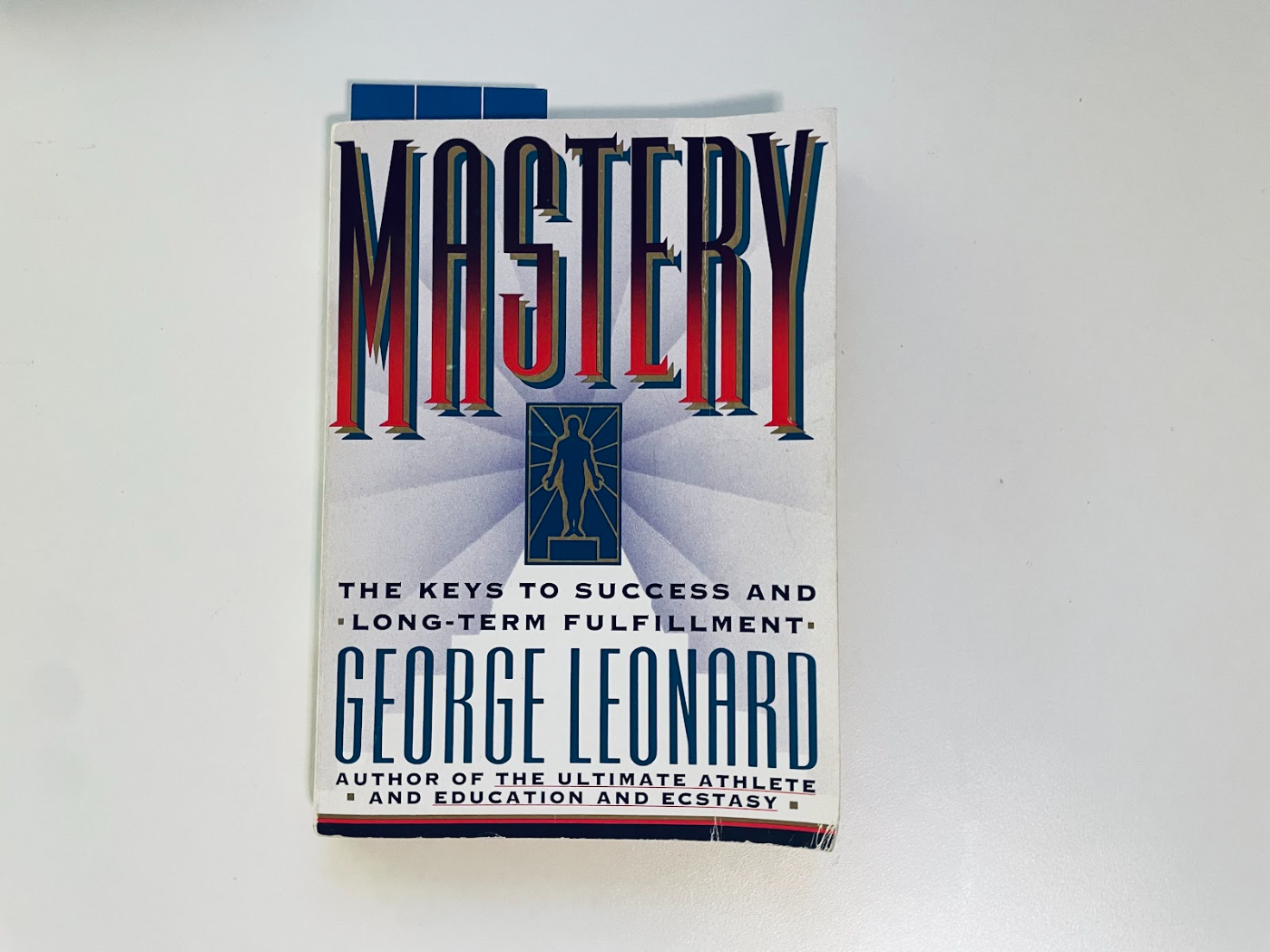
I read a book recently called Mastery that reminded me of that post. It offers a different, complementary perspective on the same problem. The big idea is that we can gain serenity without sacrificing our ambition if we focus on long-term mastery and learn to love the process of continual improvement for its own sake, trusting that the results will inevitably come.
Results-oriented?
The book opens with a parable about an athlete who wanted to become a great tennis player as soon as possible. He hired a coach who started with the basics: how to grip the racquet, how to make contact with the ball, how to track the ball with his eyes, etc.
The training process didn’t look much like the results he wanted to achieve. He stood in place and swung at easy balls the coach lobbed at him. He was purely focused on his grip and the exact angle of contact between racquet and ball. There were no epic volleys or blistering serves, and they didn’t keep score because there was nothing to win.
After a few weeks of practice, the athlete hit a plateau and began to feel impatient. He asked the coach how long it would take for him to compete and win in real matches.
“I would say you could probably start playing after about six months. But you shouldn’t start playing with winning as a major consideration until you have reasonable control of forehand, backhand, and serve. And that would be about a year or a year and a half.”
 Create a free account to continue reading
The Only Subscription
You Need to
Stay at the
Edge of AI
The essential toolkit for those shaping the future

"This might be the best value you
can get from an AI subscription."
- Jay S.
 Every Content
 AI&I Podcast
 Monologue
 Cora
Cora
 Sparkle
 Spiral
Join 100,000+ leaders, builders, and innovators

Email address

Already have an account? Sign in
What is included in a subscription?
Daily insights from AI pioneers + early access to powerful AI tools



 Front-row access to the future of AI
 In-depth reviews of new models on release day
Playbooks and guides for putting AI to work
Prompts and use cases for builders
In-depth reviews of new models on release day
Playbooks and guides for putting AI to work
Prompts and use cases for builders
In-depth reviews of new models on release day
Playbooks and guides for putting AI to work
Prompts and use cases for builders
In-depth reviews of new models on release day
Playbooks and guides for putting AI to work
Prompts and use cases for builders
 Bundle of AI software





 Evan Armstrong
 Dan Shipper
 Reviews of new AI models on release day
Comments
Don't have an account? Sign up!
Doing work for intrinsic reasons close to our desires (mental templates built over life) and taking the courage to surrender to the path are both themes that artists grapple with. I recently read an inspiring book by David Whyte Crossing the Unknow Sea which helped me get another perspective on this. Beyond the rational reasoning of reducing stress and having a more harmonious life, he beautifully describes the emotional leap of faith we should take and why. I wrote a short summary here: https://alexadamov.com/crossing-the-unknow-sea-book-review/