





The world has changed considerably since our last ”think week” five months ago—and so has Every. We’ve added new business units, launched new products, and brought on new teammates. So we've been taking this week to come up with new ideas and products that can help us improve how we do our work and, more importantly, your experience as a member of our community. In the meantime, we’re re-upping four pieces by Dan Shipper that cover basic, powerful questions about AI. (Dan hasn’t been publishing at his regular cadence because he’s working on a longer piece. Look out for that in Q2.) Yesterday we re-published his jargon-free explainer of how language models work. Today we’re re-upping his piece about how language models function as compressors—or summarizers—of text.—Kate Lee
Was this newsletter forwarded to you? Sign up to get it in your inbox.
I want to help save our idea of human creativity. Artificial intelligence can write, illustrate, design, code, and much more. But rather than eliminating the need for human creativity, these new powers can help us redefine and expand it.
We need to do a technological dissection of language models, defining what they can do well—and what they can’t. By doing so, we can isolate our own role in the creative process.
If we can do that, we’ll be able to wield language models for creative work—and still call it creativity.
To start, let’s talk about what language models can do.
The psychology and behavior of language models
The current generation of language models is called transformers, and in order to understand what they do, we need to take that word seriously. What kind of transformations can transformers do?
Mathematically, language models are recursive next-token predictors. They are given a sequence of text and predict the next bit of text in the sequence. This process runs over and over in a loop, building upon its previous outputs self-referentially until it reaches a stopping point. It’s sort of like a snowball rolling downhill and picking up more and more snow along the way.
But this question is best asked at a higher level than simply mathematical possibility. Instead, what are the inputs and outputs we observe from today’s language models? And what can we infer about how they think?
In essence, we need to study LLMs’ behavior and psychology, rather than their biology and physics.
This is a sketch based on experience. It’s a framework I’ve built for the purposes of doing great creative work with AI.
A framework for what language models do
Language models transform text in the following ways:
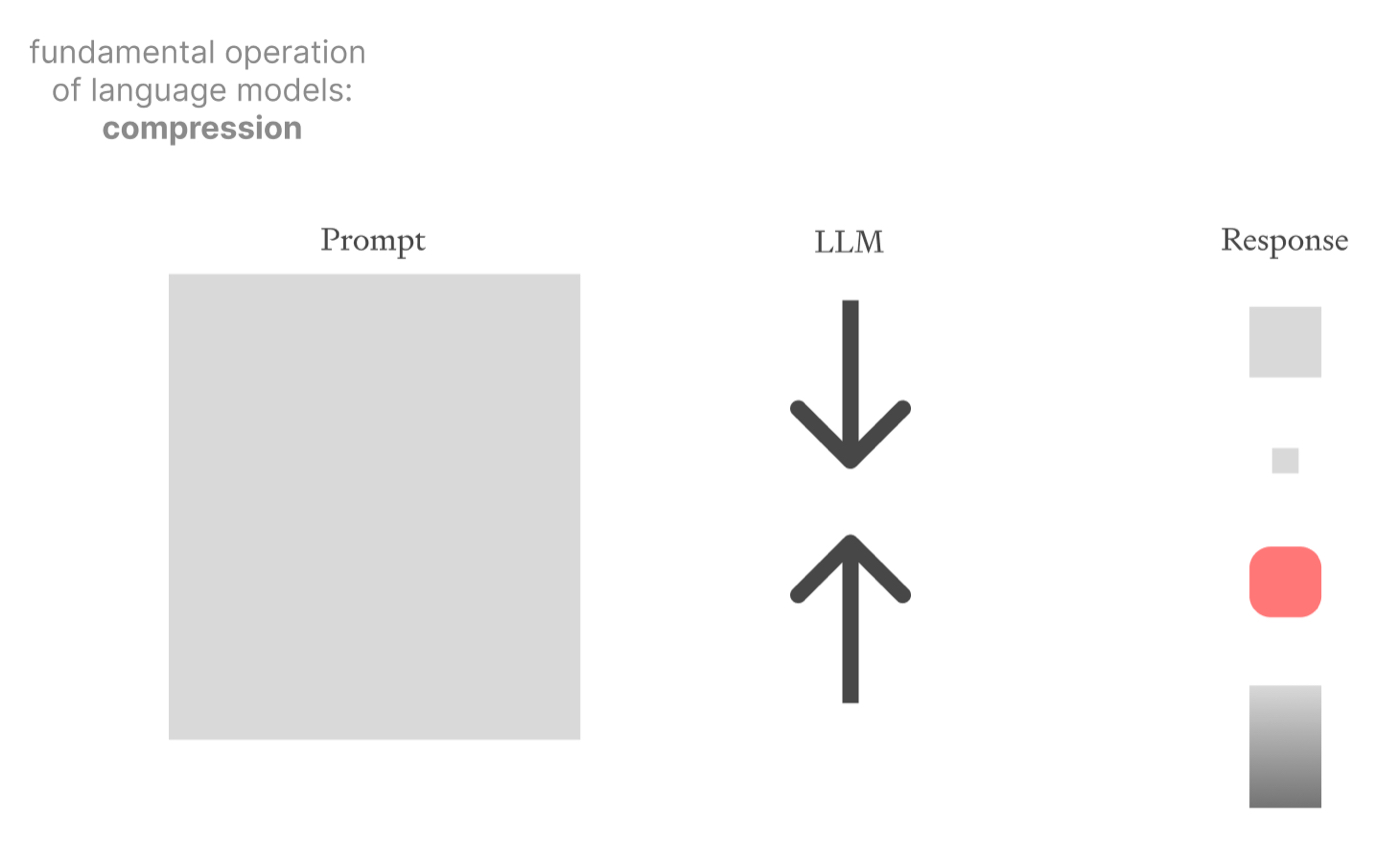
- Compression: They compress a big prompt into a short response.
- Expansion: They expand a short prompt into a long response.
- Translation: They convert a prompt in one form into a response in another form.
These are manifestations of their outward behavior. From there, we can infer a property of their psychology—the underlying thinking process that creates their behavior:
- Remixing: They mix two or more texts (or learned representations of texts) together and interpolate between them.
I’m going to break down these elements in successive parts of this series over the next few weeks. None of these answers are final, so consider this a public exploration that’s open for critique. Today, I want to talk to you about the first operation: compression.
Language models as compressors
Language models can take any piece of text and make it smaller:
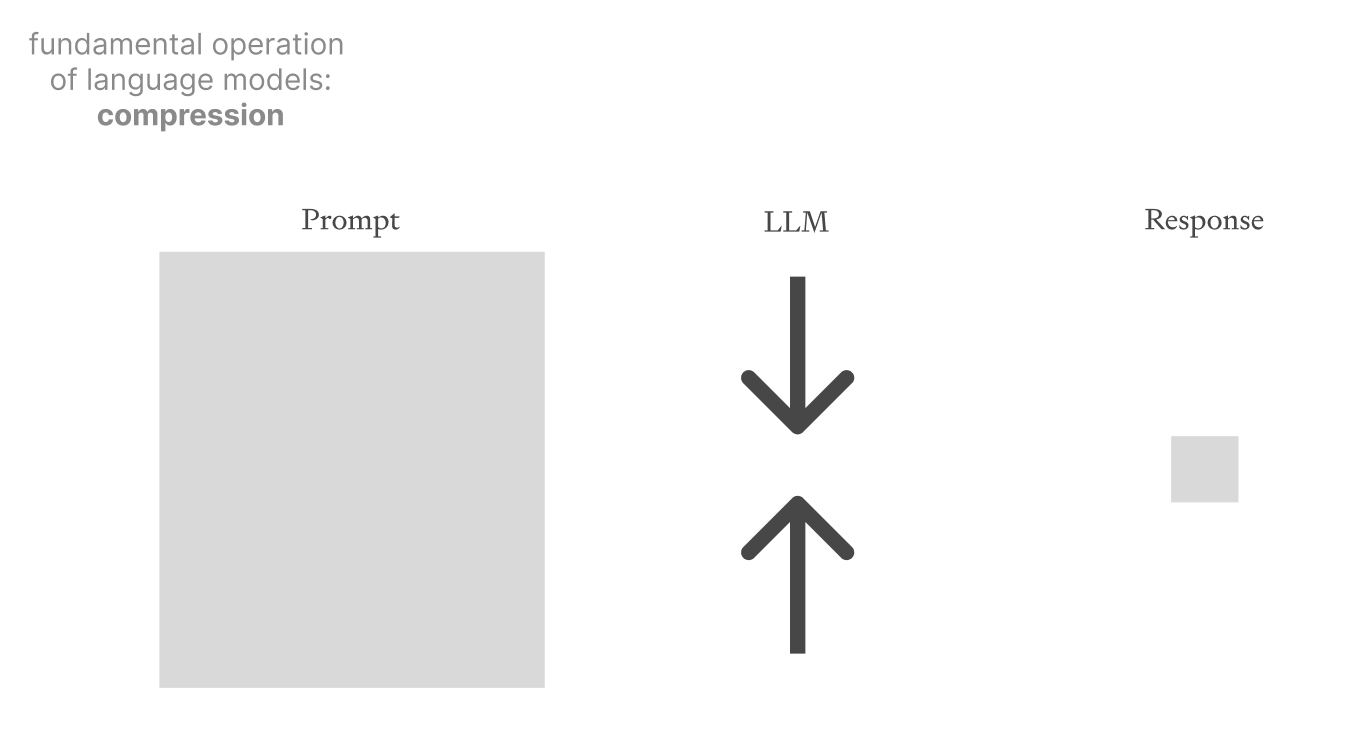
This might seem simple, but, in fact, it’s a marvel. Language models can take a big chunk of text and smush it down like a foot crushing a can of Coke. Except it doesn’t come out crushed—it comes out as a perfectly packaged and proportional mini-Coke. And it’s even drinkable! This is a Willy Wonka-esque magic trick, without the Oompa Loompas.
Language model compression comes in many different flavors. A common one is what I’ll call comprehensive compression, or summarization.
Language models are comprehensive compressors
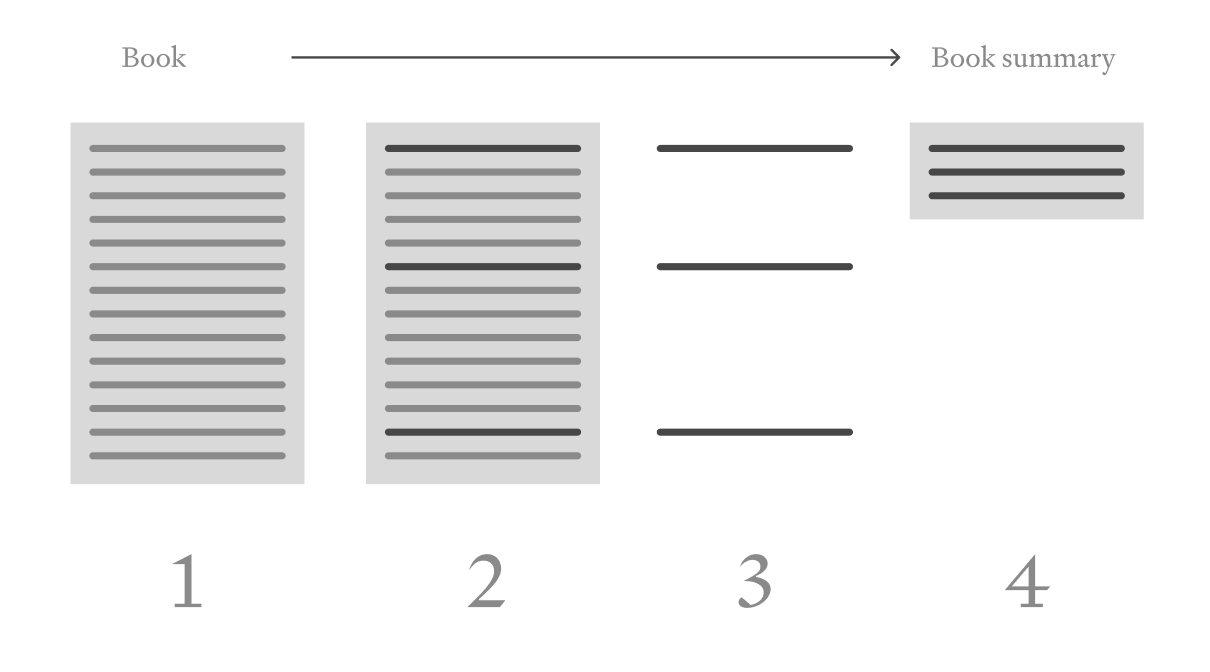
Humans comprehensively compress things all the time—it’s called summarization. Language models are good at it in the same way a fifth grader summarizes a children’s novel for a book report, or the app Blinkist summarizes nonfiction books for busy professionals.
This kind of summarizing is intended to take a source text, pick out the ideas that explain its main points for a general reader, and reconstitute those into a compressed form for faster consumption:
Language models are engaging compressors
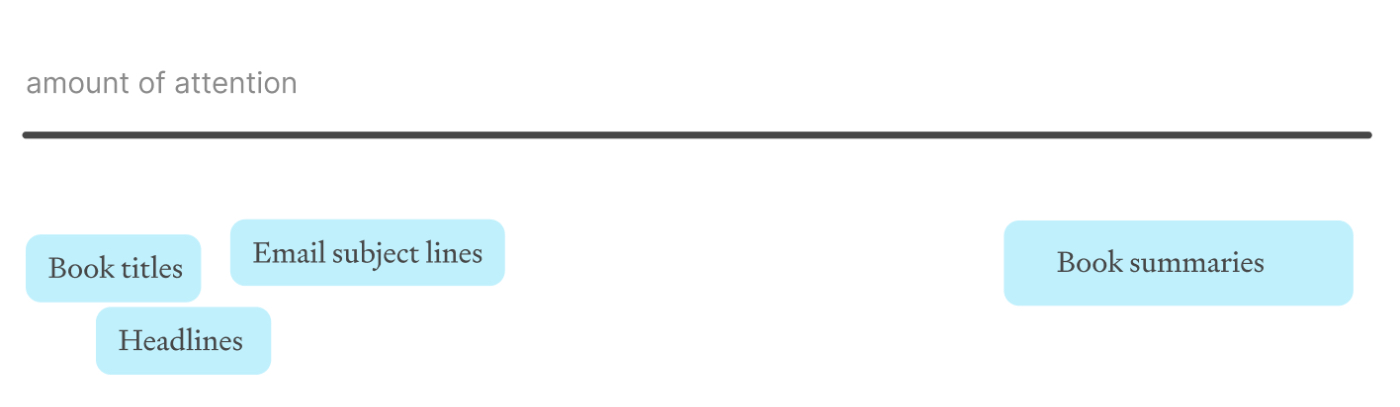
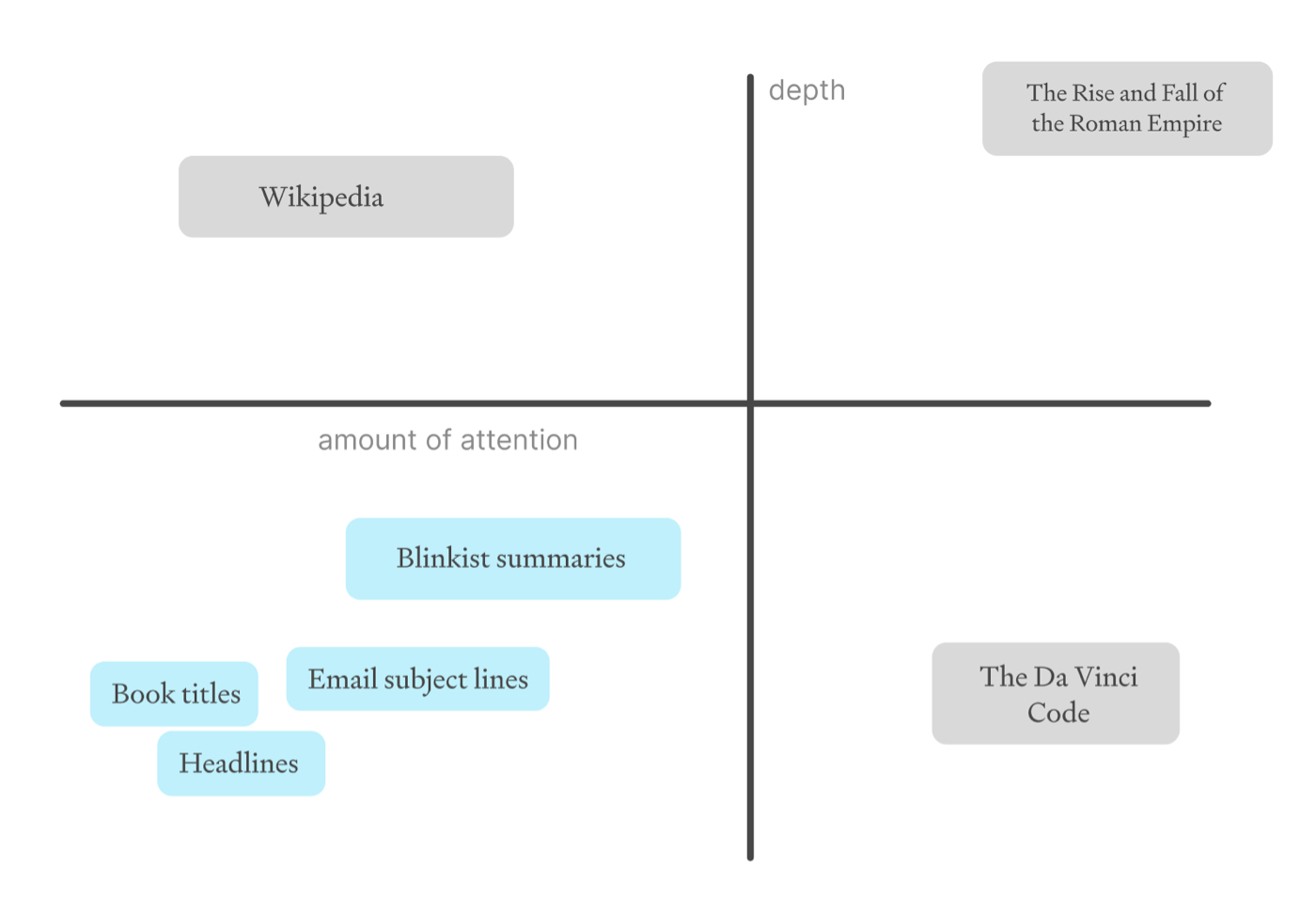
If we require our compression to be interesting instead of comprehensive, compressions look less like book reports and more like email subject lines, article headlines, book titles, and subtitles. If we graphed them by how much attention is required to consume them, it would look like this:
- The Shadow's Name
- The Warrior Mage's Shadow Quest
- The Shadow Defeated
These are pretty good! But language model compression doesn’t stop at just these two dimensions of compression.
Language models compress over many different dimensions
There are many dimensions along which compression can be run. Here are some examples of headlines, all written by Claude:
- Clickbaiting: "You Won’t Believe What This Young Wizard Discovered on a Shadow Isle!"
- Intrigue: "Secrets of the Shadowy Mage Isle"
- Vibe-y: "chill wizard explores shady island, finds self"
- Alliteration: "The Wizard’s Winding, Wondrous Wanderings"
- Snark: "Oh, Another 'Chosen One' Wizard Story Set on an Island, How Original"
- Paranoia: "They’re Watching: A Wizard’s Harrowing Shadow Odyssey"
- Pessimism: "The Gloomy Account of a Doomed Mage on Hopeless Shadow Rock"
- Confusion: "Wait, What's Happening? A Wizard Goes Somewhere Shadowy, I Think?"
- Absurdist: "Schrödinger's Wizard Simultaneously Visits and Doesn't Visit Shadow Isle"
- Ironic detachment: "I Guess This Wizard Goes to Some Dumb Island or Whatever"
- Gaslighting: "There Is No Shadow Isle, You're Just Imagining Things"
When we started talking about compression, we began with this graphic:
The dimensions of compression can also be arbitrarily specific and combined together. Here are some example prompts:
- A tweet in the style of Dan Shipper but with more snark and paranoia
- Analysis in the style of George Saunders but make it gaslight-y
- A book summary in the style of a Scott Alexander book review, but make it concise
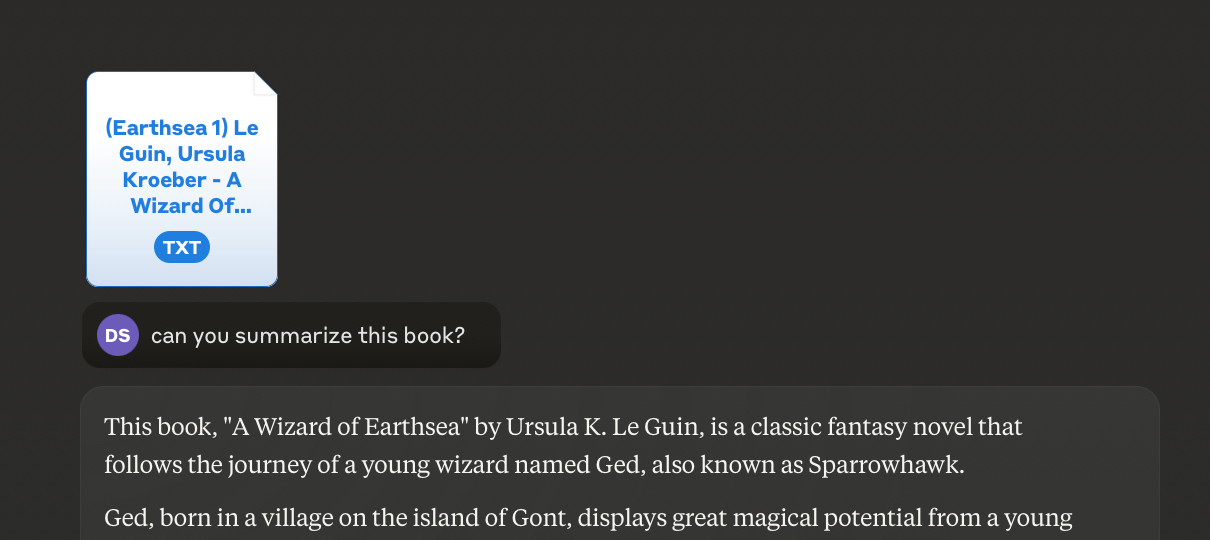
For example, using the last prompt as a jumping-off point, here’s a concise book summary of A Wizard of Earthsea that Claude created in the style of Scott Alexander from Slate Star Codex:
“A Wizard of Earthsea is about the dangers of power without wisdom.
The young wizard Ged, in a fit of youthful pride and anger, summons a shadow creature from the realm of the dead. This goes about as well as you would expect. The shadow hunts Ged across the world and he must flee from it, until finally his old master tells him that he can't run away from his own shadow. Ged realizes that the only way out is through—he has to turn around, chase down the shadow, and reintegrate it into himself.
This is a pretty standard "power corrupts" story, but it's unusually wise in depicting Ged's flaw not as a desire for power itself, but as a lack of education in how to use power. Ged isn't evil, he's just young and dumb.
His eventual victory comes from understanding how the universe works, not from overwhelming firepower. The real treasure was the wisdom he gained along the way.
Le Guin once said her books were about ‘the journey that is inward, and not the other journey.’
A Wizard of Earthsea literalizes this, as Ged sails further and further away from the known lands in pursuit of his shadow, only to realize he has to integrate it back into himself. We all have to take this journey eventually. The shadow represents the parts of ourselves we try to deny and push away. But there's no escape—in the end, the only way to grow is to acknowledge your shadow, accept it, and become whole.”
I don’t know if this is exactly what Scott Alexander would write about A Wizard of Earthsea, but it’s certainly in the neighborhood. There are a few things it gets right. The first line is a concise, engaging summary of the book’s main point, which Alexander does better than almost anyone. And the line, “This is a pretty standard ‘power corrupts’ story,” feels very much like his voice.
So we’ve made some progress. Our concept of language models as compressors now includes the idea that they “compress” text across an arbitrary number of dimensions or requirements.
When is that useful in creative work?
Why compression is useful
Let’s start with comprehensive compressions like book reports. If we graphed them by the amount of depth they convey and attention they require, they would probably be on the bottom-left quadrant of the graph—little depth, little attention required:
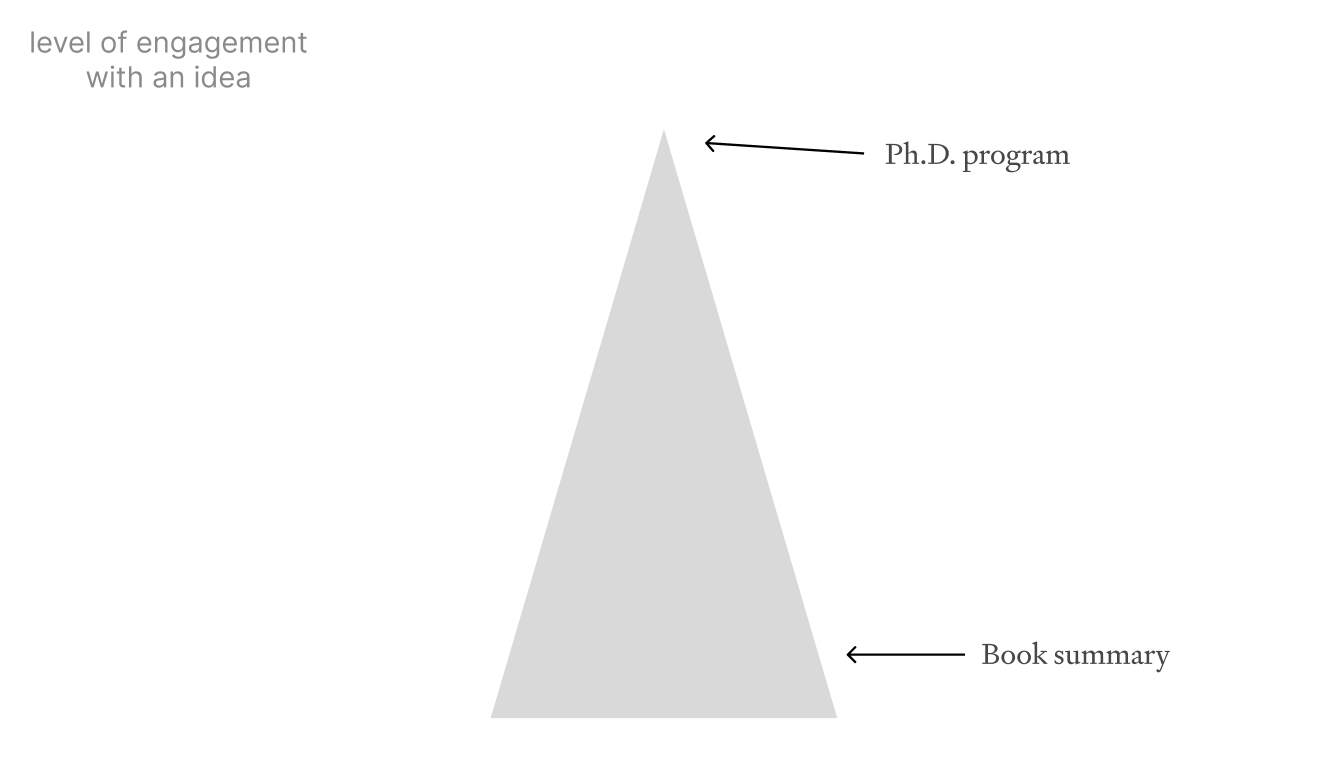
The trouble is that doing compressions like this is, generally, drudgery. Anyone who has had to write a summary of their essay for an X post, or has needed to spend a few hours rereading a complex topic so that they could summarize it in a few sentences, will know what I mean.
But language models are good at compression that sits more at the bottom of the funnel of engagement with ideas, too. They help you go deeper into the nuances of an idea instead of just skimming the surface:
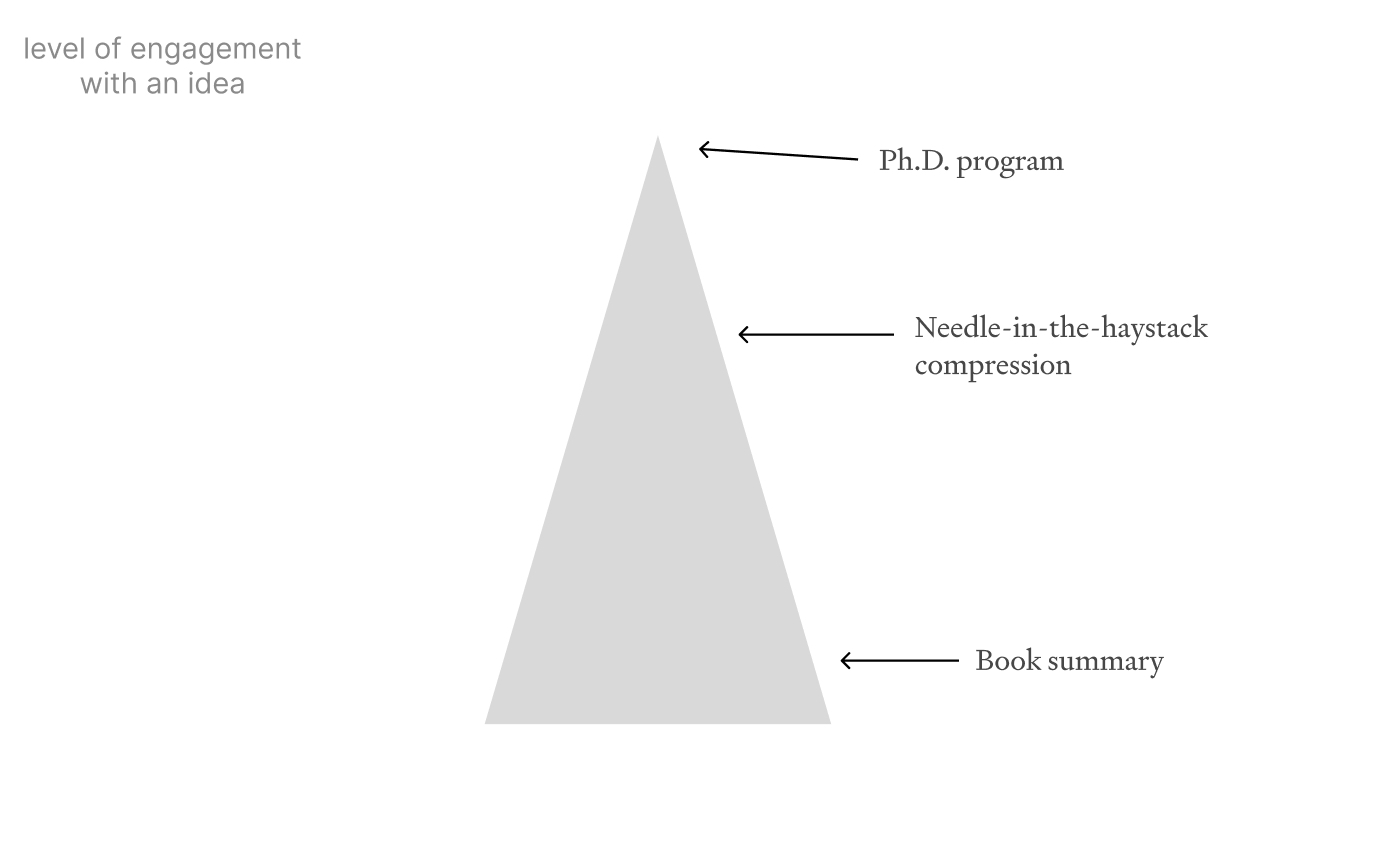
This view of the world will help you see a significant chunk of the situations in which language models can be useful for creative work.
As the cognitive scientist Alison Gopnik has written, language models are cultural technologies. They give us the best of what humanity knows about any topic—in the right form for any given context. In that way, language models are an extension of a trend that started with writing itself and has extended to the printing press, the internet, and finally our present moment with AI.
This is a superpower for creatives:
Knowledge can make its way to you—wherever you are, whenever you need it, compressed in just the right format for you to use.
What do you want to make with it?
Dan Shipper is the cofounder and CEO of Every, where he writes the Chain of Thought column and hosts the podcast AI & I. You can follow him on X at @danshipper and on LinkedIn, and Every on X at @every and on LinkedIn.
We build AI tools for readers like you. Automate repeat writing with Spiral. Organize files automatically with Sparkle. Write something great with Lex. Deliver yourself from email with Cora.
We also do AI training, adoption, and innovation for companies. Work with us to bring AI into your organization.
Get paid for sharing Every with your friends. Join our referral program.
The Only Subscription
You Need to
Stay at the
Edge of AI
The essential toolkit for those shaping the future

"This might be the best value you
can get from an AI subscription."
- Jay S.
 Every Content
 AI&I Podcast
 Monologue
 Cora
Cora
 Sparkle
 Spiral
Join 100,000+ leaders, builders, and innovators

Email address

Already have an account? Sign in
What is included in a subscription?
Daily insights from AI pioneers + early access to powerful AI tools





 Front-row access to the future of AI
 In-depth reviews of new models on release day
Playbooks and guides for putting AI to work
Prompts and use cases for builders
In-depth reviews of new models on release day
Playbooks and guides for putting AI to work
Prompts and use cases for builders
In-depth reviews of new models on release day
Playbooks and guides for putting AI to work
Prompts and use cases for builders
In-depth reviews of new models on release day
Playbooks and guides for putting AI to work
Prompts and use cases for builders
 Bundle of AI software




 Dan Shipper


 Reviews of new AI models on release day
Comments
Don't have an account? Sign up!