





Sponsored By: NERVOUS SYSTEM MASTERY
This essay is brought to you by Nervous System Mastery, a five-week boot camp designed to equip you with evidence-backed protocols to cultivate greater calm and agency over your internal state. Rewire your stress responses, improve your sleep, and elevate your daily performance. Applications close on September 27, so don't miss this chance to transform your life.
Next week Evan Armstrong will kick off the first cohort of his new course, How to Write With AI. The response to it—more than 75 people have signed up so far—has made us think a lot about how AI can be used as a creative tool. We’re surfacing the piece that started this line of thought—Dan Shipper’s discovery of ChatGPT-3 as a journaling tool.—Kate Lee
Was this newsletter forwarded to you? Sign up to get it in your inbox.
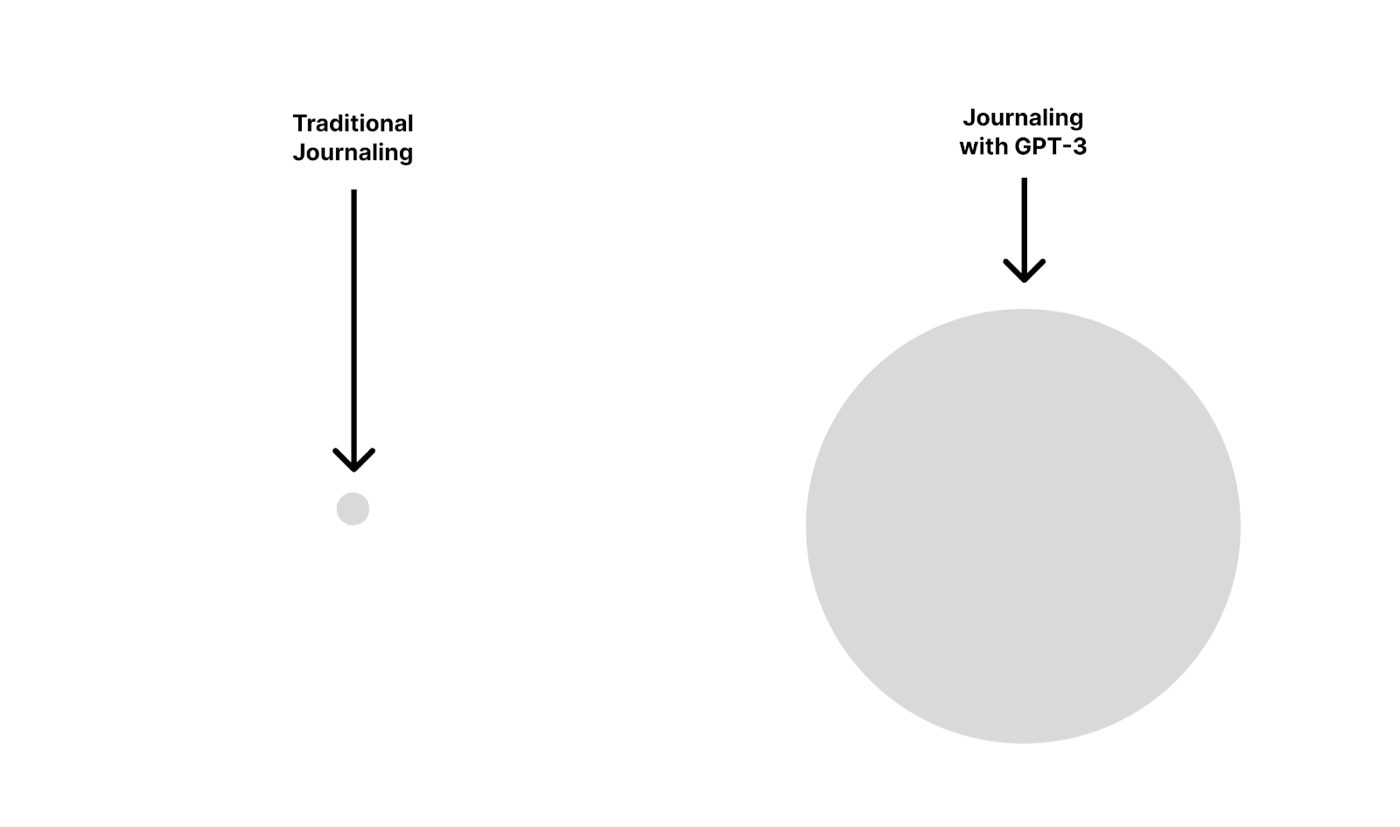
This is a joke, but it's not entirely wrong either. Source: All images courtesy of the author.
For the past few weeks, I’ve been using GPT-3 to help me with personal development. I wanted to see if it could help me understand issues in my life better, pull out patterns in my thinking, help me bring more gratitude into my life, and clarify my values.
I’ve been journaling for 10 years, and I can attest that using AI is journaling on steroids.
To understand what it’s like, think of a continuum plotting levels of support you might get from different interactions:
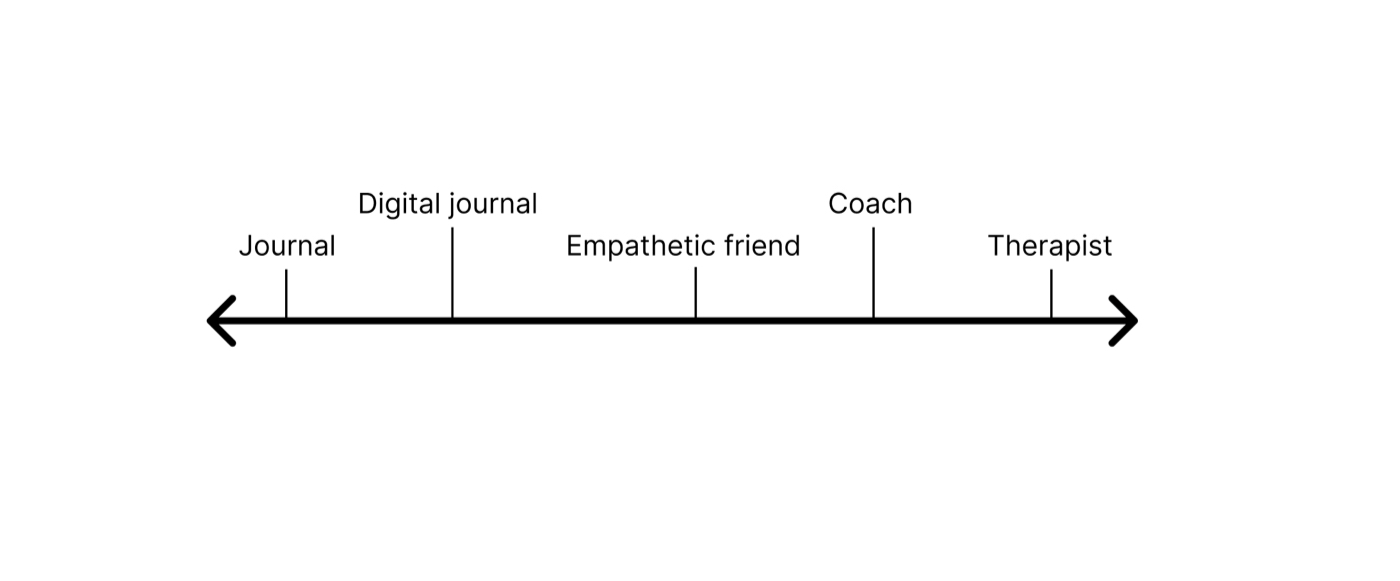
If you know how to use it correctly and you want to use it for this purpose, GPT-3 is pretty close, in a lot of ways, to being at the level of an empathic friend:
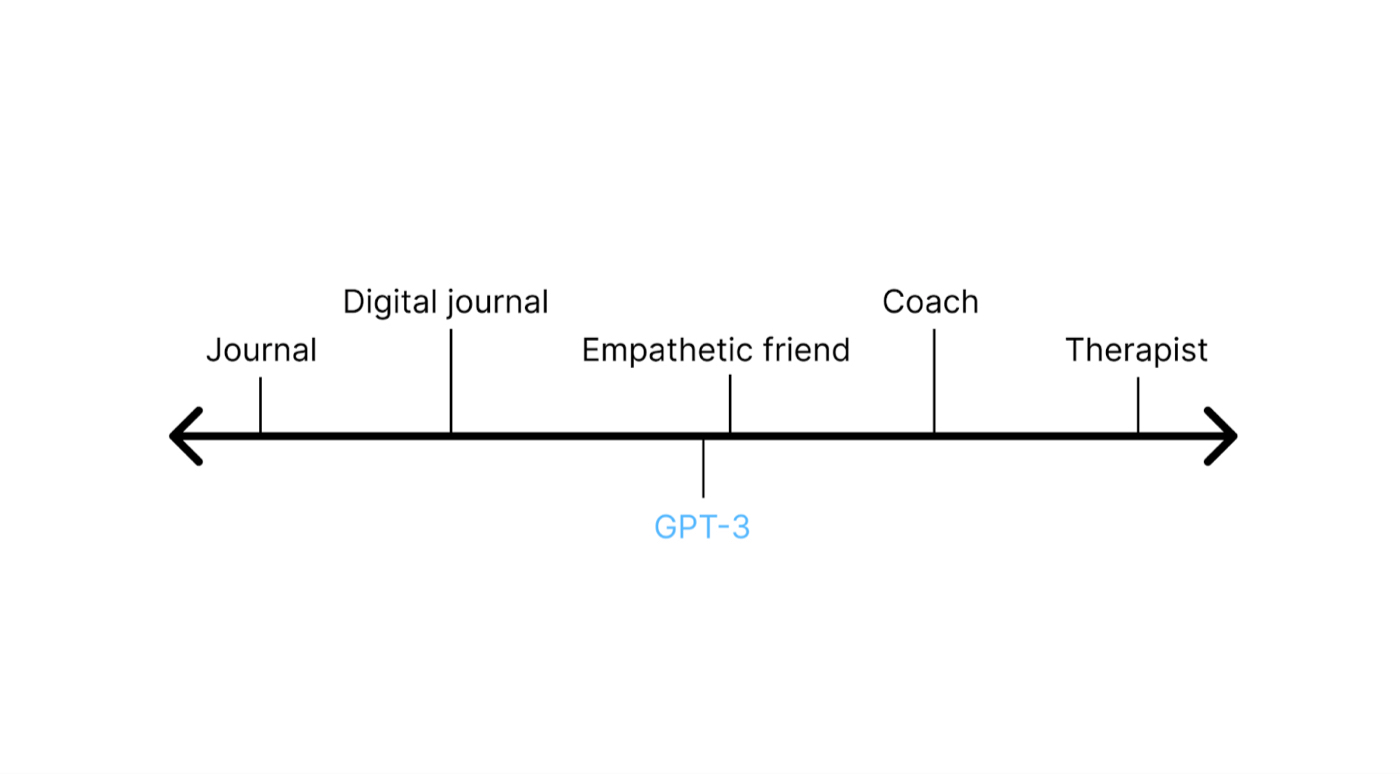
People who have been using language models for much longer than I have seem to agree:

It sounds wild and weird, but I think language models can have a productive, supportive role in any personal development practice. Here’s why I think it works.
Why chatbots are great for journaling
Journaling is already an effective personal development practice.
It can help you get your thoughts out of your head, rendering them less scary. It shows you patterns in your thinking, which increases your self-awareness and makes it easier for you to change.
It creates a record of your journey through life, which can tell you who you are at crucial moments. It can help you create a new narrative or storyline for life events so that you can make meaning out of them.
It can also guide your focus toward emotional states like gratitude, or directions you want your life to go in, rather than letting you get swept up in whatever is currently going on in your life.
But journaling has a few problems. For one, it’s sometimes hard to sit down and do it. It can be difficult to stare at a blank page and know what to write. For another, sometimes it feels a little silly—is summarizing my day really worth something?
Once you get over those hurdles, as a practice it tends to get stale. You don’t read through your old entries that often, so the act of writing down your thoughts and experiences doesn’t compound in the way that it should. The prompts you use often get old: one like, “What are you grateful for today?” might work for the first few weeks, but after a while you need something fresh in order for the question to feel genuine.
You want your journal to feel like an intimate friend that you can confide in—someone who’s seen you in different situations and can reflect back to you what’s important in crucial moments. You want your journal to be personal to you, and the act of journaling to feel fresh and full of hope and possibility every time you do.
Unfortunately, paper isn’t great at those things. But GPT-3 is.
Journaling in GPT-3 feels more like a conversation, so you don’t have to stare at a blank page or feel silly because you don’t know what to say. The way it reacts to you depends on what you say to it, so it’s much less likely to get stale or old. (Sometimes it does repeat itself, which is annoying but I think long-term solvable.) It can summarize things you’ve said to it in new language that helps you look at yourself in a different light and reframe situations more effectively.
In this way, GPT-3 is a mashup of journaling and more involved forms of support like talking to a friend. It becomes a guide through your mind—one that shows unconditional positive regard and acceptance for whatever you’re feeling. It asks thoughtful questions, and doesn’t judge. It’s around 24/7, it never gets tired or sick, and it’s not very expensive.
Let me tell you about how I use it, what its limitations are, and where I think it might be going.
How I started with GPT-3 journaling
I didn’t think of using GPT-3 in this way myself. I saw Nick Cammarata’s tweets about it over the years first. My initial reaction was a lot of skepticism mixed with some curiosity.
After we launched Lex and I got more interested in AI, I remembered those tweets and decided to play around for myself.
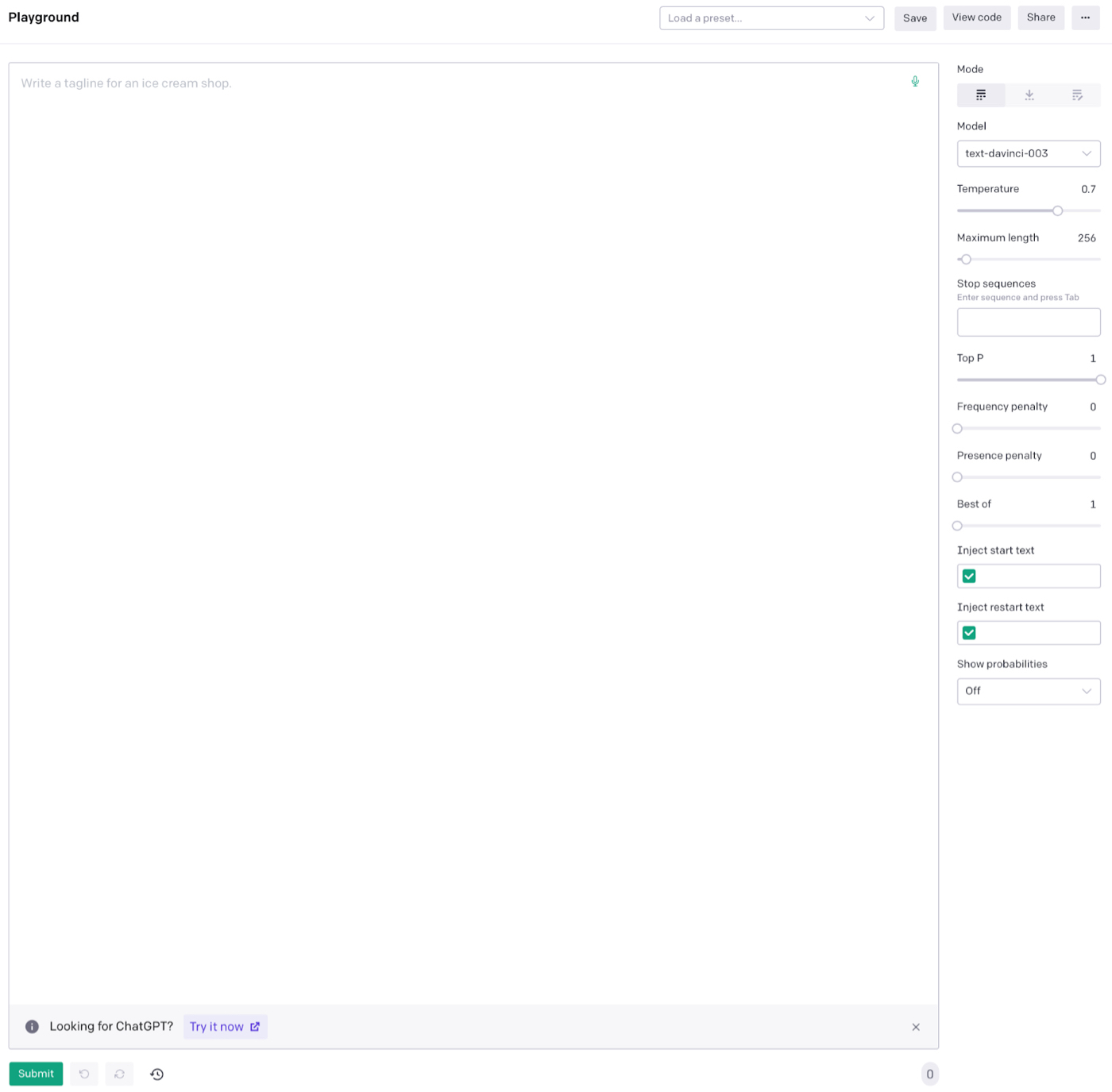
I started in the OpenAI playground—a text box where you input a prompt that tells GPT-3 how you want it to behave, and then interact with it:
 Create a free account to continue reading
The Only Subscription
You Need to
Stay at the
Edge of AI
The essential toolkit for those shaping the future

"This might be the best value you
can get from an AI subscription."
- Jay S.
 Every Content
 AI&I Podcast
 Monologue
 Cora
Cora
 Sparkle
 Spiral
Join 100,000+ leaders, builders, and innovators

Email address

Already have an account? Sign in
What is included in a subscription?
Daily insights from AI pioneers + early access to powerful AI tools





 Front-row access to the future of AI
 In-depth reviews of new models on release day
Playbooks and guides for putting AI to work
Prompts and use cases for builders
In-depth reviews of new models on release day
Playbooks and guides for putting AI to work
Prompts and use cases for builders
In-depth reviews of new models on release day
Playbooks and guides for putting AI to work
Prompts and use cases for builders
In-depth reviews of new models on release day
Playbooks and guides for putting AI to work
Prompts and use cases for builders
 Bundle of AI software





 Dan Shipper


 Reviews of new AI models on release day
Comments
Don't have an account? Sign up!
Very interesting concepts of using different modalities to experience different kinds of reflection. Is there a reason you were using GPT-3 over some of the newer alternatives?
Thanks 👍 inspiring
I have the same question as @brburke - curious as to the GPT-3 choice?? Very intriguing otherwise!
The use of AI really feels like a reflection of us. With the quality of output we receive a reflection of the input we provide. And really, a therapist just digs through the low resolution you might have with a problem and make it appear clearer to us. You touched on some of the repulsion that new users have and I love how you tied how we may have seen movies as cheap imitation but now see them for the art that they are. Whilst there is some tension between new users and adopting the technology, I think having genuine use cases like the one you presented helps us broaden our understanding of how we can use AI to works with us, rather than competing against with us.
@alyrisw Hi, this is Kate Lee, Every's EIC. We'd like to include your feedback in an upcoming edition of our Sunday newsletter. Would you let me know your job function? Feel free to respond here or email me at kate@every.to. Thank you!
Very inspiring! I am testing based on your initial prompts. Looking forward to the product you mentioned!
Hi Dan,
I enjoyed your piece, it is inspiring! It resonates with much of the work I’ve been doing in this space. If you and the team is interested, please check out an MVP I'm building - Reflektt - https://www.reflektt.com/.
I’d love to connect and exchange insights sometime. Let me know if you'd be open to a chat!
Best,
Piotr
@Dan is there an update for this? I have used your prompt shared in the article to make a customgpt (4o), works well (if anybody wants to use it, it is here https://chatgpt.com/g/g-675da90d53a481918b5ce340778767db-values-focused-therapy-bot)
Would love to hear how you progressed with the above project. I have a few bots and it would be actually interested to get them to talk to each other.
it was mentioned in the article that you built a web app with a chatbot interface. the bot lets you select a persona. how to get access to this web app?