





Sponsored By: Glean
This essay is brought to you by Glean, the AI-powered search for your work. Imagine having Google and ChatGPT, equipped and optimized for your workplace, at your fingertips, that is the power of Glean.
Years ago, Federal Express couldn’t deliver packages on time.
All packages were moved between airplanes at one central airport every night. The only problem was that the night shift wasn’t moving fast enough to get the job done—delays were common and customers were irate.
They’d tried everything they could to improve efficiency to no avail. Until they tried something new: they stopped paying by the hour. Instead, as soon as the night shift workers had completed the task of moving packages, they were allowed to go home with full pay.
Suddenly, packages were going out on time every night.
This story exemplifies one of investor Charlie Munger’s most famous adages: “Never, ever, think about something else when you should be thinking about the power of incentives.”
These sorts of Mungerisms are like catnip for business nerds. If you read through his speech, “The Psychology of Human Misjudgment,” you’ll find all sorts of heuristics and mental models like this. It’s dense with them. Listening to (or reading) it, you get the sense that if you could just imbibe it—really inscribe it in your brain—you’d make such good decisions you could do anything in the world.
Unfortunately, that’s hard.
Over the last 10 years there’s been an explosion in the use of mental models and heuristics by entrepreneurs. Andrew Wilkinson, the CEO of Tiny—a $400 million market cap public holding company of technology businesses—listened to Charlie Munger’s speech over and over again on his way to work for a year.
Everyone wants to learn the latest behavioral economics trick, psychological insight, or lesson from science or philosophy that can help them make decisions.
The problem is: we can’t remember to apply them. We make lists in Notion of our principles and use Anki to note down mental models. But they end up being mostly abandoned.
ChatGPT changes this. It allows you to bring to bear the best of what other people have figured out every time you make a decision. Every heuristic or mental model you could ask for is already in its digital brain. All you have to do is remember to use it when you’re making decisions.
I know because I’ve been using it. In order to show you how this works, I’m going to use ChatGPT to help the characters in a decisive moment in the movie The Big Short make better decisions. Then I’ll show you how to deploy it in your own life.
Ever felt overwhelmed trying to find information spread across numerous apps? Let Glean do the heavy lifting for you. It's an AI-powered search engine made for the workplace. Picture a fusion of Google and ChatGPT, specifically designed for your business's needs. With Glean, you gain access to intelligent, instantly responsive search features and a business-grade AI chatbot that swiftly navigates your company's knowledge base. Step into a new world of easy and secure information discovery with Glean.
Selling shorts to Michael Burry
In The Big Short (which is based on the true story of the traders who profited from the 2008 financial crisis), investor Michael Burry has a meeting at Goldman Sachs. He wants to short the housing market and has decided to bet $100 million.
This looks like a good trade for the Goldman Sachs bankers. In order for this trade to lose money, millions of Americans would have to fail to pay their mortgages. This has never happened. There is no chance Burry is right. The bankers see dollar signs.
They take the trade. They laugh as he leaves their office:

We know how this ends: Burry’s right, and the bankers are just blind.
Homebuyers, enticed by the prospect of cheap loans and the American dream, have been buying homes they can’t afford. Lenders, enticed by short-term profits, have been bending the rules of who is allowed to get a mortgage and originating loans to subprime homebuyers. Banks have been buying these mortgages, bundling them into securities, and selling them to investors. Bank employees are being rewarded with bonuses for the amount of securities they can sell, not their long-term performance. Credit rating agencies that are paid big bucks to sanction these securities look the other way, labeling them safe even though they contain loans that will likely blow up. The government and the media pump home ownership as the most important signal of success, and the cycle continues.
How can you help the Goldman Sachs bankers in this scene make a better decision? Let’s assume they’re smart enough to double-check their mental models before they sign away the keys to the kingdom.
Creating the psychological context for the players
The first thing you’ll want to do is have ChatGPT break down the psychology of the players in the situation. So all you have to do is ask:
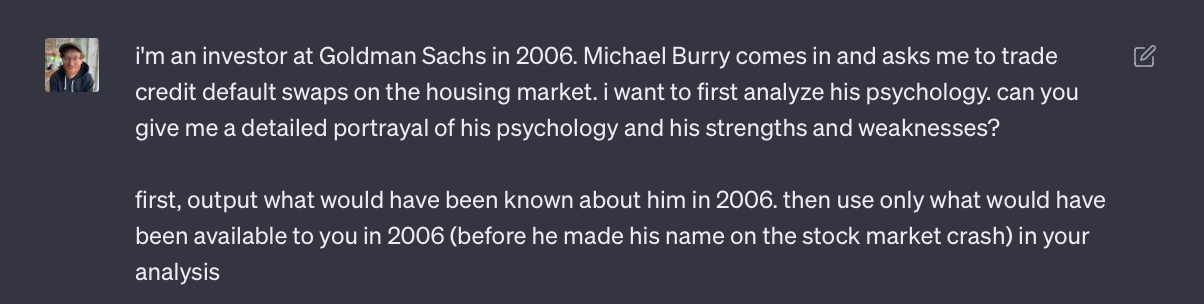
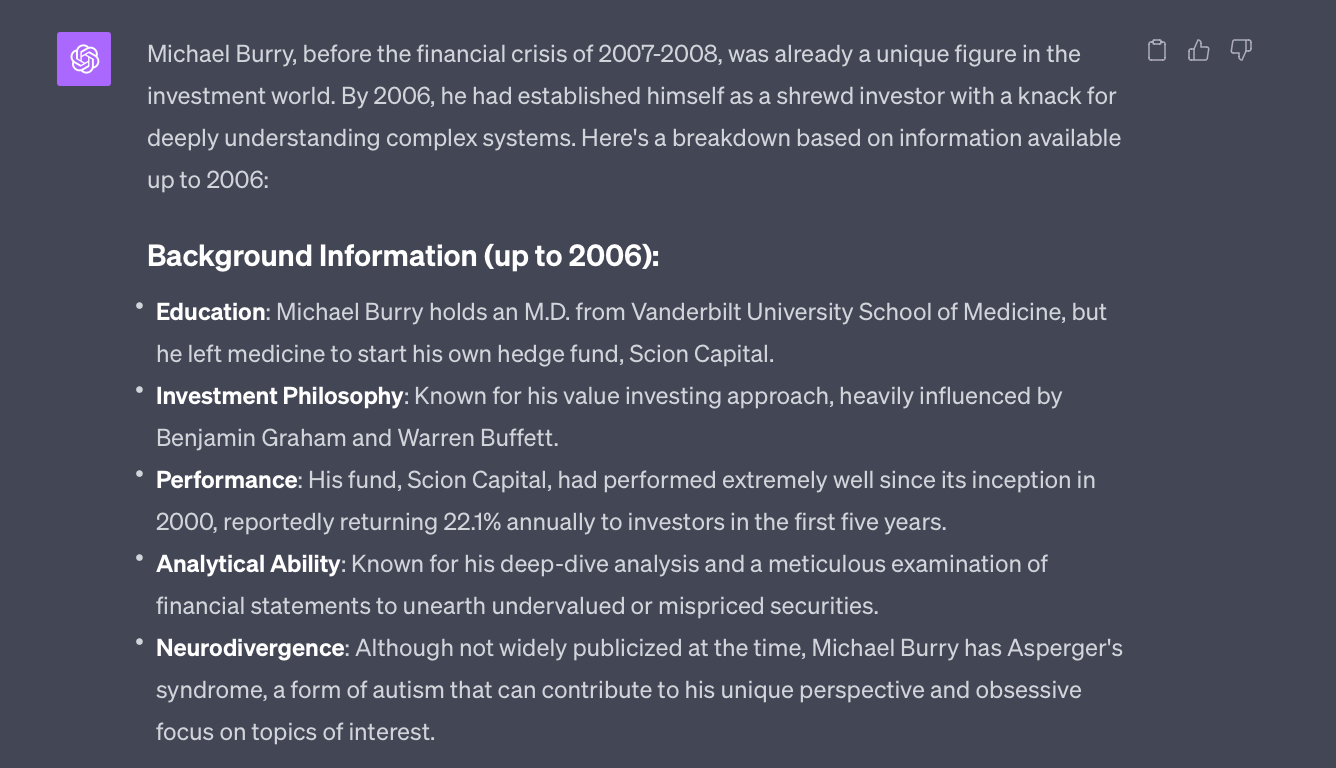
ChatGPT comes back with something pretty great. First it outlines Burry’s biography up to 2006:
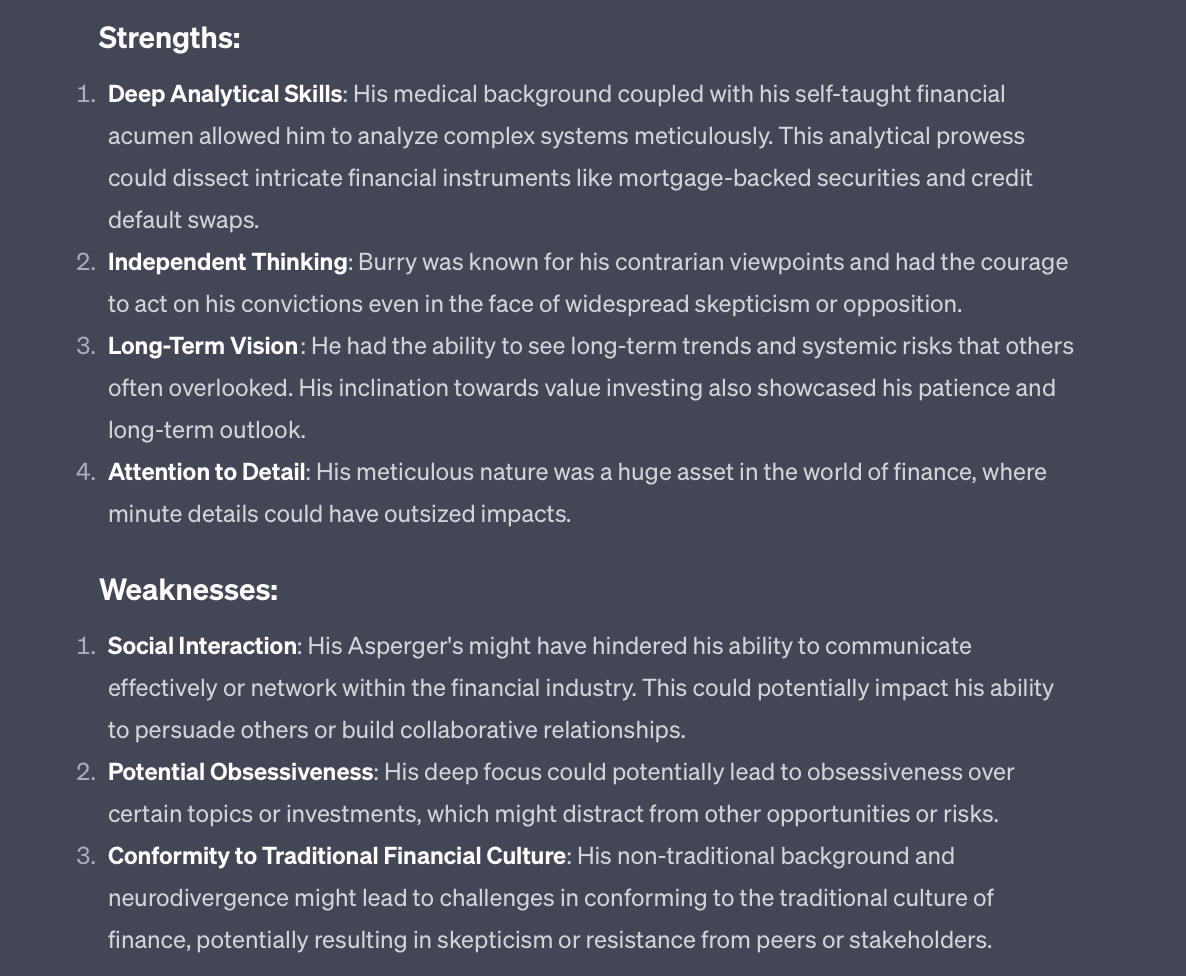
In my experience, if you provide ChatGPT with a detailed set of observations about a person in your life, even if they aren’t famous, it will come up with a psychological profile that feels accurate. For example, I recently met a founder who was in the middle of fundraising for their company and looking for me to angel invest. I fed my observations into ChatGPT to help me clarify my thinking:
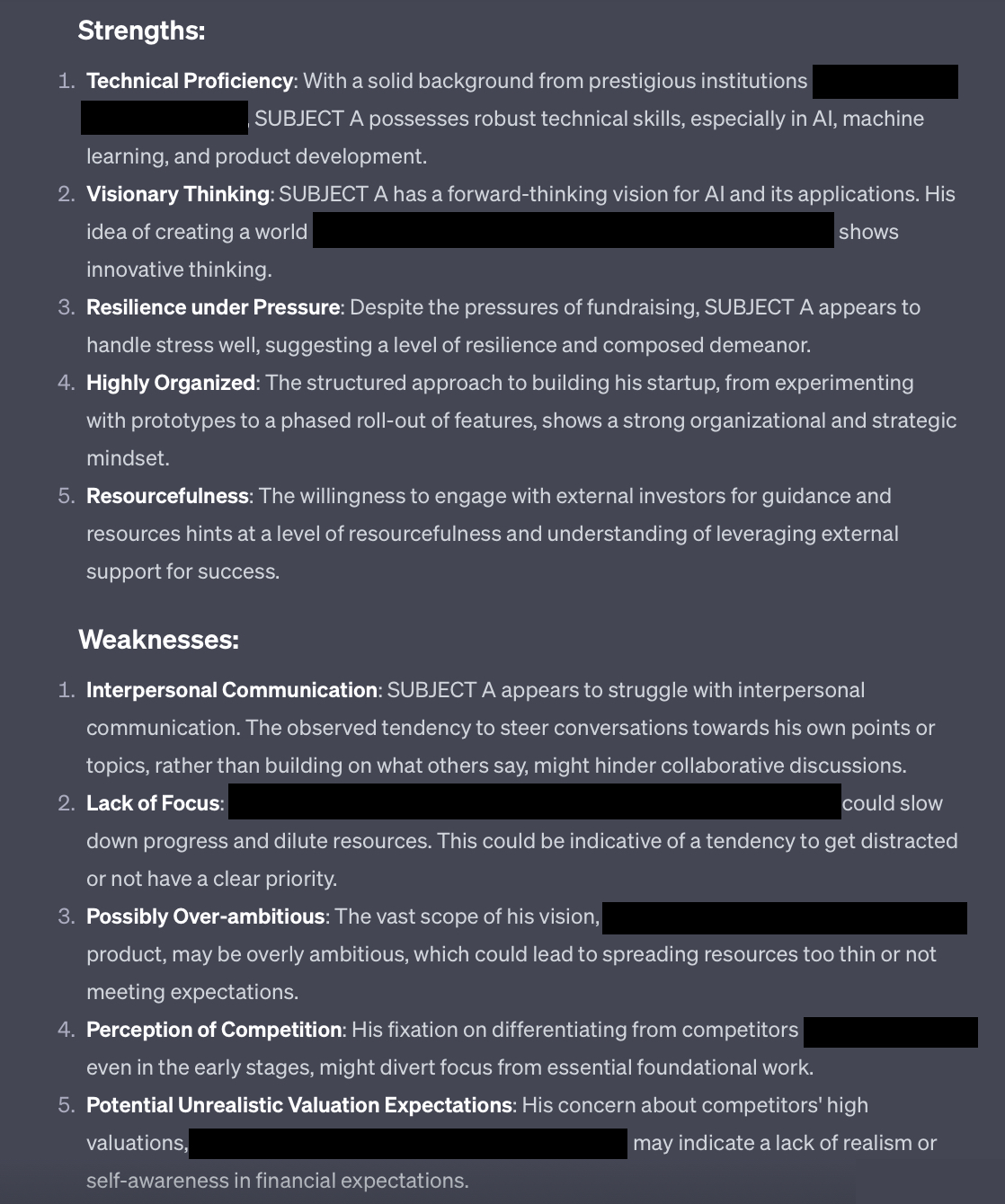
Once you’ve laid out the psychological profile of the key players in your decision, it’s time to ask ChatGPT to analyze the situation.
Analyzing the situation
We stan Munger’s list of mental models, and our Goldman Sachs scene is a perfect place to deploy them. All we have to do is set the context for ChatGPT and ask it to analyze using Munger’s speech:
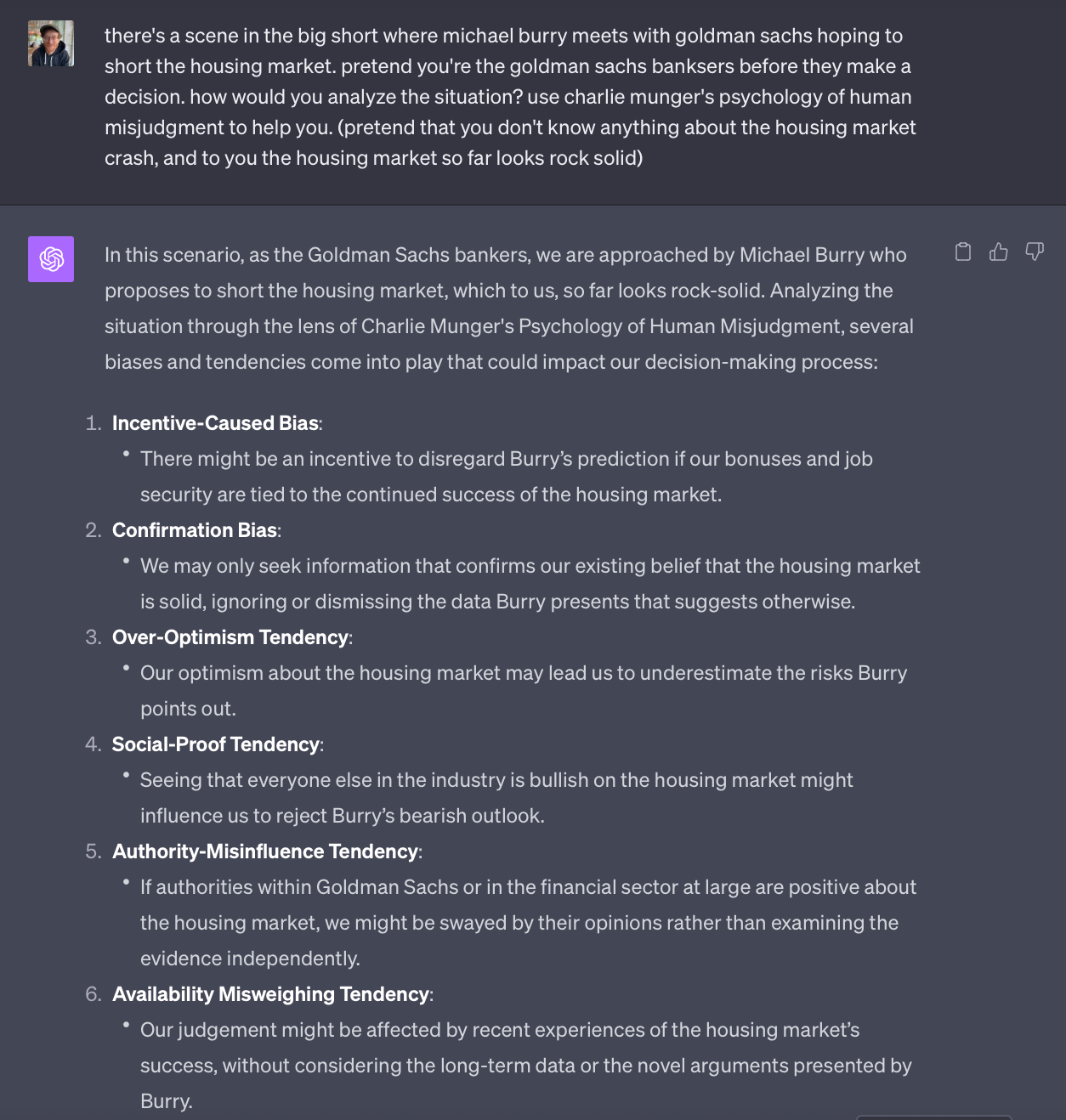
ChatGPT uses Munger’s list of misjudgments to help the hapless Sachsians analyze Burry. For example, it points out how incentives and confirmation bias might lead us to dismiss Burry as a quack without digging deeper.
If we ask it to analyze which misjudgment is most relevant given our knowledge of Burry’s strengths and weaknesses, here’s what it says:
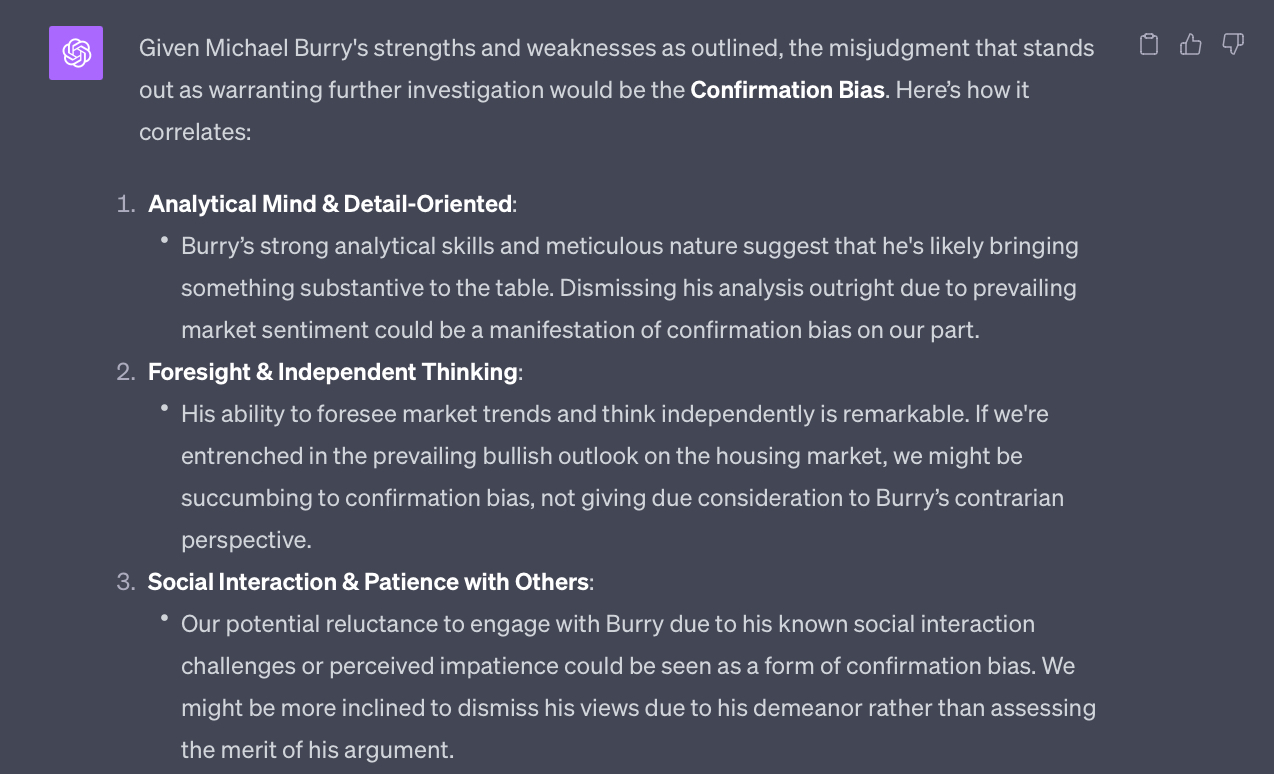
It picks up on the reason to believe Burry: he has a track record of analytical skill from long before The Big Short days. It also detects why we might be hesitant to do that: his awkward demeanor makes it easy to dismiss him.
If the bankers in this scene had consulted ChatGPT, they might have been motivated to double-check their assumptions—and avoid such a bad trade.
How to use AI in decision-making in your life
Using ChatGPT to analyze movie scenes may seem like a contrived example.
But in my experience, it’s actually quite good at analyzing situations by breaking down the motivations of key players and applying heuristics to help you unravel them. This is because GPT-4 has human-level theory of mind—the ability to ascribe mental states to people—and it knows about all of the heuristics and mental models you might need in order to make good decisions.
If you want to apply this in your life, here are a few steps to get started:
Use ChatGPT to break down decisions big and small
Next time you’re facing a decision, talk to ChatGPT about it. Just provide it with as much context as you can, and ask it to help you break down the situation.
Use heuristics and mental models to deepen the analysis
Make sure to bring in your favorite thinkers to help enrich your discussion. You can use Munger, Daniel Khaneman’s book Thinking Fast and Slow, Shane Parrish’s Farnam Street, or others.
Save things that work in Custom Instructions
In the process of doing this, you’ll likely come up with mental models or heuristics that are particularly important for you. For example, I’ve identified that I’m a little bit too agreeable in interpersonal situations. I think this is likely driven by fear of feeling guilty about letting people down. I’ve found that asking myself the question, “What would I do if I wasn’t afraid of feeling guilty?” is a useful heuristic for understanding the situation from a less subjective angle. Ideally, once I’ve identified this, I’d like ChatGPT to remind me of it. This is what Custom Instructions are for.
Custom Instructions allows you to tell ChatGPT how you want it to respond to your queries. In my Custom Instructions, I tell ChatGPT: “If I'm in a complex interpersonal situation, ask, ‘What would I do if I wasn't afraid of feeling guilty?’"
Now, whenever I ask ChatGPT for advice about situations involving other people, it starts by asking me what I would do if I weren't afraid of feeling guilty. I’ve found this helps me clarify things in my own mind and make better decisions as a result.
If you play around with ChatGPT enough, you’ll probably find clarifying questions or heuristics that are equally helpful for you.
So if you’re looking to make better decisions and want to learn how to incorporate more heuristics and mental models into your life, use ChatGPT. It’ll make a difference.
The Only Subscription
You Need to
Stay at the
Edge of AI
The essential toolkit for those shaping the future

"This might be the best value you
can get from an AI subscription."
- Jay S.
 Every Content
 AI&I Podcast
 Monologue
 Cora
Cora
 Sparkle
 Spiral
Join 100,000+ leaders, builders, and innovators

Email address

Already have an account? Sign in
What is included in a subscription?
Daily insights from AI pioneers + early access to powerful AI tools


 Front-row access to the future of AI
 In-depth reviews of new models on release day
Playbooks and guides for putting AI to work
Prompts and use cases for builders
In-depth reviews of new models on release day
Playbooks and guides for putting AI to work
Prompts and use cases for builders
In-depth reviews of new models on release day
Playbooks and guides for putting AI to work
Prompts and use cases for builders
In-depth reviews of new models on release day
Playbooks and guides for putting AI to work
Prompts and use cases for builders
 Bundle of AI software





 Dan Shipper



 Evan Armstrong
 Reviews of new AI models on release day
Comments
Don't have an account? Sign up!
Dan.... it would be much better if it was real. Start with a big decision you are struggling with, there at Every. Then show how ChatGPT gets you to a better decision. I don't know The Big Short and what does that have to do with what you are trying to do with your life? You started out great and then this felt like 30,000 feet off topic.
@Georgia@Communicators.com thanks Georgia, i think you're right! great intro, body could've been better. i'll try again with something more personal in a few weeks. i have a lot of examples to pull from :) appreciate you!
@danshipper Felt pretty on topic to me. Great post.
Very enlightening. Please talk about how you think consciousness pans out with ChatGPT dataset scenarios. A double click for chatGPT deciphering an unknown Alec, let's say like me, what are the chances that I will get a good enough response for any of my dilemmas? Is this example over-extending or over-simplifying the use case given that it's Sir. Munger and Blurry.
An insightful read, you might be onto something. I've recently discovered Farnam Street, and have started to dive into the concept of mental models (which I had been unaware of, sadly so until now). While I'm preparing for an examination, that's due next year (and yes, it's a life and death examination for me (maybe not literally, but it's the most important of my life)), I'm trying to learn much more about mental models, and how I can use them in everyday life to take better decisions, in the little time that I'm left with. My preparation for that exam takes away about 12 hours of my time, so I try to learn stuff which can help me keep my mind sharp, so that I can unwind, and take a breath away from studying exam-centered information. The use of Generative AI for observing how Mental Models might apply in real-life situations, is a fascinating idea. There was a phase, when I was using ChatGPT for analysing different news articles from multiple perspectives, but then I stopped doing so at some point due to:
a. Paucity of time, with too much to study, that it looked like, there would be diminishing returns if I spent too much on a particular topic.
b. Since the examination that I'm preparing for requires me to develop critical thinking, I was apprehensive that using Generative AI to link the information consumed to other disciplines, or for analysis would hinder me from developing critical thinking skills. Maybe, I'm wrong in choosing self-relying too much, and maybe I can use it occasionally to make better decisions, without having to take the longer and more arduous route of learning things the hard way...I guess I'll chose a synthetic approach from now on. Thanks, it was an enjoyable read.
Prompts can be better, A few AI researches made this www.promptingguide.ai/ you can get better responses